
10 Key Benefits of CDN for Faster, More Reliable Media Delivery
If you've ever watched a video buffer endlessly or waited for a high-resolution image to load, you've experienced firsthand what happens when media delivery isn't optimized. The benefits of CDN (Content Delivery Network) technology go far beyond simply speeding up load times — a well-configured CDN transforms the entire experience of serving digital media to a global audience. Whether you're a developer building a video platform, a marketer managing thousands of digital assets, or a business running a media-heavy website, understanding how a CDN works and what it can do for you is essential. In this post, we'll walk through ten of the most impactful advantages that CDN infrastructure brings to modern media delivery.
What Is a CDN and How Does It Work?
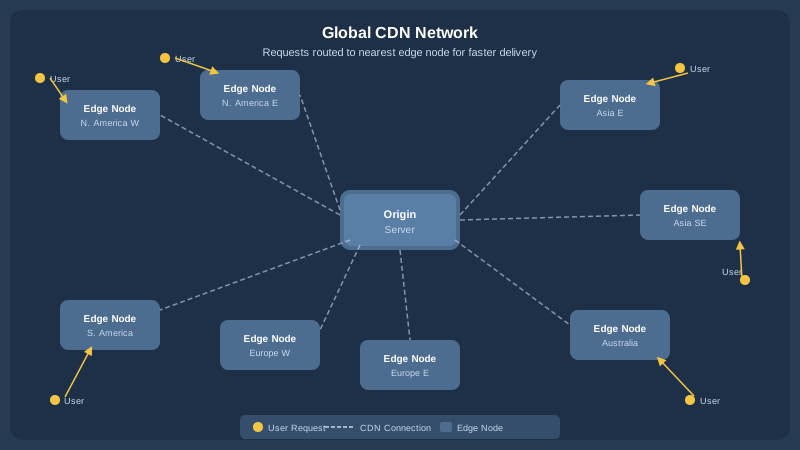
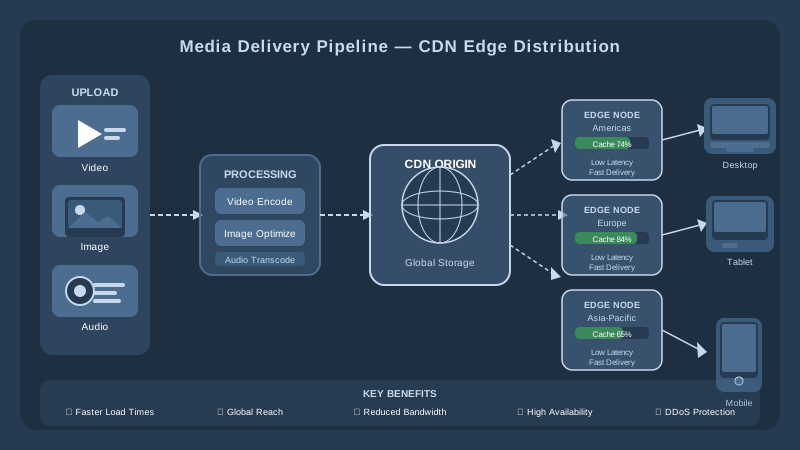
A Content Delivery Network is a geographically distributed group of servers that work together to deliver web content — including images, videos, audio, scripts, and other files — to users based on their physical location. Instead of every request traveling all the way to a single origin server, a CDN caches and serves content from the nearest edge node, dramatically reducing the distance data must travel.
When a user in Tokyo requests a video hosted on a server in New York, a CDN intercepts that request and serves the content from an edge server located in Asia — potentially thousands of miles closer. The result is faster load times, lower latency, and a smoother overall experience. Platforms like Publitio use built-in CDN delivery as a core part of their CDN infrastructure, ensuring every media file is distributed intelligently across a global network of edge locations.
Benefit 1: Dramatically Faster Load Times
The most immediate and measurable benefit of CDN technology is speed. By serving content from edge servers that are physically closer to end users, a CDN can reduce page load times and media delivery latency by orders of magnitude. This matters enormously for media-heavy platforms where large video files, high-resolution images, and audio tracks need to be delivered quickly.
For video content in particular, faster delivery translates directly into faster start times — one of the most critical metrics for viewer retention. Studies consistently show that users abandon video players if buffering lasts more than two or three seconds. With CDN-backed delivery, initial load times drop significantly, keeping audiences engaged from the very first frame.
Benefit 2: Reduced Latency for Global Audiences
Latency — the delay between a user's request and the content reaching their device — is the silent killer of media experiences. It's especially punishing for live streaming, interactive media, and real-time applications. One of the core benefits of CDN architecture is its ability to slash this latency by minimizing the number of network hops between the server and the user.
This is particularly critical for platforms delivering HLS streaming video. HLS (HTTP Live Streaming) breaks video into small chunks delivered sequentially, and any latency in retrieving those chunks causes buffering. A CDN ensures those chunks are pre-positioned at edge nodes, ready for instant delivery.
Benefit 3: Handling Traffic Spikes with Ease
Imagine your marketing team publishes a viral video, or your e-commerce site goes live with a major product launch. Sudden traffic spikes can overwhelm an origin server, leading to slow response times or complete outages. A CDN absorbs this demand by distributing requests across hundreds or thousands of edge servers simultaneously.
This scalability means your media platform can handle everything from ten simultaneous viewers to ten million without breaking a sweat. For platforms offering video-on-demand services, this elastic capacity is non-negotiable — you simply cannot predict when content will go viral or when a high-traffic event will drive mass concurrent viewership.
Benefit 4: Improved Reliability and Uptime
A traditional single-server setup is a single point of failure. If that server goes down — due to hardware issues, software bugs, or unexpected traffic — your entire media library becomes inaccessible. CDNs are built with redundancy at their core. If one edge node fails or becomes unreachable, traffic is automatically rerouted to the next closest available node.
This failover architecture dramatically improves uptime and ensures business continuity. For organizations managing large volumes of digital assets, this kind of reliability is a foundational requirement. Platforms built around digital asset management need infrastructure that never sleeps — and CDNs deliver exactly that.
Benefit 5: Significant Bandwidth Cost Savings
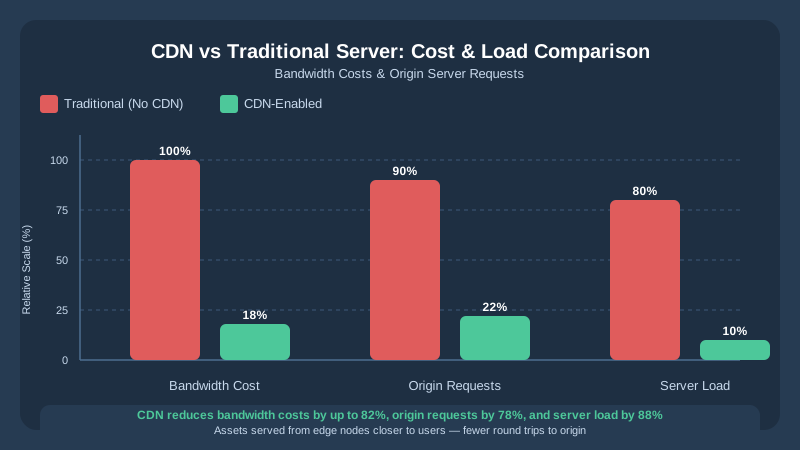
Every byte of data served from your origin server costs money — in bandwidth fees, server resources, and infrastructure overhead. A CDN caches content at the edge, meaning the origin server only needs to handle a fraction of total requests. The vast majority of traffic is served directly from edge nodes, reducing your bandwidth bill substantially.
For media-intensive applications — think platforms hosting thousands of hours of video, millions of product images, or large audio libraries — these savings can be enormous. By offloading delivery to CDN infrastructure, businesses effectively get more reach for less cost. This is one of the most compelling financial benefits of CDN adoption for growing media companies.
Benefit 6: Enhanced Security and DRM Protection
CDNs aren't just about speed — they're also a powerful layer in your security stack. Modern CDN providers offer protection against Distributed Denial of Service (DDoS) attacks, which attempt to overwhelm a server with massive volumes of fake traffic. By absorbing and filtering this traffic across thousands of distributed nodes, a CDN can neutralize attacks that would otherwise bring down a standalone server.
For media businesses, security goes beyond DDoS protection. Protecting premium video content from unauthorized access and piracy is equally critical. This is where CDN delivery integrates with digital rights management (DRM) solutions. When HLS streams are encrypted and delivered via a secure CDN, content owners can enforce licensing rules, restrict playback to authorized users, and prevent redistribution — all without sacrificing performance.
Additional security layers available through CDN-integrated platforms include hotlink protection, signed URLs with expiry times, and geo-restriction rules that limit content access by region. These tools give media publishers granular control over who can access what, and when.
Benefit 7: Better SEO and Core Web Vitals Performance
Google's ranking algorithms now explicitly factor in page experience signals, including Core Web Vitals metrics like Largest Contentful Paint (LCP), Cumulative Layout Shift (CLS), and First Input Delay (FID). All of these metrics are heavily influenced by how quickly your media assets load. A CDN directly improves LCP by ensuring images and videos are delivered as fast as possible from nearby edge locations.
Faster load times also reduce bounce rates — users who experience fast-loading pages stay longer and engage more deeply, sending positive behavioral signals to search engines. For content-heavy websites, especially those using a WordPress media offloading solution to serve images and videos from external CDN-backed storage, the SEO gains can be substantial and measurable within weeks of implementation.
Benefit 8: Seamless Video Streaming at Scale
Video is the most bandwidth-hungry and latency-sensitive type of media content. Delivering a consistent, buffer-free streaming experience requires not just fast servers, but intelligent delivery logic that adapts to viewer conditions in real time. This is where CDN-powered adaptive bitrate (ABR) streaming becomes transformative.
When paired with video processing pipelines that encode content at multiple quality levels, a CDN can dynamically serve the appropriate bitrate based on a viewer's current connection speed. A viewer on a fast fiber connection receives the full 4K stream; a mobile user on a congested network receives a lower-bitrate version — all without manual intervention and without interrupting playback.
This kind of intelligent delivery is the backbone of professional video management platforms. Combined with GPU-accelerated encoding and HLS packaging, CDN delivery makes large-scale video streaming accessible to organizations of all sizes — not just the major streaming giants.
Benefit 9: Optimized Image and Asset Delivery
Video often gets the spotlight, but images represent the majority of data transferred on most websites. High-resolution product photos, editorial images, thumbnails, and graphics can collectively add megabytes to every page load if not handled properly. A CDN integrated with image optimization capabilities can automatically compress, resize, convert formats (such as serving WebP or AVIF to browsers that support them), and cache images at the edge.
For platforms managing large image libraries — including those built around image management workflows — CDN delivery is the last mile that makes all the upstream optimization work pay off. Even the most perfectly optimized image is useless if it takes five seconds to arrive from a distant server. Edge delivery closes that gap, ensuring optimized assets reach users at maximum speed.
The same principle applies to audio files, which often go overlooked in performance conversations. Podcast platforms, music streaming services, and apps with audio features all benefit from CDN delivery for their audio asset management workflows, ensuring crisp, instant playback for listeners anywhere in the world.
Benefit 10: Real-Time Analytics and Delivery Insights
The tenth and often underappreciated benefit of a well-integrated CDN is the data it generates. Every request served through a CDN edge node is a data point — recording where requests came from, how quickly they were fulfilled, which assets are most popular, what error rates look like, and how traffic patterns shift over time. This data is invaluable for optimizing your media delivery strategy.
Platforms that combine CDN delivery with dedicated media analytics give operators a complete picture of how their content is being consumed. You can identify geographic regions where performance is lagging, detect anomalies that might indicate abuse or unauthorized access, and measure the real-world impact of infrastructure changes. For data-driven media businesses, this visibility is not a luxury — it's a competitive necessity.
Using Analytics to Continuously Improve Performance
CDN analytics don't just tell you what happened — they help you make better decisions going forward. If your data shows that 40% of your audience is located in Southeast Asia but your cache hit rate in that region is low, you know exactly where to focus optimization efforts. If you see that a particular video format is consistently causing playback errors on mobile devices, you can adjust your GPU video conversion settings to produce more compatible output.
The feedback loop between CDN performance data and content delivery strategy is one of the most powerful tools available to modern media operators — and it's one that only becomes more valuable as your audience grows.
Putting It All Together: CDN as a Foundation for Media Delivery
Looking at these ten benefits together, a clear picture emerges: CDN technology isn't just a nice-to-have feature or a performance tweak. It's foundational infrastructure for any platform that takes media delivery seriously. From the moment a user clicks play or loads a page, every millisecond of latency, every dropped frame, and every failed asset request affects engagement, conversion, and brand perception.
The businesses that win in digital media are the ones that invest in delivery infrastructure as seriously as they invest in content creation. A CDN is the bridge between great content and great experience — and in a world where audiences have unlimited alternatives a single tap away, that bridge needs to be fast, reliable, and secure.
For developers and teams looking to build on top of proven CDN delivery infrastructure without managing the complexity themselves, an API-first platform offers the fastest path to production. Explore the full technical capabilities available through the Publitio developer documentation to understand how CDN delivery integrates with transcoding, DRM, watermarking, and more.
Start Delivering Media Faster with Publitio
Publitio is built from the ground up to give developers, media companies, and digital teams everything they need for professional media management and delivery — including global CDN delivery baked into every plan. Whether you're streaming video to millions of viewers, serving a massive image library, or managing complex digital assets across teams, Publitio's infrastructure handles the heavy lifting so you can focus on what matters: your content and your audience.
Ready to experience the full benefits of CDN-powered media delivery for yourself? Sign up at publit.io today — get started for free, explore flexible pricing plans that scale with your needs, and put your media delivery on a foundation built for performance, reliability, and growth.