Publitio: The All-in-One Cloud Media Management Platform for Video, Images & Files
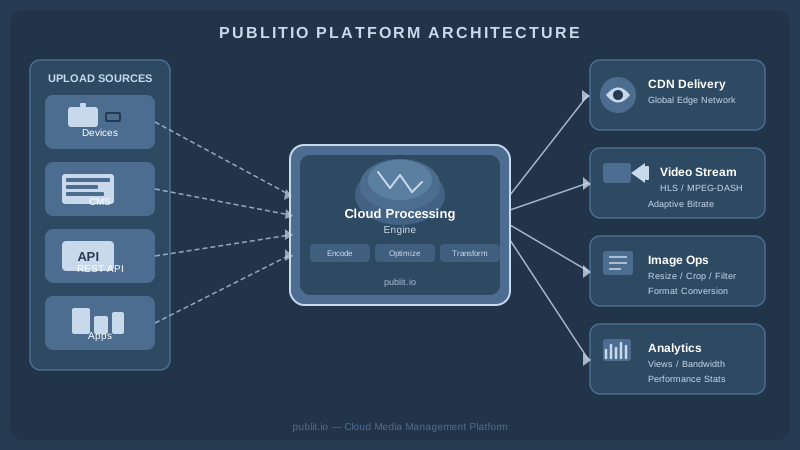
Managing media at scale is one of the most overlooked technical challenges in modern digital businesses. Whether you're a developer building a video-heavy application, a marketing team juggling thousands of brand assets, or a publisher offloading media from a slow WordPress server, the infrastructure underneath your content matters enormously. That's where Publitio comes in. Publitio is a cloud-based media management platform built to handle every stage of the digital asset lifecycle — from upload and storage to processing, delivery, and analytics — all through a single, unified API-first system.
In this post, we'll take a comprehensive look at what Publitio offers, who it's built for, and why it has become the go-to solution for developers, businesses, and content teams that need reliable, scalable, and cost-effective media infrastructure.
What Is Publitio and Who Is It For?
Publitio is a cloud media management service that sits at the intersection of digital asset management, video hosting, and developer-friendly API tooling. It was designed from the ground up with an API-first philosophy, meaning every feature available through the dashboard is also available programmatically — making it equally useful for technical teams writing code and non-technical teams managing files through a visual interface.
The platform serves a wide range of users:
- Developers and software engineers who need a robust API to manage, transform, and deliver media assets within their applications.
- Marketing and content teams who need organized, searchable, and shareable digital asset libraries.
- Video creators and publishers who need reliable video hosting with streaming, encoding, and DRM protection.
- WordPress site owners who want to offload media storage and delivery to the cloud to improve site performance.
- Enterprises that require secure, scalable media infrastructure with advanced access controls and usage analytics.
Rather than stitching together separate tools for image optimization, video hosting, file storage, and content delivery, Publitio provides all of these capabilities under one roof — with consistent pricing, a single dashboard, and one unified API.
Core Capabilities of the Publitio Platform
Digital Asset Management (DAM)
At its core, Publitio is a powerful digital asset management solution. It provides a centralized repository where all your media files — videos, images, audio files, PDFs, documents — can be uploaded, tagged, organized into folders, and retrieved at any time. Metadata management, custom tagging, and search functionality make it easy for teams to locate the right asset quickly, even when working with libraries that contain tens of thousands of files.
For media-heavy organizations, Publitio also functions as a full media asset management (MAM) platform, with support for video proxies, format management, and workflow-oriented organization. This makes it suitable not just for static marketing assets, but for dynamic, production-level media pipelines.
Video Hosting and Video-on-Demand
Video is where Publitio truly shines. The platform provides end-to-end video management — from upload and transcoding through to hosting, streaming, and analytics. Videos uploaded to Publitio are automatically processed and made available for playback across all devices and connection speeds.
The video-on-demand (VoD) system supports adaptive bitrate streaming, meaning viewers always receive the highest quality video their connection can handle without buffering. This is powered by HLS (HTTP Live Streaming), the industry-standard protocol for adaptive video delivery. Whether you're hosting a library of training videos, premium content, or product demos, Publitio's VoD infrastructure ensures a smooth playback experience for every viewer.
For organizations that rely heavily on video conversion at scale, Publitio offers GPU-accelerated video conversion, dramatically reducing the time it takes to transcode large video files compared to CPU-only processing pipelines.
HLS Streaming with DRM and Encryption
Security-conscious publishers — particularly those distributing premium or paid video content — will find Publitio's HLS streaming capabilities essential. The platform supports encrypted HLS delivery, protecting your video content from unauthorized downloads and redistribution.
Combined with Digital Rights Management (DRM), Publitio gives content owners fine-grained control over who can access their media, for how long, and under what conditions. This is critical for subscription video platforms, e-learning providers, corporate training systems, and any application where content protection is a business requirement rather than an afterthought.
Image Management and Optimization
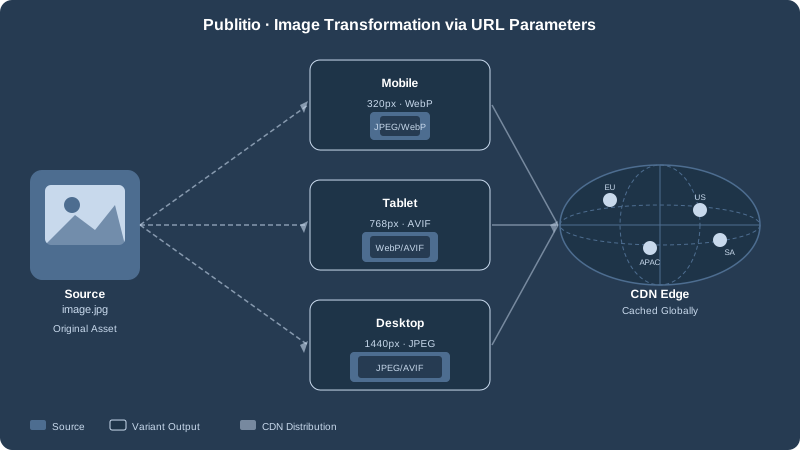
Images are the most common type of media asset on the web, and Publitio provides a comprehensive suite of tools for managing them. Through the platform's image management features, users can upload, organize, and serve images with on-the-fly transformations applied via URL parameters — resizing, cropping, format conversion (including WebP and AVIF), quality adjustments, and more.
This URL-based image transformation system is especially valuable for developers who need to serve the right image dimensions for different device types and screen resolutions without maintaining multiple versions of every asset. Publitio generates the appropriate variant dynamically and caches it at the CDN edge for fast subsequent delivery.
The platform also supports watermarking, allowing you to protect visual assets with branded overlays — either static image watermarks or text-based watermarks — applied automatically at delivery time.
The Developer-First API: Building with Publitio
One of the most compelling aspects of Publitio is its deeply developer-oriented architecture. The platform offers a free video API and a comprehensive media API that covers every operation you'd need to integrate media management into a custom application: uploading files, retrieving asset metadata, generating signed URLs, applying transformations, managing folders, and pulling usage statistics.
SDKs and code samples are available for the most popular programming languages and frameworks, and the full API reference is documented thoroughly in the Publitio developer documentation. The documentation includes practical examples, authentication guides, and webhook integration instructions, making it approachable for developers who are integrating media infrastructure for the first time as well as experienced engineers who want to get into the details quickly.
The API's design also means that Publitio fits naturally into modern development workflows. It can be integrated into CI/CD pipelines, headless CMS architectures, e-commerce platforms, mobile applications, and custom web applications with minimal overhead. If you're building a product and you need media — stored, processed, and delivered reliably — the Publitio API is designed to be the layer that handles all of that so you don't have to build it from scratch.
Video Processing and Automated Transcoding
Raw video files come in a bewildering variety of formats, codecs, and container types. Publitio's video processing engine automatically handles transcoding to web-optimized formats upon upload, so you never have to worry about compatibility issues across different browsers, devices, or operating systems. The platform generates multiple quality levels from a single source file, enabling the adaptive bitrate streaming that underpins smooth VoD playback.
Custom encoding profiles, thumbnail generation, and clip extraction are also available, giving development teams and content managers control over the exact output format that their application requires.
Global CDN Delivery and Performance
Even the most beautifully managed media library is only as good as the speed at which it reaches end users. Publitio uses a global content delivery network (CDN) to ensure that your files — whether images, videos, or documents — are served from edge locations that are geographically close to each viewer. This reduces latency, improves load times, and provides a better experience for audiences around the world.
CDN delivery is not an optional add-on for Publitio customers; it's baked into the platform by default. Every asset served through Publitio benefits from edge caching, intelligent routing, and the reliability that comes with distributed infrastructure. This is particularly important for video streaming, where latency and throughput directly affect playback quality and viewer retention.
Analytics and Usage Insights
Understanding how your media is being consumed is as important as delivering it efficiently. Publitio's built-in analytics feature gives you visibility into how your assets are being accessed — including bandwidth consumption, play counts, geographic distribution of viewers, and storage utilization. These insights help teams make informed decisions about content strategy, infrastructure costs, and audience reach.
For developers and DevOps teams, usage analytics also serve a practical role in cost management: knowing exactly where bandwidth is being consumed helps optimize delivery configurations and control spending as your media library grows.
WordPress Media Offloading: A Game-Changer for WordPress Sites
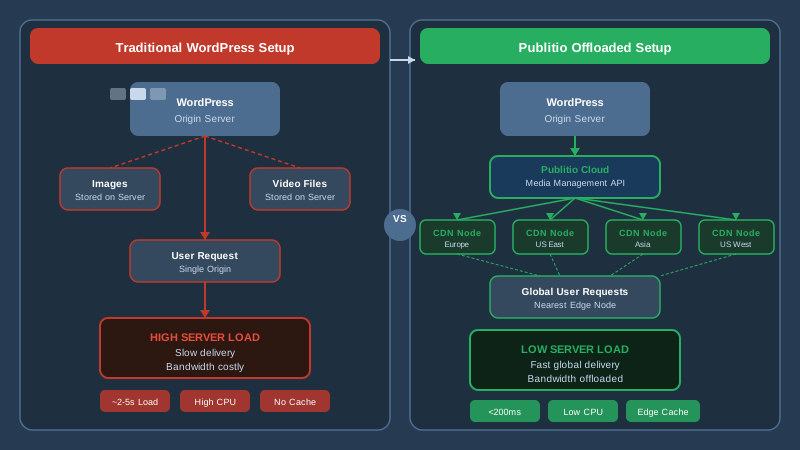
WordPress powers a significant portion of the web, and one of the most persistent performance problems for WordPress site owners is media storage. When images and videos are stored directly on the web server and served from the same origin as the site itself, performance degrades — especially as the media library grows. Server storage fills up, page load times increase, and scalability becomes a real obstacle.
Publitio solves this with its dedicated WordPress media offloading plugin. Once installed and configured, the plugin automatically syncs your WordPress media library to Publitio's cloud storage and rewrites asset URLs so that all media is delivered through Publitio's CDN instead of your origin server. The result is dramatically faster page loads, reduced server load, and a media library that can grow without being constrained by your hosting plan's storage limits.
The plugin supports existing media libraries as well as newly uploaded files, making migration painless for established sites. For WordPress users running WooCommerce stores, news sites, or content-heavy blogs, this offloading capability alone can justify the platform entirely.
Audio Management: Beyond Video and Images
While video and image management tend to get the most attention, Publitio also provides robust audio management capabilities. Podcasters, music platforms, e-learning providers with audio lectures, and any application that works with audio files can upload, organize, and deliver audio content through the same unified platform and API. Format conversion, CDN delivery, and metadata management apply to audio assets just as they do to video and image files.
Publitio Pricing: Flexible Plans for Every Scale
Publitio offers a tiered pricing model designed to work for projects at every stage of growth — from individual developers experimenting with a side project to enterprises running large-scale media operations. There is a free tier available that gives developers access to core platform features, making it genuinely easy to evaluate and integrate Publitio before committing to a paid plan.
Paid plans scale with storage capacity, bandwidth usage, and the number of transformations or video conversions your account performs. For teams with predictable usage patterns, this model is straightforward and cost-effective. For teams with more variable usage, Publitio's model ensures you're only paying for what you actually use. Full details, including current plan limits and pricing breakdowns, are available on the Publitio pricing page.
Why Publitio Stands Out in a Crowded Market
There are plenty of cloud storage services, video hosting platforms, and image CDN tools on the market. What makes Publitio distinctive is the combination of breadth and depth: it doesn't just do one thing well, it does all of these things — DAM, video hosting, HLS streaming, DRM, image transformation, audio management, WordPress integration, CDN delivery, analytics — within a single platform, under a single account, through a single API.
For growing businesses, this consolidation has real value. Every additional vendor you rely on for media infrastructure means another contract, another API to integrate, another dashboard to monitor, and another potential point of failure. Publitio reduces that complexity significantly without sacrificing capability.
The platform is also built with developer experience as a first-class priority. The API is clean and consistent, the documentation is thorough, and features like URL-based image transformations and automatic video transcoding are designed to minimize the custom code that teams need to write and maintain.
Getting Started with Publitio
Getting up and running with Publitio takes minutes. New users can sign up, upload their first file, and generate a deliverable URL within a single session. The onboarding experience is designed to get developers and content teams to their first working integration quickly, with sample code and a guided dashboard making the learning curve as shallow as possible.
Whether you start with the free tier to explore the API or jump directly into a plan that matches your production requirements, the path from sign-up to shipping media-powered features is shorter with Publitio than with most alternatives.
If you're building an application that works with video, images, audio, or any kind of file — or if you're managing a WordPress site that's straining under the weight of a growing media library — Publitio is purpose-built to solve exactly those problems, at any scale, with the reliability and flexibility that modern digital products demand.
Ready to take your media infrastructure to the next level? Sign up for a free Publitio account at publit.io and experience the difference that a truly unified cloud media management platform makes. Whether you're a solo developer, a fast-growing startup, or an enterprise team managing thousands of assets, Publitio has the tools, the API, and the infrastructure to power your media at scale — starting today.