
Best Image Management Solutions for Growing Teams in 2025
As organizations scale, the challenge of organizing, storing, delivering, and sharing visual assets grows exponentially. Choosing the right image management solutions can be the difference between a smooth creative workflow and a chaotic digital mess where files get lost, duplicated, or delivered at the wrong size. In 2025, growing teams need platforms that do more than just store images — they need intelligent systems that integrate with existing tools, serve assets through fast CDNs, and provide developer-friendly APIs for automation. This guide breaks down what to look for and highlights the best options available today.
Why Image Management Matters More Than Ever in 2025
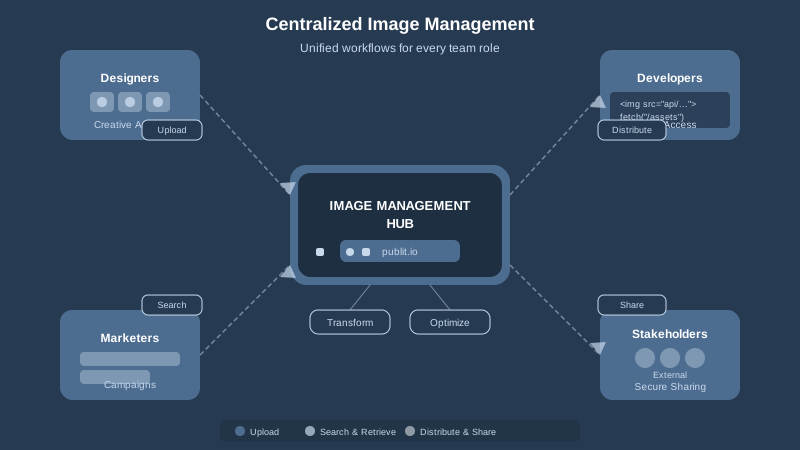
The average marketing team now manages thousands of image assets across campaigns, social media channels, product pages, and internal documentation. Without a centralized system, teams waste hours searching for the right file, recreating assets that already exist, and dealing with inconsistent branding caused by outdated image versions being used in the wrong places.
The numbers tell a clear story. Research consistently shows that creative professionals spend up to 30% of their working week simply searching for files. For a growing team of ten designers, that is a staggering volume of lost productivity. Beyond internal efficiency, poor image delivery also hurts customer experience — slow-loading, unoptimized images increase bounce rates and damage SEO rankings.
Modern image management solutions address these problems at every level: storage organization, metadata tagging, access control, transformation on the fly, and CDN-powered delivery to end users around the globe.
Key Features to Look for in Image Management Solutions
Not all image management platforms are created equal. When evaluating options for your team, keep these critical capabilities on your checklist.
1. Organized Storage with Smart Metadata
The foundation of any good image management system is an organized storage hierarchy backed by rich metadata. Look for platforms that support custom tags, automatic metadata extraction from EXIF data, and full-text search across file names, descriptions, and tags. The ability to create nested folders, collections, or albums is equally important for keeping campaigns and projects separated and easy to navigate.
2. On-the-Fly Image Transformation
Growing teams serve images across a huge range of contexts — hero banners, thumbnails, social media crops, email headers, and mobile app assets. Manually exporting every variant is not scalable. The best image management solutions offer URL-based image transformations, allowing developers and marketers to resize, crop, convert, compress, or apply watermarks simply by modifying query parameters in the image URL. This eliminates the need to store dozens of redundant copies of the same asset.
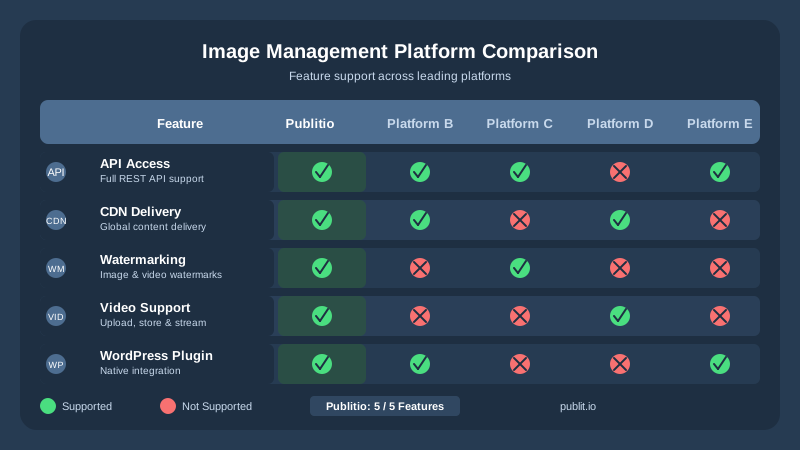
Platforms like Publitio offer built-in watermarking features that let you protect visual assets automatically, which is especially valuable for photographers, media companies, and brands managing licensed imagery.
3. CDN-Powered Delivery
Image delivery speed matters enormously for both user experience and Core Web Vitals. A platform with integrated CDN distribution ensures your images are served from edge locations closest to your users, dramatically reducing load times. Publitio's global CDN delivery is built into the platform, meaning you do not need to configure a separate CDN provider — your images are automatically served at scale from day one.
4. API-First Architecture for Developers
For teams with development resources, an API-first image management platform unlocks automation at every step. You can programmatically upload assets from your CMS, trigger transformations during build processes, and fetch asset metadata for dynamic applications. Robust API documentation is non-negotiable. Publitio's developer documentation provides comprehensive reference guides for integrating image management directly into custom applications.
5. Access Control and Permissions
As teams grow, access control becomes critical. You need the ability to set role-based permissions — ensuring that freelancers can upload assets but cannot delete core brand files, for example. Digital rights management features add another layer of protection for sensitive or licensed visual content.
6. Analytics and Usage Insights
Understanding how your images are being accessed — which assets are most viewed, how they are being delivered, and where bandwidth is being consumed — helps teams make smarter decisions about storage and delivery costs. Look for platforms with built-in asset analytics so you can track performance without relying on third-party tools.
Top Image Management Solutions for Growing Teams
With the core requirements in mind, here are the leading platforms worth considering in 2025, each with distinct strengths depending on your team's size, technical capabilities, and use cases.
Publitio — Best All-in-One Image Management Solution for API-Driven Teams
Publitio is a cloud-based media management platform purpose-built for teams that need more than basic image storage. It covers the full lifecycle of digital assets — upload, organize, transform, protect, and deliver — through a unified API and intuitive dashboard. Its image management solution supports on-the-fly resizing, format conversion, watermarking, and direct CDN delivery without additional configuration.
What sets Publitio apart for growing teams is its combination of breadth and developer-friendliness. You get a powerful API, a WordPress plugin for media offloading, video hosting capabilities, and digital asset management — all under one roof. Teams that currently use multiple tools for image hosting, video management, and file delivery can consolidate onto a single platform, reducing costs and complexity.
The platform also offers a comprehensive digital asset management system with folder organization, tagging, search, and sharing capabilities that non-technical team members can use without engineering support.
For WordPress-heavy teams, the WordPress media offloading plugin is a standout feature. It automatically offloads media uploads from your WordPress server to Publitio's CDN-backed cloud storage, improving site performance without requiring code changes.
Pricing is transparent and scales with usage. You can review the full breakdown on the Publitio pricing page to find a plan that matches your team's storage and bandwidth needs.
Cloudinary — Best for Enterprise Scale
Cloudinary is one of the most established names in media management and offers an extremely powerful set of image transformation and optimization features. It is particularly strong at automated image optimization pipelines and has deep integrations with e-commerce and enterprise CMS platforms. However, its pricing can escalate quickly for growing teams with high-volume usage, and the platform's breadth can feel overwhelming for smaller organizations that do not need enterprise-grade complexity.
Bynder — Best for Brand-Focused Marketing Teams
Bynder positions itself primarily as a digital asset management platform with strong brand portal capabilities. It excels at creative workflow management, brand guideline enforcement, and approval workflows. It is a solid choice for larger marketing departments where brand consistency is the top priority, but it lacks the developer-centric API flexibility and media delivery features that technical teams require.
Canto — Best for Mid-Sized Teams Managing Large Asset Libraries
Canto offers a clean, user-friendly interface and strong search capabilities, making it accessible to non-technical users across a team. Its metadata management and AI-powered auto-tagging are particularly well regarded. However, it is primarily a storage and organization platform — you will need additional tools for image transformation and CDN delivery, which adds cost and integration complexity.
Widen Collective — Best for Manufacturing and Product-Intensive Industries
Widen Collective (now part of Acquia) provides robust product content management alongside DAM capabilities. It is an excellent fit for companies managing large volumes of product imagery across multiple channels. Like Bynder, it leans toward enterprise use cases and enterprise pricing, making it less accessible for fast-growing startups or mid-market teams on tighter budgets.
How to Choose the Right Image Management Solution for Your Team
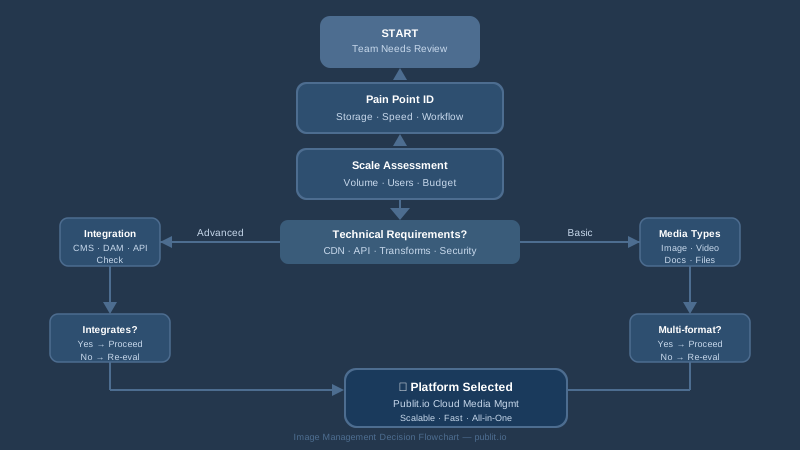
Selecting the right platform comes down to understanding your team's specific workflows, technical capabilities, and growth trajectory. Here is a practical framework for making the decision.
Assess Your Current Pain Points
Start by mapping exactly where your current image workflow breaks down. Is the problem primarily storage and organization — files scattered across Dropbox, Google Drive, and local hard drives? Or is it delivery performance — images loading slowly on your website and hurting conversion rates? Or is it access control — the wrong people deleting or publishing the wrong files? The answer shapes which platform features should carry the most weight in your evaluation.
Consider Your Technical Resources
If your team includes developers who can build integrations and leverage APIs, you will get significantly more value from platforms like Publitio that offer deep API access and automation capabilities. If your team is primarily non-technical marketers and designers, prioritize platforms with intuitive dashboards and no-code workflow tools.
Plan for Scale
Choose a platform that can grow with you. Evaluate not just current pricing but how costs scale as your storage volume, bandwidth consumption, and number of users increase. Platforms that charge heavily for each additional user or each additional transformation can become expensive as your team expands. Publitio's usage-based pricing model is transparent and scales predictably, making it easier to forecast costs as you grow.
Integration Requirements
Map your existing tech stack before committing to any platform. Does it integrate with your CMS — WordPress, Webflow, Contentful? Does it offer webhooks or Zapier integrations for workflow automation? Can it connect to your e-commerce platform or PIM system? The fewer manual handoffs in your workflow, the more productive your team will be.
Beyond Images — Think About Your Entire Media Strategy
Many growing teams start with image management but quickly find they also need video hosting, audio file management, and document storage. Choosing a platform that handles all media types from day one prevents the need to migrate platforms as your needs evolve. Publitio's media asset management platform covers images, video, audio, and documents under a single API, making it a future-proof choice for teams with diverse media needs.
Why Publitio Stands Out as an Image Management Solution in 2025
Among all the platforms evaluated, Publitio offers the most compelling combination of features for growing teams that need power without complexity. Here is a quick summary of what makes it the standout choice:
- Unified platform: Manage images, video, audio, and documents through a single API and dashboard — no stitching together multiple tools.
- On-the-fly transformations: Resize, crop, convert, and watermark images dynamically via URL parameters without storing redundant copies.
- Built-in CDN: Assets are delivered globally from edge servers automatically, without additional CDN configuration or cost.
- Developer-friendly API: Comprehensive REST API with clear documentation makes integration into any application straightforward.
- WordPress integration: The media offload plugin makes it effortless to improve WordPress site performance without changing your publishing workflow.
- Digital rights management: Protect sensitive and licensed assets with built-in DRM capabilities alongside image protection features.
- Transparent pricing: Usage-based plans that scale predictably with your team's growth.
For teams that also need video capabilities, Publitio extends seamlessly into video management, HLS streaming, and video-on-demand delivery — making it the only platform many growing teams will ever need across their entire media stack.
Final Thoughts on Choosing Image Management Solutions
The right image management solution in 2025 is not just a storage tool — it is a core part of your team's creative infrastructure. The best platforms reduce time spent searching for files, eliminate delivery bottlenecks, protect your visual assets, and scale gracefully as your team and content library grow. Whether you are a startup managing your first product image library or a mid-market company dealing with thousands of brand assets, there is a platform that fits your needs and budget.
For most growing teams, the combination of power, flexibility, ease of use, and all-in-one media management that Publitio provides makes it the strongest contender in 2025. It removes the need to juggle multiple vendor relationships and gives your developers, designers, and marketers a single, reliable home for every visual asset your business creates.
Ready to see what the right image management solution can do for your team? Sign up for a free account at publit.io and experience organized, fast, and scalable image management from day one. No credit card required — get started in minutes and discover why thousands of growing teams trust Publitio to manage their most important visual assets.