publit.io: The Complete Cloud Media Management Platform for Video, Images & Files
Whether you are a developer building a media-rich application, a content creator hosting thousands of videos, or an enterprise team managing a sprawling library of digital assets, publit.io gives you everything you need in a single, unified cloud platform. From uploading your first file to streaming encrypted video at scale across a global CDN, publit.io is designed to handle every stage of the media lifecycle — without forcing you to stitch together a dozen separate tools. In this post, we will walk through what publit.io is, what makes it different, and why it has become the go-to platform for teams that take media management seriously.
What Is publit.io?
publit.io is a cloud-based media management platform built around an API-first philosophy. At its core, it lets you store, transform, deliver, and monetise digital media — videos, images, audio files, PDFs, documents, and more — through a single account and a consistent set of APIs and dashboard tools.
Unlike traditional file storage services, publit.io is purpose-built for media workflows. That means automatic video transcoding, real-time image transformations, adaptive HLS streaming, DRM content protection, and analytics are all available out of the box. Developers get clean REST APIs and SDKs; non-technical users get an intuitive web dashboard. Both audiences get the same powerful infrastructure underneath.
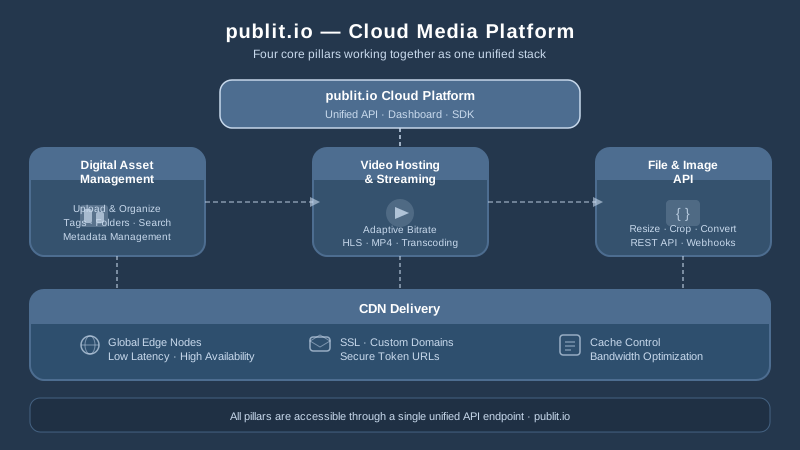
The platform sits at the intersection of four categories that are usually sold separately:
- Digital Asset Management (DAM) — organise, tag, search, and share media assets across teams.
- Video Hosting & Streaming — upload, encode, and stream video with adaptive bitrate delivery.
- File & Image API — manipulate and serve images and files dynamically via URL parameters.
- CDN Delivery — push every asset to the edge so audiences worldwide receive fast, reliable content.
Managing Every Type of Digital Asset with publit.io
One of the most common pain points for growing teams is asset sprawl — videos in one tool, images in another, documents scattered across shared drives. publit.io solves this with a comprehensive digital asset management solution that keeps every file type in one searchable, permission-controlled library.
Digital Asset Management for Teams
The publit.io DAM layer supports folders, tags, custom metadata fields, and role-based access controls. You can create shared collections for specific campaigns, restrict access to sensitive assets by user role, and generate shareable links with expiry dates. Full-text search and metadata filtering make it easy to find any asset in a library of millions within seconds.
For media-heavy organisations, the platform also supports media asset management workflows that go beyond simple storage — including version history, usage tracking, and approval workflows that fit into existing production pipelines.
Image Management at Scale
Images are often the highest-volume asset type, and publit.io handles them with a dynamic, URL-based transformation engine. Resize, crop, convert format, apply watermarks, adjust quality, and optimise for WebP delivery — all by appending simple parameters to the asset URL. No pre-generating variants, no extra storage for every size. The image management solution means your origin image is stored once, and every variation is generated on the fly and cached at the CDN edge.
Audio and Document Handling
Beyond video and images, publit.io manages audio files and documents with the same consistency. Podcast producers, e-learning platforms, and publishing teams can store MP3s, WAVs, PDFs, and ePub files alongside their other media — all retrievable via the same API, all delivered via the same CDN infrastructure. The audio management solution supports secure streaming and embedding just like video.
Video Hosting, Processing, and Streaming
Video is where publit.io truly shines. The platform was built from the ground up to handle the full video lifecycle: ingest, transcode, protect, stream, and analyse — all without requiring you to manage servers or configure encoding pipelines.
Automatic Video Processing and GPU Transcoding
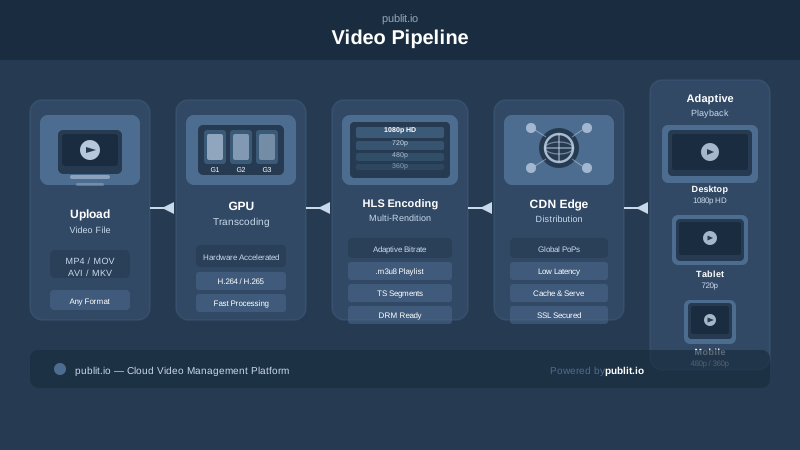
When you upload a video to publit.io, the platform automatically triggers a processing pipeline. Raw footage is transcoded into multiple quality levels suitable for adaptive streaming. The platform leverages GPU-accelerated video conversion to dramatically reduce encoding times compared to CPU-based approaches — critical when you need to publish content quickly after upload.
The video processing engine supports trimming, clipping, thumbnail extraction, resolution scaling, bitrate control, and format conversion. These operations can be triggered via the API or configured as automatic post-upload workflows, making publit.io a natural fit for CI/CD media pipelines.
HLS Streaming with Adaptive Bitrate Delivery
Once encoded, videos are served using HTTP Live Streaming (HLS) — the industry standard for adaptive bitrate video delivery. The player automatically selects the appropriate quality level based on the viewer's connection speed, ensuring smooth playback without buffering on both mobile and desktop devices.
publit.io's HLS streaming infrastructure supports multi-rendition playlists, subtitle tracks, and chapter markers. Whether you are building a video-on-demand library or a live-event replay platform, the streaming layer scales elastically to handle traffic spikes without any manual intervention.
Video on Demand (VoD)
For publishers monetising content libraries, publit.io provides a complete video-on-demand solution with customisable embeds, password protection, domain restrictions, and analytics. You can create branded video players, configure autoplay and loop behaviour, and embed videos anywhere with a simple iframe or JavaScript snippet.
Content Protection and Digital Rights Management
Distributing valuable video content online without proper protection is a significant business risk. publit.io addresses this head-on with a layered content protection system that gives rights holders granular control over who can access their media and under what conditions.
DRM and Encryption
For premium content, publit.io supports digital rights management (DRM) with industry-standard encryption. Video streams can be encrypted at the HLS segment level, ensuring that even if a viewer intercepts the stream, they cannot play back the content without a valid licence key. This makes publit.io suitable for film distributors, online educators, and subscription platforms that need to protect proprietary video.
Watermarking for Visual Protection
Beyond encryption, publit.io's dynamic watermarking feature lets you overlay image or text watermarks on videos and images automatically. Watermarks can be static branding elements or dynamic user-identifying tokens that make it easy to trace the source of any leaked content. The watermark parameters are applied via the API, so you can personalise overlays per viewer or per licence tier without re-encoding the underlying asset.
Access Controls and Signed URLs
At the delivery layer, publit.io supports signed URLs with expiry times and IP restrictions. This means that even if a CDN link is shared externally, it will stop working after a defined window — essential for paid content, internal media, and time-limited previews. Combined with the DRM and watermarking layers, this creates a comprehensive content protection stack with no additional services required.
Global CDN Delivery and Performance
The best media management infrastructure is useless if assets are slow to load. publit.io integrates CDN delivery directly into the platform so that every asset — from a small product thumbnail to a full-length 4K video — is served from the edge node closest to the end user.
The CDN layer automatically handles cache invalidation when assets are updated, multi-region redundancy for high availability, and HTTP/2 delivery for reduced latency. You do not need a separate CDN account or complex cache-control configurations. Upload an asset, and it is globally distributed within minutes.
For image delivery specifically, the CDN works in concert with the dynamic transformation engine — the first request for a given image variant triggers generation and caching, and every subsequent request for that variant is served directly from the edge with no origin round-trip. This pattern dramatically reduces server load while ensuring consistent performance at scale.
Developer-First API and Integrations
publit.io is built for developers who need to embed media management capabilities into their own applications. The platform exposes a comprehensive video and media API with endpoints for uploading, querying, transforming, and deleting assets programmatically. Authentication uses API keys and OAuth tokens, and every response is returned as clean JSON.
The API documentation is thorough and up to date — developers can explore every endpoint, parameter, and response schema in the publit.io developer docs. SDKs are available for popular languages and frameworks, and webhook support means you can trigger downstream workflows as soon as encoding or processing jobs complete.
WordPress Media Offloading
For teams running WordPress, publit.io offers a dedicated WordPress media offloading plugin that automatically syncs media uploads to the publit.io cloud and rewrites URLs in your content to point to the CDN. This immediately reduces your WordPress server's storage burden, speeds up your site's media load times, and gives you access to publit.io's image transformation capabilities without touching a line of code.
The plugin works with any WordPress theme and is compatible with WooCommerce, page builders, and major SEO plugins. It is one of the fastest ways to go from a sluggish, storage-heavy WordPress install to a fast, scalable media delivery setup.
Analytics and Reporting
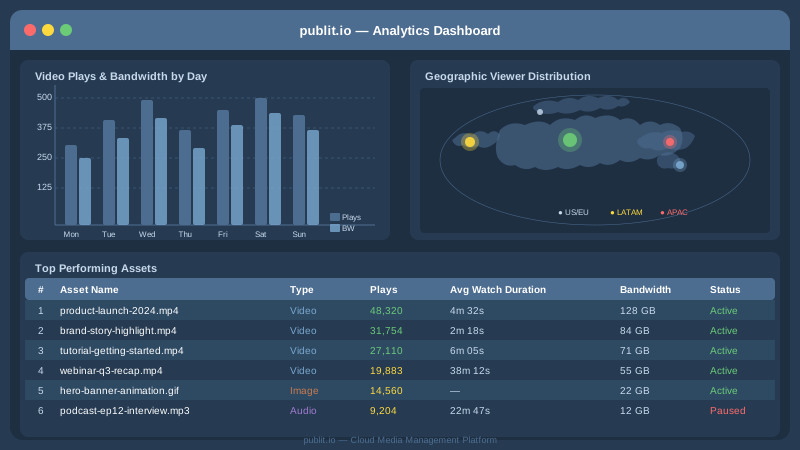
Understanding how your media is being consumed is as important as delivering it. publit.io includes built-in media analytics that track views, plays, bandwidth consumption, geographic distribution, device types, and engagement metrics at both the asset and account level.
Video analytics go deeper — tracking play rate, average watch duration, drop-off points, and replay behaviour. These insights help content teams understand which videos are performing and where audiences are losing interest, enabling data-driven decisions about content strategy and production investment.
All analytics data is accessible via the dashboard or exportable via the API, making it straightforward to feed media performance data into your existing BI tools or reporting dashboards.
Pricing and Getting Started with publit.io
publit.io is available on a range of plans designed to grow with you. Whether you are a solo developer exploring the API on a free tier, a startup scaling a VoD product, or an enterprise team with high-volume asset libraries and strict security requirements, there is a plan that fits. The publit.io pricing page breaks down storage, bandwidth, video minutes, and feature availability across each tier so you can choose the right starting point and upgrade as your needs evolve.
All plans share the same underlying infrastructure — the difference is in usage limits and access to advanced features like DRM, custom domains, and priority encoding queues. There are no hidden egress fees structured to penalise growth, and the API is available on every paid plan without additional licensing costs.
Why Teams Choose publit.io Over Piecemeal Solutions
The most common alternative to a platform like publit.io is assembling a stack: cloud object storage for files, a separate transcoding service for video, a third-party image CDN, a DRM vendor, and an analytics tool. Each of these comes with its own pricing model, API quirks, and operational overhead. When something breaks — and it will — you need to diagnose which service in the chain is responsible.
publit.io collapses that complexity into a single account, a single API, and a single support relationship. That is not just a convenience argument — it is a real reduction in engineering time, operational risk, and monthly tooling costs for most teams that do the comparison honestly.
For organisations with specific compliance, access control, or integration requirements, the API-first architecture means publit.io can fit into almost any existing workflow. It acts as the media infrastructure layer while your application handles the business logic on top.
Start Managing Your Media with publit.io Today
If you are ready to stop juggling multiple tools and start managing all your video, image, audio, and file assets from one powerful cloud platform, publit.io is the answer. Sign up at publit.io and get immediate access to the full platform — upload your first assets, explore the API, test HLS video streaming, and see exactly how seamless cloud media management can be. Your first steps on the platform are free, and the team is available to help you design the right architecture for your use case. Join the thousands of developers, creators, and enterprises already building on publit.io.