
What Is HLS Streaming? How It Works and Why It Matters for Video Delivery
If you've ever watched a video on your phone and noticed it automatically adjusted quality when your signal dropped, you've already experienced HLS streaming in action. But what is HLS streaming, exactly, and why has it become the dominant standard for delivering video across the internet? Whether you're a developer building a video platform, a content creator looking to reach global audiences, or a business exploring media hosting solutions, understanding HLS is fundamental to making smart decisions about your video infrastructure. In this guide, we'll break down how HLS works, why it outperforms older streaming methods, and how platforms like Publitio's HLS streaming make enterprise-grade video delivery accessible to everyone.
What Is HLS Streaming? A Plain-Language Definition
HLS stands for HTTP Live Streaming. It is an adaptive bitrate streaming protocol originally developed by Apple in 2009 and released as part of iOS 3.0. Despite its Apple origins, HLS has since become a universal standard supported by virtually every browser, device, and platform — from Android phones and smart TVs to desktop browsers and OTT applications.
At its core, HLS is a method of delivering video and audio content over the internet using standard HTTP web servers. Unlike older real-time protocols such as RTMP (Real-Time Messaging Protocol), HLS does not require specialized server infrastructure or proprietary software to deliver streams. This makes it dramatically easier to scale, cache, and distribute through content delivery networks.
The "live" in its name is slightly misleading today — HLS is used just as widely for on-demand video as it is for live broadcasts. Any time you stream a film on a major platform, attend a virtual event, or watch a product demo on a company website, there's a strong chance HLS is the technology carrying that video to your screen.
How HLS Streaming Works: The Technical Breakdown
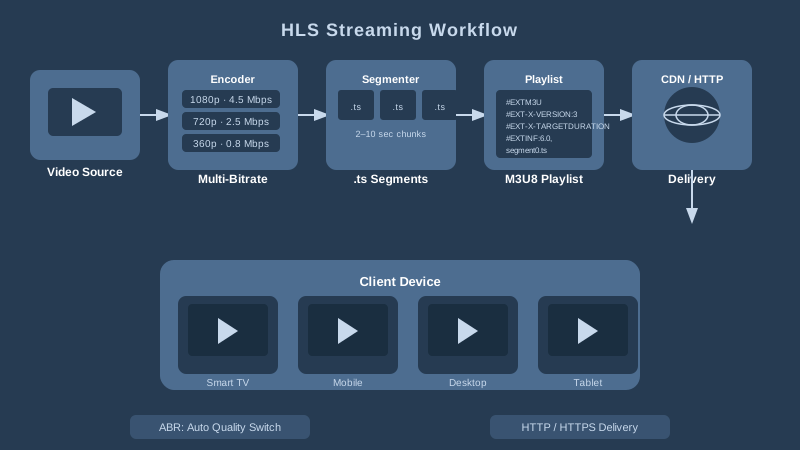
To truly understand HLS, it helps to walk through its technical mechanics step by step. The protocol involves several interconnected components working together to deliver smooth, adaptive video playback.
Step 1: Encoding and Transcoding
Before a video can be delivered via HLS, it must be encoded — or in most pipeline scenarios, transcoded — into multiple quality levels. A typical HLS setup might produce renditions at 240p, 360p, 480p, 720p, and 1080p (and beyond, for 4K content). Each rendition is encoded at a different bitrate so the player can switch between them depending on the viewer's available bandwidth.
This transcoding step is where a lot of the computational work happens. Modern platforms use GPU-accelerated processing to handle this efficiently at scale. Publitio, for example, uses GPU video conversion to transcode uploaded videos into HLS-ready formats rapidly, without making you wait hours for processing to complete.
Step 2: Segmentation
Once encoded, each quality rendition is split into small segments — typically 2 to 10 seconds long. These segments are saved as .ts (MPEG-2 Transport Stream) files or, in newer implementations, .fmp4 (Fragmented MP4) files. The segmented approach is the secret to HLS's flexibility: players only request the next segment just before they need it, which means they can switch quality levels between segments without interrupting playback.
Step 3: The M3U8 Playlist
Every HLS stream relies on a manifest file called an M3U8 playlist. This is a plain-text file that tells the video player where to find each segment and what quality levels are available. There are two types of playlists in HLS:
- Master playlist: Lists all available renditions (quality levels) and their associated media playlists.
- Media playlist: Lists the individual segment files for a specific quality level, along with their durations and sequence numbers.
When a player loads an HLS stream, it first fetches the master playlist, selects an appropriate starting quality based on current network conditions, then begins fetching segment files from the corresponding media playlist. As the session continues, the player continually monitors download speeds and buffer health, switching between renditions as needed.
Step 4: CDN Delivery
Because HLS uses standard HTTP, the segment files and playlist files can be cached and served by a content delivery network (CDN). This is a massive advantage. CDN nodes distributed across the globe can serve the same cached segments to millions of concurrent viewers simultaneously, reducing latency and server load while improving reliability. For live events especially, CDN caching means a single origin server can support enormous audiences without being overwhelmed.
Step 5: Adaptive Bitrate Selection on the Client
The player running in the viewer's browser or app is responsible for adaptive bitrate (ABR) logic. It monitors network throughput, buffer levels, and playback history to decide which quality rendition to request next. This all happens automatically and invisibly — the viewer simply sees a smooth, high-quality video that adjusts when their connection changes, rather than a spinning buffering indicator.
HLS vs. Other Streaming Protocols
To fully appreciate what is HLS streaming and why it dominates modern video delivery, it's worth comparing it to competing protocols.
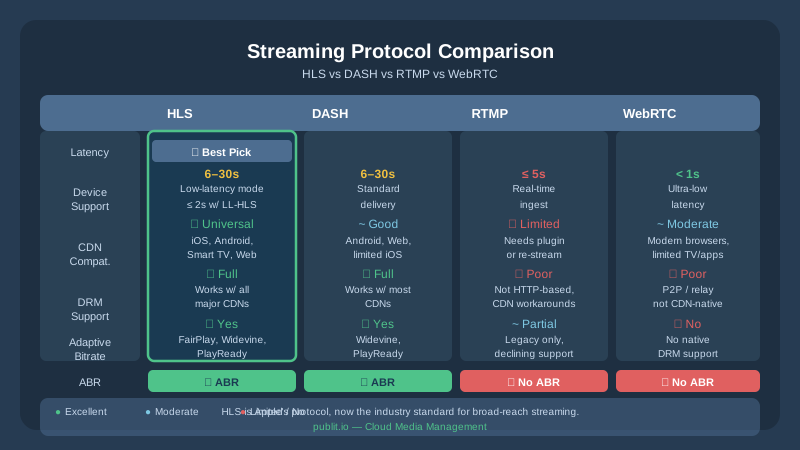
HLS vs. RTMP
RTMP (Real-Time Messaging Protocol) was the backbone of internet video for years, popularized by Flash Player. RTMP is excellent for ingest — sending a live video feed from an encoder to a streaming server — but it is not well-suited for last-mile delivery to viewers. Flash's end of life and the rise of mobile devices rendered RTMP nearly obsolete for playback. Today, RTMP is still commonly used for the first leg of a live stream (from the broadcaster's software to the media server), but HLS takes over for delivery to end users.
HLS vs. DASH
MPEG-DASH (Dynamic Adaptive Streaming over HTTP) is HLS's closest competitor and is also widely used. DASH is an open international standard, whereas HLS originated as an Apple proprietary format (though it is now openly documented). The two protocols are architecturally similar — both segment video, use adaptive bitrate logic, and deliver over HTTP. The main practical difference is device support: HLS has near-universal support, including on iOS (which does not natively support DASH), making it the safer default choice for most use cases.
HLS vs. WebRTC
WebRTC is designed for ultra-low latency, peer-to-peer communication — think video calls and interactive live streams. It can achieve sub-second latency, while standard HLS has a latency of 6–30 seconds. For interactive applications requiring real-time feedback, WebRTC is superior. But for broadcast-style video delivery — where reaching the maximum number of viewers reliably matters more than near-zero latency — HLS remains the preferred protocol. Low-Latency HLS (LL-HLS), introduced by Apple in 2019, narrows the gap significantly, bringing HLS latency down to 2–4 seconds.
Why HLS Streaming Matters for Modern Video Delivery
Understanding what HLS streaming is technically is one thing — but why should businesses and developers care about it specifically? The answer lies in a combination of viewer experience, operational simplicity, and ecosystem maturity.
Universal Device and Browser Support
HLS works natively on iOS and Safari, and is supported via JavaScript players (like HLS.js, Video.js, and Shaka Player) on Chrome, Firefox, Edge, and Android. Smart TVs, Roku, Fire TV, and nearly every OTT device support HLS out of the box. This means you can build a single HLS-based video pipeline and confidently reach your entire audience without fragmentation.
Resilience and Scalability
Because HLS segments are static files served over HTTP, they behave like any other web asset. They can be cached at the edge by CDNs, replicated across multiple regions, and served with the same infrastructure used for images and web pages. This makes HLS streaming inherently scalable and fault-tolerant in a way that stateful streaming protocols cannot match.
Built-In Support for DRM and Encryption
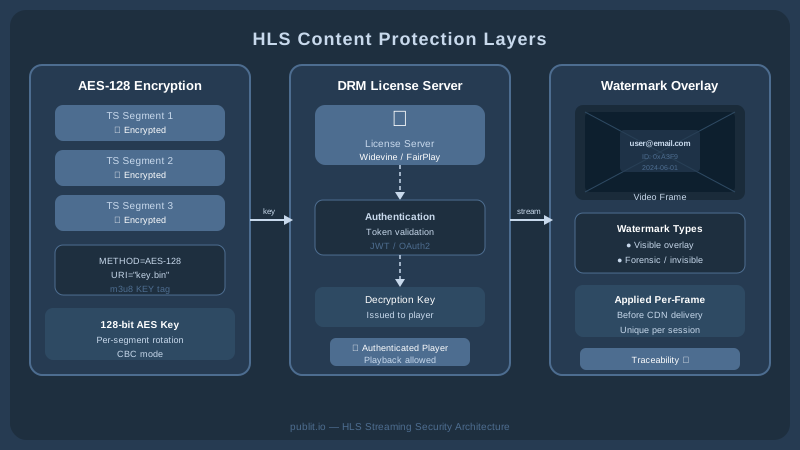
HLS supports AES-128 encryption natively, and can integrate with DRM systems like Apple FairPlay, Google Widevine, and Microsoft PlayReady. This is critical for premium content delivery — pay-per-view events, subscription video on demand, corporate training libraries, and any content that must be protected from unauthorized distribution. Publitio's digital rights management capabilities are built on top of HLS encryption, giving you content protection without needing to build it from scratch.
Adaptive Quality for Every Connection
One of the most user-visible benefits of HLS streaming is adaptive bitrate delivery. A viewer on a fast fiber connection gets 1080p or 4K; a viewer on a congested mobile network gets 360p — and both experiences are smooth because the player adapts automatically. This dramatically reduces buffering-related abandonment, which is one of the leading causes of viewer drop-off in video platforms.
Compatibility With Video-on-Demand Infrastructure
HLS is equally well-suited to live streaming and video-on-demand (VoD) delivery. For VoD, the entire video is pre-segmented and stored, so the media playlist is static and can be cached indefinitely. This makes HLS-based VoD exceptionally cost-efficient at scale — popular content gets served almost entirely from CDN cache with minimal origin server involvement.
HLS Streaming in Practice: What a Full Pipeline Looks Like
For developers and technical teams evaluating how to implement HLS, it's useful to understand what a production-grade pipeline actually involves. A complete HLS streaming workflow typically includes the following components:
- Ingest: Accepting video uploads (for VoD) or live encoder feeds (for live streaming).
- Transcoding: Converting source video into multiple HLS renditions using video processing pipelines.
- Storage: Storing segment files, playlist files, and original assets in object storage.
- CDN distribution: Serving all files through a geographically distributed CDN to minimize latency for global audiences.
- Encryption/DRM: Optionally encrypting segment files to protect premium content.
- Player: Embedding a compatible video player (HTML5-based) that handles adaptive playback logic.
- Analytics: Tracking viewing data, quality metrics, and engagement through a video analytics layer.
Building all of this from scratch requires significant engineering investment. That's why most businesses — from startups to large enterprises — opt for a managed platform that provides the full HLS pipeline as a service. Publitio's video API handles every step of this pipeline: you upload a video, and it automatically transcodes, segments, and makes it available via HLS through a global CDN, with optional encryption, within minutes.
HLS Streaming and Content Protection
For many organizations, content protection is the deciding factor in how they architect their video delivery. HLS streaming offers robust built-in options that make it the protocol of choice for premium and enterprise video use cases.
AES-128 Encryption
The simplest form of HLS content protection is AES-128 encryption, where each segment is encrypted with a key that is served separately to authorized players. This prevents casual interception and unauthorized download of video segments, though it is not as robust as full DRM.
Full DRM Integration
For enterprise-grade protection — protecting high-value content against determined extraction attempts — HLS can be paired with DRM systems. Apple FairPlay is required for DRM-protected HLS on iOS and Safari. Combined with Widevine (Chrome, Android) and PlayReady (Edge, Windows), a multi-DRM approach covers every major platform. Publitio's DRM solution manages these keys and licenses automatically, so you don't need to build and maintain your own key server infrastructure.
Visual Watermarking
Beyond encryption, visible and forensic video watermarks can deter unauthorized redistribution by identifying the source of any leak. Watermarking is particularly common in screener distribution, media review workflows, and premium live events.
Who Should Use HLS Streaming?
HLS streaming is not just for large media companies. Any organization that delivers video content to external audiences can benefit from it. Here are some common use cases:
- Media and entertainment companies delivering subscription video libraries and live events.
- E-learning platforms hosting course videos that must be protected and delivered reliably worldwide.
- Enterprise businesses running internal video portals, all-hands meetings, or product launch streams.
- Developers and SaaS companies embedding video in applications via API without managing their own streaming infrastructure.
- Marketing teams hosting high-quality video content without relying on third-party platforms that place ads or limit customization.
If your use case involves delivering video to multiple users, on multiple devices, at reliable quality — HLS is the right foundation. Publitio's video management solution is built around HLS and designed to serve all of these use cases through a single, unified API.
Getting Started with HLS Streaming on Publitio
Publitio is an API-first cloud media platform that makes HLS streaming straightforward for teams of any size and technical background. When you upload a video to Publitio, the platform automatically handles transcoding into multiple HLS renditions, generates the M3U8 playlists, stores all assets, and serves everything through a global CDN. Optional features — including DRM encryption, watermarking, analytics, and adaptive player embedding — are all available through the same API and dashboard.
You don't need to configure encoder clusters, manage object storage buckets, set up CDN origins, or build a key management server. Publitio abstracts all of that complexity so you can focus on your product, not your infrastructure. You can review the full technical documentation at Publitio Docs or explore pricing plans to find the tier that fits your video volume and feature needs.
For organizations managing broader media libraries alongside video — images, audio, documents, and other digital assets — Publitio also provides comprehensive digital asset management capabilities, so your entire media workflow lives in one place.
Conclusion: HLS Is the Foundation of Modern Video Delivery
What is HLS streaming? It's the standard that made reliable, high-quality, adaptive video delivery possible at internet scale — and it remains the best choice for the vast majority of video delivery scenarios today. From its elegant segmentation architecture and M3U8 playlist system to its deep CDN compatibility and robust content protection options, HLS combines technical sophistication with practical deployability in a way no competing protocol has matched for broad-audience video delivery.
Understanding HLS puts you in a much stronger position to evaluate video platforms, architect streaming pipelines, and make decisions that will scale with your audience. And choosing a platform that handles HLS delivery natively — rather than bolting it on as an afterthought — means your viewers get a better experience from day one.
Ready to deliver your video content over HLS without the infrastructure headaches? Sign up at publit.io today and get your first videos transcoded, stored, and streaming in minutes. Explore Publitio's HLS streaming features, CDN delivery, DRM protection, and full video API — everything you need to build a world-class video experience, without building the infrastructure yourself.