
How to Build a VoD Platform: The Complete Guide for 2025
Whether you're an independent creator launching a subscription channel, a business delivering employee training content, or a startup competing with the streaming giants, knowing how to build a VoD platform from scratch is one of the most valuable technical skills you can have in 2025. The global video-on-demand market is projected to surpass $600 billion by 2030, and the barrier to entry has never been lower — if you choose the right infrastructure. This guide walks you through every architectural decision, technical requirement, and tooling choice you need to make, and shows you how Publitio can serve as the backbone of your entire operation.
What Is a VoD Platform and Why Build One?
A video-on-demand platform is a system that stores, processes, and delivers video content to viewers on their schedule — not yours. Unlike live streaming, VoD content is pre-recorded, encoded, stored on a server, and served whenever a user requests it. Think Netflix, Coursera, or your company's internal training portal.
The reasons to build your own platform rather than uploading to YouTube or Vimeo are straightforward:
- Revenue control: Keep 100% of subscription or pay-per-view income without platform cuts.
- Brand ownership: No competitor ads or algorithmic recommendations pulling your audience away.
- Data sovereignty: You own every analytics data point about your viewers.
- Content protection: Enforce DRM, geo-restrictions, and watermarking on your terms.
- Flexibility: Build exactly the user experience your audience needs.
Core Components of a VoD Platform Architecture
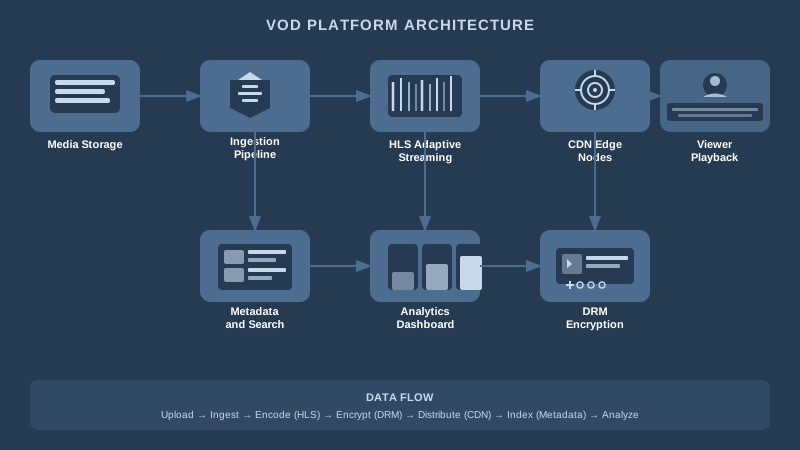
Before you write a single line of code, you need to understand the seven pillars that every production-grade VoD platform rests on. Missing any one of them will create bottlenecks that hurt both your viewers and your bottom line.
1. Media Storage and Asset Management
Your videos, thumbnails, subtitle files, and marketing assets all need a home. A raw cloud bucket (S3, GCS) works at the smallest scale, but as your library grows you need a proper media asset management system that lets you tag, search, version, and organize content programmatically. Publitio's API-first DAM gives you that structure without building a bespoke CMS from zero.
2. Video Ingestion and Processing Pipeline
When a video file is uploaded — whether it's a 4K master from a professional shoot or a 1080p export from a laptop — your platform must transcode it into multiple adaptive bitrates suitable for every device and connection speed. This is computationally expensive work. Publitio's GPU-accelerated video conversion slashes encoding times dramatically compared to CPU-only pipelines, which is critical when you're publishing dozens of titles a week.
3. Adaptive Bitrate Streaming (HLS)
HTTP Live Streaming (HLS) is the de-facto delivery protocol for VoD content in 2025. It breaks video into small segments and serves them at different quality levels based on the viewer's available bandwidth. A viewer on a 5G phone gets the 1080p segment; a viewer on a congested hotel Wi-Fi gets the 360p segment — seamlessly. Publitio's native HLS streaming handles segmentation, manifest generation, and multi-rendition packaging automatically.
4. Content Delivery Network (CDN)
Raw streaming from a single origin server creates latency for geographically distant viewers and single points of failure. A CDN caches your video segments at edge nodes worldwide, reducing buffering and improving start times. Publitio's integrated CDN delivery means your content is distributed globally without configuring a separate vendor relationship.
5. Digital Rights Management (DRM)
If your content has commercial value, you need encryption. DRM systems prevent unauthorized downloading, screen capture bypass, and redistribution. Publitio's digital rights management solution supports industry-standard encryption so you can protect premium content with confidence.
6. Metadata, Search, and Discovery
A library of 500 videos is only useful if viewers can find what they're looking for. You'll need a metadata schema (titles, descriptions, categories, tags, custom fields) and a search interface. This is also where your digital asset management layer pays dividends — structured metadata from day one prevents an organizational nightmare later.
7. Analytics and Business Intelligence
How many people started your video? How many finished it? Which device do most viewers use? Where do they drop off? These questions drive every content and monetization decision. Publitio's built-in analytics surface engagement metrics without requiring a separate third-party integration at launch.
How to Build a VoD Platform: Step-by-Step
With the architecture mapped out, let's translate it into a concrete build sequence. Following this order prevents the expensive rework that happens when teams build features before their infrastructure is stable.
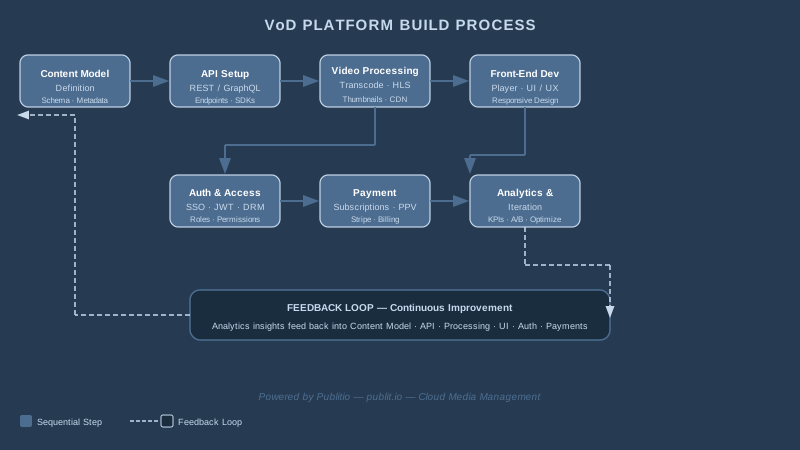
Step 1: Define Your Content Model and Monetization Strategy
Before touching any API, answer these questions:
- What is your content type? Courses, films, fitness classes, corporate training, live event replays?
- How will you monetize? SVOD (subscription), TVOD (pay-per-title), AVOD (ad-supported), or a hybrid?
- Who is your audience? Consumer, B2B, internal employees?
- What devices must you support? Web, iOS, Android, smart TV, Roku?
Your answers drive every downstream technical decision: which DRM is needed, what player you'll embed, whether you need offline download support, and how you'll structure your pricing tiers.
Step 2: Set Up Your Media Backend with Publitio
Sign up for a Publitio account and generate your API credentials. Publitio's video API gives you endpoints for uploading, managing, transforming, and streaming video without provisioning any server infrastructure. Read through the developer documentation to understand the upload workflow, webhook events, and transformation parameter syntax.
A typical upload call looks like this conceptually: your application receives a file from a content creator, POSTs it to the Publitio API with metadata fields attached, and receives back a media object with a unique identifier, a streaming URL, and processing status. From that point, Publitio handles transcoding, HLS packaging, and CDN propagation automatically.
Step 3: Configure Video Processing and Quality Ladders
For a professional VoD platform, you'll want at minimum a five-rung quality ladder: 240p, 360p, 480p, 720p, and 1080p. Premium platforms add 1440p and 4K. Publitio's video processing pipeline lets you define output profiles so every uploaded asset is automatically transcoded to your required renditions. Set this up once and it applies to every future upload.
Also configure:
- Thumbnail generation: Auto-generate poster frames at defined timestamps.
- Watermarking: Apply your logo or user-specific watermarks via Publitio's watermark feature to deter piracy and identify leaks.
- Audio normalization: Ensure consistent loudness levels across your library.
Step 4: Build Your Front-End Application
Your front end is what your audience actually experiences. Key screens include:
- Home / Browse: Featured content, categories, personalized recommendations.
- Content detail page: Trailer, description, cast/metadata, CTA to watch or purchase.
- Video player page: Embedded HLS player, quality selector, subtitles toggle, progress tracking.
- User dashboard: Watch history, saved content, subscription management.
- Admin panel: Upload interface, analytics view, pricing management.
For the video player, use an HLS-compatible player such as Video.js, Shaka Player, or hls.js. Point it at the HLS manifest URL that Publitio returns for each media asset. These players handle adaptive switching, buffering logic, and cross-browser compatibility out of the box.
Step 5: Implement Authentication and Access Control
Gate your premium content behind a proper auth layer. Signed URLs and token-based stream authentication ensure that only paying or authorized users can access your HLS manifests. Publitio supports URL signing so you can issue time-limited, user-specific links — if someone shares the URL, it expires before it can be redistributed effectively.
Combine this with your DRM layer for maximum protection: signed URLs prevent link sharing, while DRM prevents screen capture and client-side extraction of the media segments themselves.
Step 6: Integrate Payments and Subscription Management
Stripe and Paddle are the most developer-friendly payment processors for subscription and pay-per-view models. Wire your payment events to your user database: a successful payment unlocks content access; a failed renewal downgrades the account. Keep this logic server-side to prevent client-side manipulation.
Step 7: Set Up Analytics and Iteration Loops
Instrument your player to send engagement events: play, pause, seek, quality change, and completion. Feed these into your analytics layer. Publitio's built-in analytics give you a starting baseline; as you scale you can pipe additional data into a warehouse for deeper cohort analysis. Use this data to identify underperforming content, optimize your recommendation algorithm, and decide what to produce next.
Monetization Models for Your VoD Platform
Once the technical foundation is in place, how you make money becomes the central strategic question. Most successful platforms use a hybrid approach.
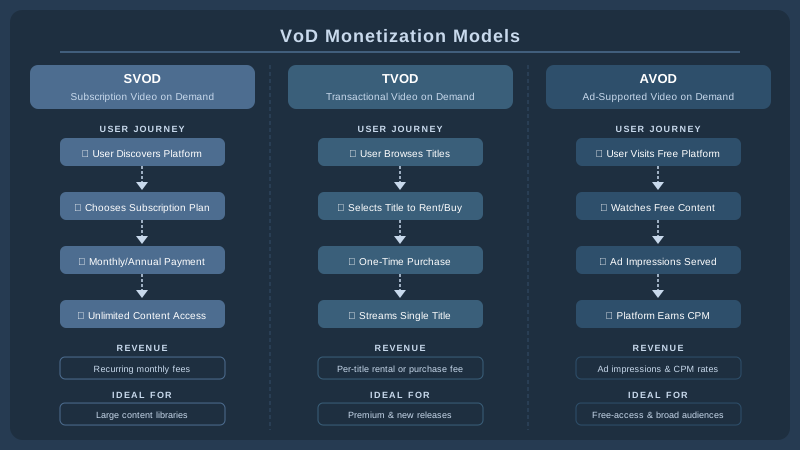
SVOD — Subscription Video on Demand
Users pay a recurring monthly or annual fee for unlimited access. Predictable revenue, high lifetime value, but requires a large enough content library to justify the subscription. Best for: entertainment platforms, fitness apps, e-learning portals.
TVOD — Transactional Video on Demand
Users pay per title — either to rent (time-limited access) or buy (permanent). Lower friction for new visitors who don't want to commit to a subscription. Best for: event replays, new film releases, niche educational courses.
AVOD — Ad-Supported Video on Demand
Free access for viewers, monetized through pre-roll, mid-roll, or display advertising. Requires significant viewer volume to generate meaningful revenue. Best for: news publishers, free-tier hybrid platforms.
Hybrid and Premium Tiers
Many platforms offer a free AVOD tier to grow audience, a mid-tier SVOD plan removing ads, and a premium tier adding downloads, 4K quality, or exclusive content. This funnel converts free users into paying subscribers over time.
Key Technical Challenges When You Build a VoD Platform
Even with a solid plan, you'll encounter these recurring challenges. Knowing them in advance helps you architect around them.
Storage Costs at Scale
A single hour of 4K video, transcoded to five quality levels, can consume 20–50 GB of storage. At 1,000 hours of content, that's potentially 50 TB. Design your storage strategy early: archive cold content, use tiered storage pricing, and delete intermediate processing files after transcoding completes.
Encoding Bottlenecks
CPU-based transcoding is slow and expensive. GPU acceleration reduces a 4K encoding job from 45 minutes to under 5 minutes at comparable quality. This matters at scale: if you're publishing 20 videos a day, CPU encoding creates a backlog that delays content availability. Publitio's GPU pipeline eliminates this bottleneck.
Global Latency for Live Replay
When a major event ends and thousands of users immediately request the replay, your CDN edge nodes absorb the burst. A direct-origin architecture would buckle under this load. Proper CDN configuration with pre-warming strategies is essential for event-driven traffic spikes.
Cross-Device Player Consistency
A video that plays perfectly in Chrome may stutter in Safari due to codec differences. Use a battle-tested player library, test on real devices (not just emulators), and configure your HLS manifests to include both H.264 and HEVC renditions where device support warrants it.
WordPress Integration
If your platform runs on WordPress — common for course creators and media publishers — offloading your media library is critical. Storing video and image assets on your WordPress server bloats your hosting costs and slows your site. Publitio's WordPress media offloading plugin automatically routes all media to Publitio's CDN, keeping your WordPress install lean while your video library scales without limit.
How Publitio Powers Your VoD Platform Build
Building every layer of a VoD platform from scratch — storage, transcoding, CDN, DRM, analytics — can take an engineering team 12–18 months and cost hundreds of thousands of dollars before you serve your first viewer. Publitio collapses that timeline by providing all of these layers as a unified, API-first cloud service.
Here's what that means in practice:
- Upload a video file via the API and receive a complete video-on-demand asset with HLS manifest URLs, thumbnail URLs, and processing status — all within minutes.
- Apply watermarks, crop thumbnails, and generate preview GIFs through URL transformation parameters — no image editing server required, thanks to Publitio's image management capabilities.
- Encrypt your content with DRM and issue signed streaming URLs through the same API that manages your entire media library.
- Monitor playback performance and engagement through built-in analytics without configuring a separate data pipeline.
- Scale from 10 videos to 10,000 videos without changing a line of infrastructure code — Publitio's cloud backend scales with you.
Review the pricing page to find the plan that matches your current library size and expected monthly bandwidth, then benchmark your actual costs as you grow.
VoD Platform Launch Checklist
Before you flip the switch to public, run through this checklist:
- ☑ All video assets transcoded to at least three quality tiers (360p, 720p, 1080p minimum)
- ☑ HLS manifests tested across Chrome, Safari, Firefox, and mobile browsers
- ☑ DRM and signed URL authentication verified — attempt to access a URL after expiry and confirm it fails
- ☑ Payment flow tested end-to-end in Stripe test mode with all monetization tiers
- ☑ Analytics events firing correctly for play, pause, and completion
- ☑ CDN cache headers configured correctly so content is cached at edge nodes
- ☑ Watermarks applied to premium content
- ☑ Mobile responsiveness tested on iOS and Android
- ☑ Load test completed simulating peak concurrent viewer count
- ☑ GDPR/CCPA compliance confirmed for analytics data collection
Ready to Build Your VoD Platform?
You now have a complete blueprint — from architecture and ingestion to monetization and launch. The difference between platforms that ship in weeks versus those that take years almost always comes down to infrastructure choices made on day one. Publitio gives you a battle-tested, globally distributed media backend through a single API, so your team can focus on building the product experience that makes your platform unique instead of reinventing the encoding pipeline.
Start building today. Create your free Publitio account at publit.io, explore the developer documentation, and have your first video streaming via HLS within the hour. Your VoD platform is closer than you think.