


CDN for Videos: How to Stream Faster and Cut Buffering for Good
If you have ever watched a progress bar freeze mid-stream or sat through an agonising rebuffering spinner, you already understand the core problem that a CDN for videos is designed to solve. Video is now the dominant format on the internet, accounting for the majority of downstream traffic worldwide — and audiences have zero patience for slow delivery. Whether you are running a learning platform, a media company, a SaaS product with video tutorials, or an e-commerce store with product demos, the speed and reliability of your video delivery directly affects watch time, conversion rates, and brand perception. In this guide we will break down exactly how video CDNs work, why they matter more than ever, and how to pick the right solution for your use case.
What Is a CDN for Videos and Why Is It Different from a Standard CDN?
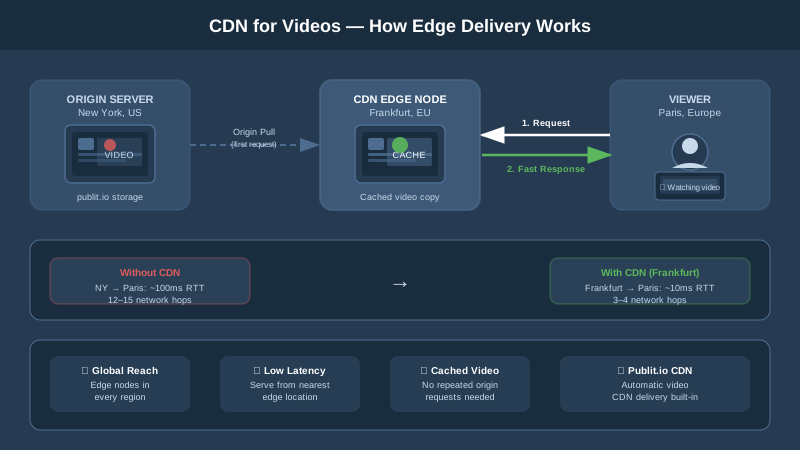
A Content Delivery Network (CDN) is a globally distributed network of servers — called Points of Presence (PoPs) — that cache and serve content from locations physically close to the end viewer. Instead of every request travelling all the way back to your origin server, a nearby PoP answers the request, dramatically reducing latency and network hops.
A video CDN, however, is more specialised than a generic CDN used for web assets like CSS or images. Videos demand:
- High sustained throughput — a single HD stream can consume 5–8 Mbps; a 4K stream, 25 Mbps or more.
- Adaptive bitrate (ABR) logic — the CDN must serve the right quality tier in real time based on viewer bandwidth.
- Large object caching — video segments can be hundreds of megabytes, requiring cache configurations far beyond typical web objects.
- Low time-to-first-byte (TTFB) — viewers abandon streams that take more than two or three seconds to start.
- Redundancy and failover — a live event cannot afford a single point of failure.
A purpose-built video CDN addresses all of these concerns in ways a generic CDN simply cannot match out of the box.
How Buffering Actually Happens — and How a CDN for Videos Stops It
Buffering is not random; it follows a predictable chain of events. Understanding that chain makes it easier to see exactly where a CDN intervenes.
The Buffering Chain
- Request initiation — the player requests the first video segment from your origin server.
- Network propagation delay — the request travels across multiple network hops, each adding milliseconds.
- Origin processing — your server reads the file from storage, passes it through any processing logic, and begins transmitting.
- Bandwidth constraint — if the connection between origin and viewer cannot sustain the bitrate of the chosen quality tier, the player's buffer drains faster than it fills.
- Rebuffering event — the player pauses playback, displaying that dreaded spinner, while it refills the buffer.
Where CDN Delivery Breaks the Chain
A video CDN interrupts this chain at steps 2, 3, and 4 simultaneously. The edge node is geographically close, so propagation delay collapses. The cached segment is served from fast edge storage without touching your origin. And because CDN PoPs have massive, redundant bandwidth, the sustained throughput needed for high-bitrate video is readily available.
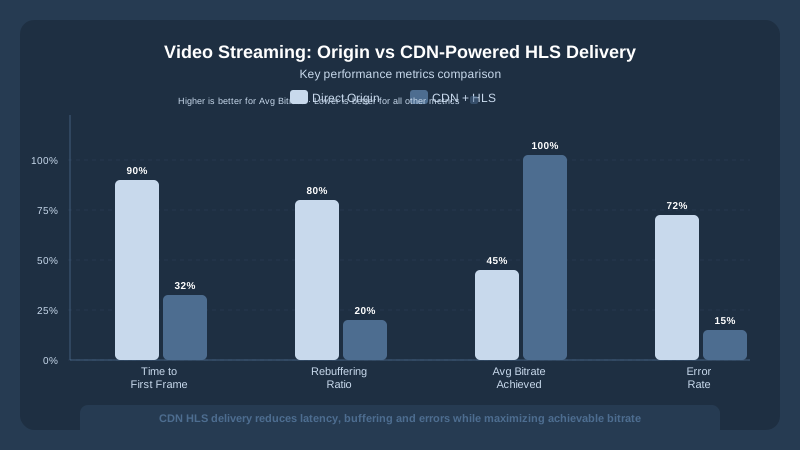
When CDN delivery is paired with HLS streaming, the benefits compound further. HLS (HTTP Live Streaming) splits video into small segments — typically two to six seconds each — and creates a manifest file listing every available quality level. The player dynamically switches quality tiers based on real-time bandwidth measurements. Because each tiny segment is an independent HTTP object, CDNs cache them extremely efficiently. The result is near-instant start times, smooth quality switching, and virtually zero rebuffering even on fluctuating connections.
Key Metrics a CDN for Videos Improves
When evaluating any video CDN solution, focus on these quantifiable metrics rather than marketing claims:
Time to First Frame (TTFF)
The number of milliseconds from pressing play to seeing the first frame. Industry benchmarks put acceptable TTFF at under two seconds; premium experiences aim for under one second. CDN edge caching slashes origin TTFB and directly improves TTFF.
Rebuffering Ratio
The percentage of total watch time spent buffering. A ratio above 0.5% measurably increases viewer abandonment. Studies from streaming analytics firms consistently show rebuffering ratio as the single strongest predictor of viewer churn.
Bitrate Achieved
The average quality tier actually delivered. If your CDN cannot sustain bandwidth to serve 1080p when a viewer's connection supports it, you are degrading their experience unnecessarily. A well-distributed CDN maximises achieved bitrate by serving from the closest, least-congested PoP.
Error Rate
The percentage of segment requests that return 4xx or 5xx errors. CDN redundancy and automatic failover keep error rates low even during traffic spikes or origin outages.
CDN for Videos: Use Cases That Demand Edge Delivery
Not every use case feels the pain of poor video delivery equally. These are the scenarios where investing in a proper video CDN pays back fastest.
Video-on-Demand Platforms
A video-on-demand library can have thousands of titles, each available to viewers across multiple continents simultaneously. Without CDN, every play triggers an origin request. With CDN caching, popular titles are served entirely from edge nodes, and even long-tail content loads quickly because edge PoPs pre-warm cache from origin asynchronously.
E-Learning and Training Platforms
Corporate learners are often distributed globally, and slow video is a direct barrier to course completion. LMS platforms that offload video to a CDN-backed host consistently report higher completion rates than those streaming from a single region.
Media and News Publishers
Breaking news video can see request volumes spike from zero to millions within minutes. Origin infrastructure simply cannot scale that fast. CDN edge nodes absorb traffic spikes without any advance provisioning, making them essential for any publisher whose traffic is unpredictable.
Product and Marketing Videos
Homepage hero videos and product demo embeds load in the critical path of a buyer's first impression. A rebuffering event on a landing page directly depresses conversion. CDN delivery ensures even first-time visitors in distant regions see a clean, instant playback experience.
SaaS Applications with In-App Video
Developers embedding video tutorials, onboarding walkthroughs, or user-generated content inside applications need a reliable video API that handles CDN delivery transparently, so they can focus on their core product rather than infrastructure.
Combining CDN Delivery with Video Processing and DRM
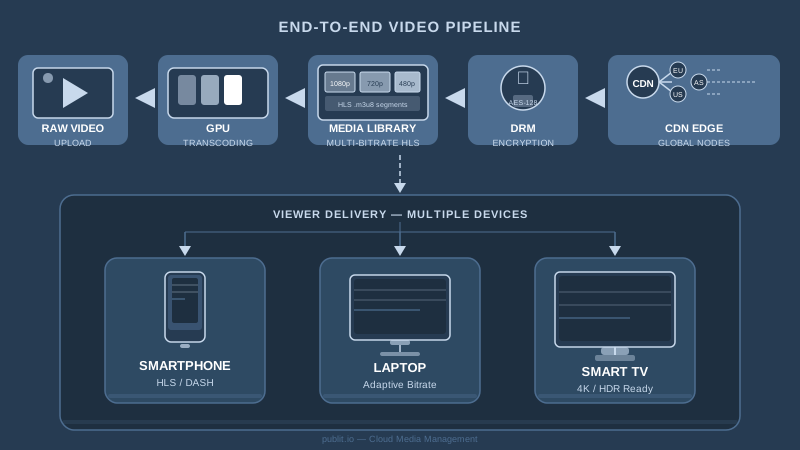
A CDN is most powerful when it sits at the end of a complete video pipeline rather than as a standalone bolt-on. Here is how a modern video workflow integrates the pieces:
Ingest and Transcode
Raw video is uploaded in its source format — anything from a smartphone recording to a broadcast-quality master. Video processing converts it into multiple quality tiers (e.g., 360p, 720p, 1080p, 4K) and packages them into HLS or DASH manifests. GPU-accelerated video conversion makes this step dramatically faster than CPU-only transcoding, which matters when you are uploading hundreds of files per day.
Secure Storage
Processed segments and manifests are stored in a managed media library. This is the origin from which the CDN pulls when it needs to populate edge caches. Organising assets in a structured video management system makes it easy to update, replace, or retire content without breaking CDN cache paths.
DRM and Encryption
For premium content, digital rights management ensures that even if a viewer obtains a raw segment URL, they cannot play it without a valid licence. DRM is applied at the packaging stage and is fully compatible with CDN delivery — the edge nodes serve the encrypted segments, and the player's DRM client handles licence acquisition directly, without adding a round-trip through your origin for every segment.
CDN Delivery and Analytics
The CDN serves segments globally. Concurrently, video analytics capture playback events — start, pause, quality switches, errors, completion — giving you the data you need to optimise both your content strategy and your CDN configuration over time.
What to Look for When Choosing a Video CDN Solution
The market offers many CDN options, from DIY configurations on commodity providers to fully managed platforms. Here is a practical checklist:
Global PoP Coverage
Verify that the CDN has PoPs in the regions where your viewers actually are, not just where the provider's marketing page highlights. A CDN with strong North American coverage but sparse Asian PoPs is a poor choice if 40% of your audience is in Asia-Pacific.
Native HLS and DASH Support
The CDN should understand streaming manifests natively — not just treat them as generic files. This enables proper cache-control header handling for live manifests (which must not be cached too long) versus segment files (which can be cached indefinitely).
Adaptive Bitrate Integration
Confirm that the end-to-end platform — transcoder, packager, and CDN — supports proper ABR ladder creation and delivery. A CDN that serves files without an ABR strategy will not help viewers on variable connections.
Security Features
Look for signed URLs or token authentication, hotlink protection, geo-blocking, and DRM compatibility. Serving video through a CDN without access controls means anyone who discovers your manifest URL can consume your bandwidth at your cost.
Transparent Pricing
CDN costs scale with egress bandwidth. Make sure you understand the per-GB pricing, whether there are minimums or overages, and whether the pricing differs by region. Check the pricing page of any platform you evaluate to understand the total cost of ownership before you commit.
Developer-Friendly APIs and Documentation
If you are building a product or automating workflows, the CDN-backed platform needs solid API coverage. Review the developer documentation to confirm the API supports your use cases — upload, transcoding, playback URL generation, purging cache, managing metadata — before you invest engineering time in integration.
How Publitio Delivers a Complete CDN for Videos Solution
Publitio is built around the idea that every team — from a solo developer to an enterprise media operation — deserves professional-grade video infrastructure without the complexity of assembling and maintaining it themselves. The platform combines every layer of the pipeline described above into a single, API-first service.
Video files uploaded to Publitio are automatically transcoded into multiple quality tiers using GPU-accelerated conversion, packaged as HLS streams, and delivered through an integrated CDN with global PoP coverage. You do not need to configure a separate CDN, manage cache invalidation rules, or negotiate bandwidth contracts. CDN delivery is baked in from day one.
For teams already using WordPress, the WordPress media offloading plugin moves all media — including video — off your web host and onto Publitio's CDN-backed infrastructure, instantly improving both your site's performance and your server's resource usage.
Beyond raw delivery, Publitio gives you the management layer you need to stay organised at scale. A structured digital asset management system keeps every video, image, audio file, and document in one searchable library with role-based access and full metadata control. When your library grows to thousands of assets, that organisational foundation becomes as important as the CDN delivery itself.
Security-conscious publishers can protect premium content with DRM and signed playback URLs, while detailed analytics surface exactly how viewers are engaging — which titles are completing, where drop-offs occur, which quality tiers are most commonly served, and where in the world your audience is concentrated.
Quick-Start Tips to Maximise Your Video CDN Performance
Whether you are just getting started or optimising an existing setup, these practical steps will help you get the most from CDN video delivery:
- Transcode before you store. Never serve raw camera files through a CDN. Transcode to web-optimised H.264 or H.265 first, ideally into an ABR ladder. Raw files waste bandwidth and produce poor player compatibility.
- Set correct cache-control headers. Segment files should have long TTLs (days or weeks); manifest files for on-demand content should have moderate TTLs (minutes to hours). Incorrect headers either waste origin bandwidth or prevent viewers from seeing updated content.
- Use token authentication on all playback URLs. Unprotected CDN URLs are an open invitation for bandwidth theft. Token auth or signed URLs ensure only your authorised users trigger CDN delivery.
- Monitor rebuffering ratio, not just uptime. A server can be "up" while delivering a terrible streaming experience. Track rebuffering ratio and TTFF in your analytics dashboard and set alert thresholds before viewers start complaining.
- Purge cache after content updates. If you replace a video file or update a manifest, proactively purge the relevant CDN cache paths. Stale cache is a common source of confusing playback bugs.
- Match your ABR ladder to your audience. If analytics show most viewers are on mobile with median bandwidth of 5 Mbps, a 4K tier at the top of your ladder wastes transcoding time. Tune your quality ladder to match real viewer conditions.
The Bottom Line on CDN for Videos
Buffering is not a technical inconvenience — it is a business problem. Every rebuffering event erodes trust, reduces watch time, and increases the likelihood that a viewer abandons your platform for a competitor. A purpose-built CDN for videos, integrated with professional transcoding, HLS packaging, DRM, and analytics, is the infrastructure foundation that separates streaming experiences viewers love from ones they abandon.
The good news is that this level of infrastructure is no longer reserved for large media companies with dedicated engineering teams. Platforms like Publitio put the full stack — transcoding, HLS delivery, CDN, DRM, and a developer API — within reach of any team, at any stage of growth.
Ready to eliminate buffering and deliver video your audience will actually watch all the way through? Sign up at publit.io today and get your first videos streaming through a global CDN in minutes. No infrastructure to configure, no bandwidth contracts to negotiate — just fast, reliable video delivery from day one.


