


Encrypted Video Hosting: How to Secure and Stream Your Videos with Confidence
Whether you're distributing premium online courses, confidential corporate training videos, or exclusive entertainment content, encrypted video hosting is no longer a luxury — it's a necessity. Without robust encryption and access controls, your video content is vulnerable to unauthorized downloads, screen capture piracy, and hotlink theft that can cost you revenue and damage your brand. In this guide, we'll break down exactly how video encryption works, what to look for in a secure video hosting platform, and how Publitio gives you enterprise-grade protection without the enterprise-grade complexity.
Why Video Security Matters More Than Ever
The global online video market is worth hundreds of billions of dollars, and piracy threatens a significant slice of it. Content creators, e-learning platforms, media companies, and SaaS developers face a shared challenge: how do you make a video accessible to legitimate viewers while making it practically impossible for bad actors to steal or redistribute?
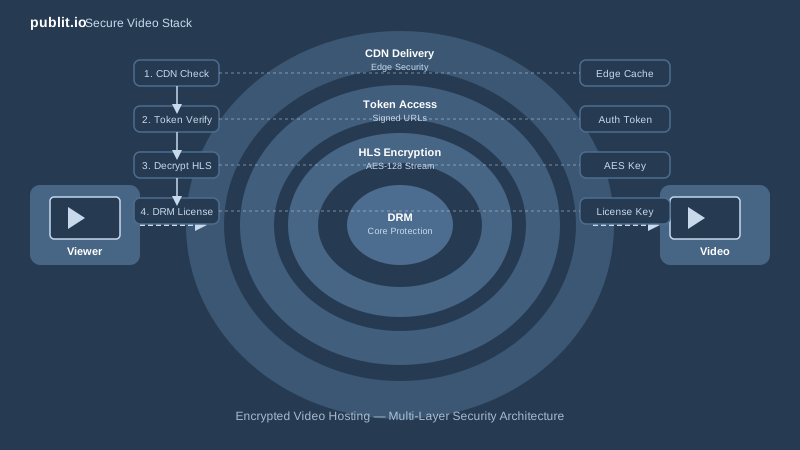
The answer lies in a layered security approach that combines encryption at the protocol level, token-based access control, digital rights management (DRM), and smart delivery infrastructure. Getting any one of those layers wrong creates a gap that pirates are quick to exploit.
Beyond piracy, there are compliance considerations. Industries like healthcare, finance, and legal services often require that video content be encrypted in transit and at rest to satisfy regulations such as HIPAA or GDPR. A hosting solution that treats security as an afterthought simply won't meet those standards.
How Encrypted Video Hosting Actually Works
Understanding the mechanics of video encryption helps you make smarter decisions when evaluating hosting platforms. There are several technologies at play, and the best solutions combine more than one.
HLS Streaming with AES-128 Encryption
HTTP Live Streaming (HLS) is the dominant adaptive streaming protocol used on the web today. When encryption is enabled, each video segment — typically a few seconds long — is individually encrypted using AES-128 encryption. The video player must fetch a decryption key from a secure key server before it can render each segment. This means that even if someone intercepts the raw stream data, they cannot play it back without the corresponding key.
Publitio's HLS streaming implementation supports segment-level AES-128 encryption out of the box. You don't need to manage key servers or encoding pipelines yourself — the platform handles all of that automatically when you upload or transcode a video.
Digital Rights Management (DRM)
DRM goes a step further than basic encryption by binding playback rights to specific devices, users, or time windows. The three major DRM systems are Google Widevine (used on Chrome and Android), Apple FairPlay (used on Safari and iOS), and Microsoft PlayReady (used on Edge and Windows). A production-grade digital rights management solution typically implements all three so that protected content plays correctly across every major browser and device.
DRM is particularly important for premium content businesses — streaming services, e-learning platforms with paid subscriptions, and media distributors who have licensed content with strict redistribution agreements. With DRM, you can enforce rules like "this video can only play on two devices simultaneously" or "this rental expires after 48 hours."
Signed URLs and Token-Based Access
Even with HLS encryption and DRM in place, you need to control who gets access to the video in the first place. Signed URLs are time-limited, cryptographically signed links that grant temporary access to a specific resource. Once the token expires, the URL stops working — so a link shared outside your platform can't be used indefinitely by unauthorized viewers.
Token-based access pairs naturally with your authentication layer: when a user logs in and purchases access to a video, your backend generates a signed URL for that session. This is a core pattern for any serious video-on-demand platform.
Geo-Restrictions and Domain Locking
Supplementing encryption with geo-restrictions lets you honor regional licensing agreements — blocking playback in countries where you don't hold distribution rights. Domain locking (or hotlink protection) ensures your video player embed code only works when loaded from your own domain, preventing competitors or pirates from embedding your player on their sites and consuming your bandwidth while serving your content.
What to Look for in an Encrypted Video Hosting Platform
Not all video hosting providers offer the same depth of security features. When evaluating platforms, here's the checklist you should run through:
End-to-End Encryption Support
Ensure the platform encrypts video both in transit (using HTTPS/TLS) and at rest (server-side encryption on stored files). Some budget providers only cover transit encryption, leaving stored originals exposed if there's ever a server compromise.
Native HLS Encryption and DRM Integration
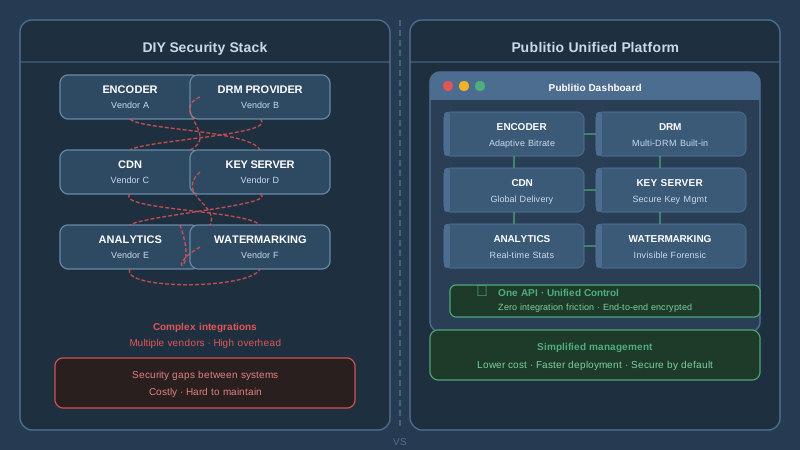
Look for a platform that handles video processing and encryption as a unified workflow. Having to send your files to a third-party encryption service before uploading to a hosting platform introduces complexity and potential security gaps.
CDN Delivery
A global content delivery network isn't just about speed — it's also a security asset. A good CDN absorbs DDoS attacks, enforces access policies at the edge, and ensures that your encrypted video segments are served from nodes close to the viewer, reducing latency without sacrificing security. Publitio's built-in CDN delivery is included with every plan, so you don't have to stitch together a separate CDN contract.
Video Watermarking
Visible and invisible watermarking add another deterrent against piracy. Visible watermarks stamp your brand on the video frame. Forensic (invisible) watermarks embed a unique identifier per viewer — so if a pirated copy surfaces online, you can trace it back to the original account. Publitio supports video and image watermarks that can be applied automatically during upload processing.
Analytics and Monitoring
Security isn't only about prevention — it's also about detection. Detailed video analytics let you spot unusual patterns: a single account streaming from dozens of IP addresses simultaneously, or a video getting played thousands of times from an unexpected geography. These signals can indicate credential sharing or active piracy campaigns.
API-First Architecture
If you're building a custom platform, you need programmatic control over every security setting — not just a dashboard toggle. An API-first platform lets your development team automate token generation, set per-video DRM policies, trigger watermark application, and integrate everything into your own user authentication flow. Publitio's video API provides RESTful endpoints for all of these operations, and the full API documentation is publicly available.
Encrypted Video Hosting for Different Use Cases
The right security configuration depends on what you're building. Here's how different industries typically approach the problem:
E-Learning and Online Course Platforms
Course creators need to prevent students from downloading and redistributing paid content. The ideal setup combines HLS encryption with signed URLs tied to individual user sessions, plus visible watermarks showing the enrolled student's email or name. If you're running a WordPress-based LMS, Publitio's WordPress media offloading plugin makes it straightforward to offload your video files to a secure CDN while keeping your site fast and your content protected.
Corporate Training and Internal Communications
Organizations distributing internal training videos need confidentiality — employees in one region shouldn't be able to share sensitive materials outside the company. Signed URLs with short expiry windows and geo-restrictions handle this well. For enterprises managing large libraries of training assets, a proper digital asset management system ensures that video files, documents, and images all live in a single governed repository with granular access controls.
OTT and Subscription Streaming Services
For consumer streaming services with licensed content, full multi-DRM support (Widevine + FairPlay + PlayReady) is non-negotiable. Distributors and studios require it as a contractual condition of licensing. Combined with video management tools that let you organize and publish large catalogs efficiently, Publitio gives OTT builders a complete infrastructure layer without needing to assemble disparate vendor services.
Media and Entertainment
Broadcast and media companies often deal with time-sensitive content — live event replays, early-access premieres, or regionally windowed releases. For these scenarios, the ability to set per-asset expiry dates, enforce regional blocks, and switch DRM keys on the fly is critical. GPU-accelerated transcoding (see GPU video conversion) also matters here because fast turnaround from raw footage to encrypted, multi-bitrate delivery is a competitive advantage in time-sensitive publishing.
Common Mistakes That Undermine Video Security
Even platforms with good intentions often leave doors open through implementation mistakes. Here are the most frequent security gaps we see:
- Serving unencrypted MP4 originals alongside HLS streams. If your HLS stream is encrypted but the original MP4 upload is publicly accessible via a predictable URL, all that encryption effort is irrelevant. Always restrict direct access to source files.
- Using static, non-expiring signed URLs. A signed URL that never expires is barely better than a public URL once it's shared. Always set sensible expiry windows — typically matching the length of a session or a few hours at most.
- Neglecting CORS configuration. Cross-Origin Resource Sharing misconfiguration can allow scripts on unauthorized domains to fetch your video segments. Your CDN and key server should have strict CORS policies aligned with your domain whitelist.
- Skipping watermarks because they "look ugly." Visible watermarks are one of the most effective piracy deterrents precisely because they degrade the value of stolen content. Even a subtle, semi-transparent watermark makes redistribution far less appealing.
- Not monitoring access logs. Encryption prevents most casual theft, but compromised credentials or key leaks do happen. Regular review of analytics and access logs is your early-warning system.
How Publitio Makes Encrypted Video Hosting Simple
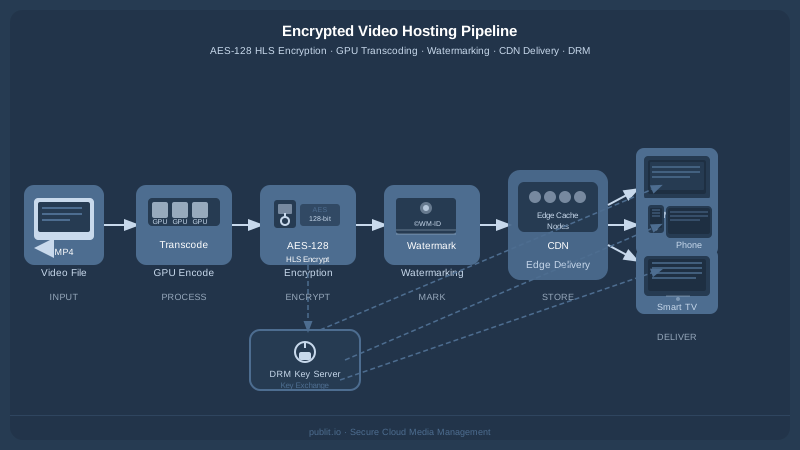
Publitio was built API-first, which means every security feature is available both through the dashboard and programmatically via the API. Here's what the workflow looks like in practice:
- Upload: Send your video file via the API or the web dashboard. Publitio accepts all major formats and begins processing immediately.
- Transcode: GPU-accelerated encoding converts your source file into multiple quality levels (adaptive bitrate), optimized for HLS delivery.
- Encrypt: HLS segments are encrypted with AES-128. DRM policies are applied based on your account configuration — you choose which DRM systems to activate per video or per folder.
- Watermark: Apply a text or image watermark automatically during processing — no need for a separate post-production step.
- Deliver: The encrypted stream is distributed across Publitio's CDN edge network. Your player fetches a signed URL from your backend and begins adaptive streaming.
- Monitor: Real-time analytics show you playback counts, geographic distribution, device breakdown, and bandwidth consumption.
The entire stack — transcoding, encryption, DRM key management, CDN delivery, watermarking, and analytics — is managed under one roof. There's no juggling multiple vendor dashboards or reconciling separate billing accounts.
Getting Started with Encrypted Video Hosting on Publitio
If you're ready to move from insecure video hosting to a properly encrypted, DRM-protected delivery pipeline, the good news is that you don't need to be a security engineer to get started. Publitio's onboarding is designed so that developers can integrate the API in hours, and non-technical users can configure security settings through a clean dashboard without writing a single line of code.
You can explore available plans — including a free tier to test all core features — on the Publitio pricing page. If you want to go deeper before committing, the developer documentation covers every API endpoint, webhook, and SDK in detail, with code examples in multiple languages.
For teams managing large mixed-media libraries alongside their videos, Publitio's media asset management capabilities handle images, audio, and documents alongside video under the same access control and encryption umbrella — so you're not solving the same security problem twice for different file types.
Conclusion: Confidence Comes from Layers
There's no single switch that makes your video content perfectly secure. Genuine confidence in your video security comes from stacking complementary protections: HLS encryption at the segment level, DRM for device-level rights enforcement, signed URLs for session-based access, watermarks as a piracy deterrent, CDN delivery with edge-enforced policies, and analytics for ongoing detection. The platforms that deliver all of these capabilities in an integrated, developer-friendly package are the ones worth building on.
Publitio is built precisely for this: secure, scalable, encrypted video hosting that works the way developers expect and protects content the way rights holders require.
Ready to host and stream your videos with confidence? Sign up for a free Publitio account at publit.io and start uploading encrypted, DRM-protected video in minutes. No credit card required — just powerful, secure video infrastructure ready to scale with your business.


