


Free Video API: The Best Options in 2025 (Including One That Scales)
Finding a reliable free video API in 2025 is harder than it looks. Most options either cap you at a frustratingly low bandwidth limit, lock advanced features behind expensive enterprise tiers, or quietly discontinue their free plan the moment you've built your entire stack around it. Whether you're a solo developer prototyping a video platform, a startup building out your MVP, or a growing product team evaluating infrastructure, you need something that actually works — and ideally, something that can grow with you. In this guide, we break down the best free video API options available right now, compare what they truly offer for free, and show you why Publitio stands out as the one platform that gives you real functionality from day one while scaling gracefully as your needs expand.
What to Look For in a Free Video API
Before diving into specific platforms, it's worth establishing what "free" actually means in the context of video APIs — because the definition varies wildly. Some platforms offer a perpetually free tier with genuine utility. Others offer a time-limited free trial dressed up as a free plan. And some give you API access for free but charge heavily the moment you touch CDN delivery, transcoding, or storage.
Here are the key capabilities you should evaluate:
- Storage limits: How many gigabytes can you store before paying?
- Bandwidth and CDN delivery: Is global delivery included, or metered separately?
- Video transcoding: Can you convert and process uploads automatically?
- Streaming protocols: Does the API support HLS adaptive streaming, not just direct file serving?
- API completeness: Can you upload, manage, retrieve, and deliver through the API alone?
- Player and embed options: Do you get an embeddable player or must you build your own?
- DRM and security: Are access controls and encryption available, even on free tiers?
- Scalability path: When you outgrow the free tier, can you upgrade without migrating your entire infrastructure?
With those criteria in mind, let's look at the major players.
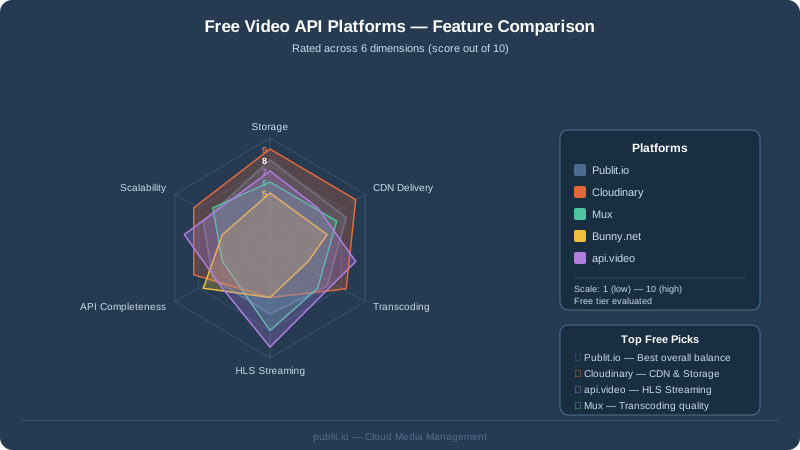
The Best Free Video API Options in 2025
1. Publitio — The Free Video API That Actually Scales
Publitio is a cloud-based media management platform built API-first, which means every feature you see in the dashboard is also available through clean, well-documented REST API endpoints. The free plan is genuinely useful: you get storage, video hosting, image management, and CDN delivery without needing a credit card to start. More importantly, the architecture you build on the free tier is identical to what enterprise customers use — so there's no painful migration when you're ready to scale.
What makes Publitio particularly compelling as a free video API for developers is the breadth of functionality included from the start:
- Video upload and storage via REST API with support for direct uploads and URL-based ingestion
- Automatic transcoding with video processing pipelines that convert your uploads to web-optimized formats
- HLS adaptive streaming — you can explore HLS streaming capabilities that intelligently adjust quality to the viewer's connection speed
- Global CDN delivery so your videos load fast for viewers anywhere — see the CDN feature details for specifics
- Image and file management through the same unified API — useful for managing thumbnails, posters, and supplementary assets alongside your videos
- Video-on-demand delivery via a VoD infrastructure that handles playback reliably at scale
- Watermarking, basic access controls, and embedding options out of the box
- Analytics so you can track plays, bandwidth, and engagement from day one
The Publitio free video API page walks through exactly what's included in each tier. The developer documentation at publit.io/docs is thorough, with code examples in multiple languages and clear endpoint references. Pricing is transparent and modular — you can see the full breakdown on the pricing page — so you always know what you're paying for and when.
For teams managing large libraries, Publitio also offers a full video management solution that adds organizational tools, metadata management, bulk operations, and role-based access on top of the core API.
2. Mux — Developer-Focused but Costs Add Up Fast
Mux is a well-regarded video infrastructure platform that has earned genuine respect in the developer community. Its API is clean, its documentation is excellent, and its player is polished. Mux offers a development environment where you can experiment for free, and the video quality through their pipeline is genuinely impressive.
The catch? Mux charges per minute of video stored and per minute watched. There's no true perpetual free tier — the free access is scoped to a development environment with watermarked video. The moment you want production-ready, unwatermarked output that you can ship to real users, the meter starts running. For high-volume applications, Mux costs can escalate quickly, especially if your content library is large or your audience grows unexpectedly.
For developers who prioritize developer experience above all else and have budget confidence, Mux is excellent. For those who need a genuine free tier that produces production-quality output, it's more limited than it first appears.
3. Cloudinary — Great for Images, Functional for Video
Cloudinary is primarily known as an image management and transformation API, and it's genuinely one of the best in that category. Video support was added later and has improved significantly, but it remains a secondary capability rather than a core focus. The free plan gives you a meaningful amount of storage and transformations, making it viable for lighter video use cases.
Where Cloudinary falls short as a video-first API is in streaming sophistication. HLS adaptive streaming, proper VoD infrastructure, and video-specific features like chapters, thumbnails, and subtitle tracks are either limited or require more expensive plans. If your primary use case is image management with occasional video, Cloudinary works well. If video is central to your product, it can feel like a workaround rather than a purpose-built solution.
4. api.video — Clean API, Limited Free Tier
api.video is a video-native platform with a genuinely elegant API design. The developer experience is strong, with straightforward endpoints, good SDKs across multiple languages, and solid documentation. Their focus is squarely on video, which means features like progressive upload, player customization, and analytics are well thought out.
The free tier allows a limited number of encoding minutes per month and a cap on storage and delivery. For prototyping and early development, this is workable. For production applications with any meaningful video volume, you'll hit the limits quickly. The pricing structure also lacks the granularity that some teams need — you tend to jump between tier levels rather than paying for exactly what you use.
5. Vimeo API — Familiar Brand, Developer Limitations
Vimeo has a public API that lets developers embed and interact with videos hosted on Vimeo accounts. For a certain class of use case — particularly content creators who already host on Vimeo and want to integrate playback into a custom site — the Vimeo API is perfectly functional. The embeddable player is polished and widely trusted.
However, Vimeo's API is better described as a platform integration API than a true video infrastructure API. You can't build a full custom video pipeline on top of it. Upload limits, privacy controls, and programmatic management capabilities are all tied to Vimeo's consumer-oriented product tiers rather than developer needs. It's not the right choice if you want to build a custom video product.
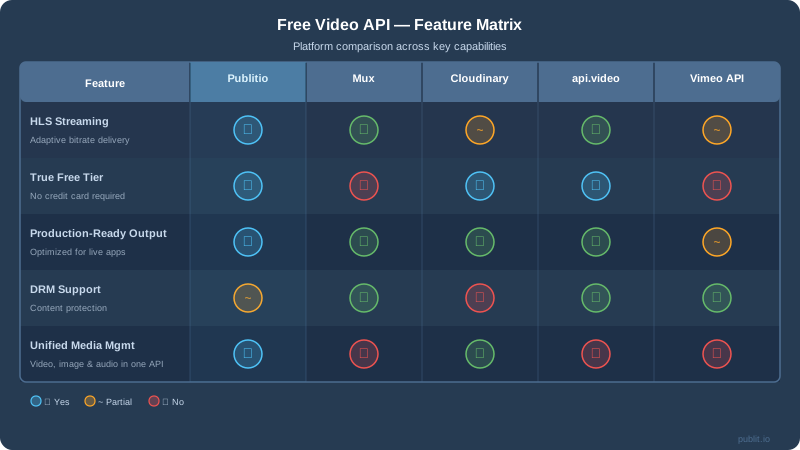
Why Most Free Video APIs Fall Short in Production
The pattern across most free video API offerings is predictable: the free tier is designed to get you building, not to support real production workloads. This isn't cynical — it's a reasonable business model — but it means developers often discover the limitations at the worst possible moment, when traffic spikes or a demo goes live.
The most common failure points are:
Bandwidth Throttling at Scale
Video is bandwidth-intensive by nature. A single HD video viewed by a few hundred concurrent users can generate significant delivery costs. Free tiers that don't include CDN delivery — or that serve video from a single origin — will buckle under this load. When evaluating any free video API, simulate what happens when your video content goes viral or gets embedded somewhere with high traffic. Can the infrastructure handle it? Does it degrade gracefully or fail entirely?
Transcoding Limits That Stifle Flexibility
Most video platforms receive uploads in a wide variety of formats: MOV files from iPhones, MKV files from screen recorders, MP4 files in dozens of codec configurations. A robust video API should transcode these to standardized web-friendly formats automatically. Free tiers often cap the number of transcoding minutes per month or limit output resolutions, which forces you to pre-process video before upload — adding complexity to your pipeline.
Missing Security Features
For most consumer video applications, basic security is acceptable. But as soon as you're handling premium content, corporate training materials, medical media, or any proprietary video, you need proper access controls. Token-based URL signing, domain restrictions, and DRM encryption are typically enterprise features. Publitio offers digital rights management capabilities that protect content at the delivery layer, which is rare to find in platforms that also offer a genuine free tier for getting started.
No Path Forward Without Migration
Perhaps the most damaging limitation isn't about features at all — it's about architecture. Some free video API platforms use fundamentally different infrastructure between their free and paid tiers, meaning that upgrading requires re-uploading assets, changing API endpoints, or rebuilding integrations. This hidden migration cost is one of the strongest arguments for choosing a platform like Publitio, where the free and paid tiers are built on the same underlying infrastructure.
How Publitio's Free Video API Compares in Practice
Let's be concrete about what you can actually build using Publitio's free tier before spending a single dollar.
A Portfolio or Showcase Site
Upload your video content via the API, get back HLS stream URLs, embed them using Publitio's player or your own, and serve them globally via CDN. Image thumbnails and poster frames are managed through the same API. Everything is organized, accessible, and documented.
An MVP Video Platform
Publitio's API-first design means you can build authenticated upload flows, manage video metadata, control playback permissions, and generate signed URLs for private content — all within the free tier. For an MVP that needs to impress early users or investors, this is a surprisingly complete foundation.
A WordPress Site With Offloaded Media
If your video lives inside a WordPress site, Publitio's WordPress media offloading plugin moves your media library to Publitio's infrastructure, reducing server load and improving delivery speed — without you touching a single API endpoint manually.
A Multi-Format Media Library
Beyond video, Publitio handles images, audio, and documents through the same platform. If you're building a content-heavy application that needs a unified digital asset management layer, Publitio removes the need to integrate multiple specialized APIs. The media asset management capabilities let you tag, search, organize, and retrieve any file type programmatically.
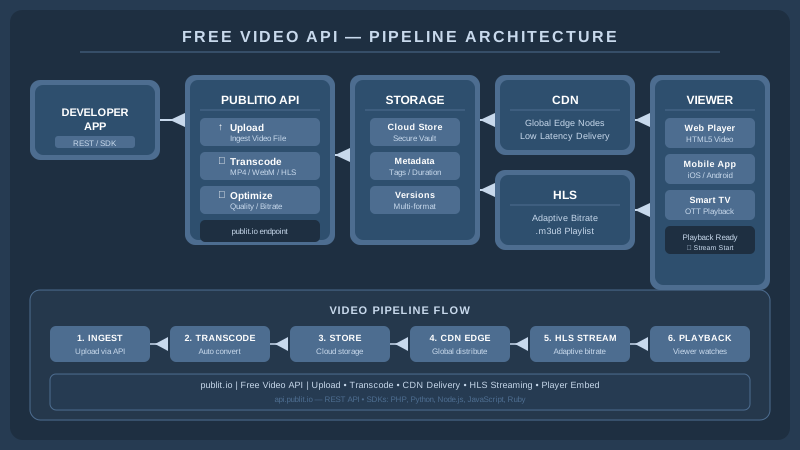
Making the Right Choice for Your Use Case
Here's a simple decision framework based on what you're actually building:
If You're Prototyping or Building an MVP
Start with Publitio. The free tier gives you enough real infrastructure — storage, transcoding, CDN, HLS streaming — to validate your product with actual users. You won't hit artificial walls designed to push you to a paid tier before you've proven your concept.
If You Need Enterprise Video Management
Look at Publitio's paid tiers, which add GPU-accelerated transcoding via GPU video conversion, advanced DRM, higher storage allocations, and priority support. The transition from free to paid is seamless because the architecture is identical.
If Image Management Is Your Primary Need
Cloudinary is a strong option for image-first use cases. But if you anticipate video becoming important over time, starting on Publitio means you won't need to switch platforms later.
If Developer Experience Is Non-Negotiable
Mux and api.video both have genuinely excellent APIs. But evaluate them against Publitio's documentation at publit.io/docs before assuming they're ahead — Publitio's API design is clean, consistent, and well-documented with real-world examples.
Key Takeaways
The search for the ideal free video API in 2025 comes down to a simple question: do you want a free plan that's a demonstration environment, or one that's a genuine starting point for a production system? Most platforms offer the former. Publitio offers the latter.
You get real HLS streaming, real CDN delivery, real transcoding, and a real API — all without a credit card. When your project grows, you grow with the same platform rather than rebuilding from scratch. That's the fundamental difference between a free tier designed to convert you into a paying customer through frustration, and one designed to earn your loyalty through genuine value.
Whether you're evaluating options for a new project, migrating away from a platform that's raised its prices, or simply looking for a developer-friendly media backbone that won't surprise you with hidden costs, Publitio belongs at the top of your shortlist.
Ready to start building? Sign up for free at publit.io and have your first video live via API in minutes — no credit card required. Explore the full feature set, test the streaming quality, and see exactly why thousands of developers choose Publitio as their video infrastructure layer. When you're ready to scale, everything you've built stays exactly where it is.


