
Free Video Hosting API: Best Options and How Publitio Compares
Finding a reliable free video hosting API is one of the first challenges developers and product teams face when building video-powered applications. Whether you're launching a streaming platform, embedding video into a SaaS product, or managing a library of media assets, the API you choose will shape your performance, scalability, and long-term costs. In this guide, we compare the most popular free video hosting API options available today and show you exactly how Publitio stacks up — so you can make an informed decision before writing a single line of code.
Why Your Choice of Video Hosting API Matters
A video hosting API is far more than a place to upload and serve files. It underpins your entire media delivery pipeline — controlling encoding quality, playback performance, CDN distribution, access control, and the developer experience for everyone building on top of it. Choosing poorly means hitting rate limits, paying surprise overage fees, or inheriting a platform that can't scale when your user base grows.
When evaluating any free video hosting API, you should look at:
- Storage and bandwidth limits on the free tier
- Encoding and transcoding capabilities (formats supported, quality presets)
- Streaming protocol support — especially HLS for adaptive bitrate delivery
- CDN reach and geographic distribution
- Security features such as DRM, encryption, and signed URLs
- API design — REST, SDKs, documentation quality
- Upgrade path when your project outgrows the free tier
With those criteria in mind, let's look at the most commonly considered options.
Top Free Video Hosting API Options Compared
1. YouTube Data API v3
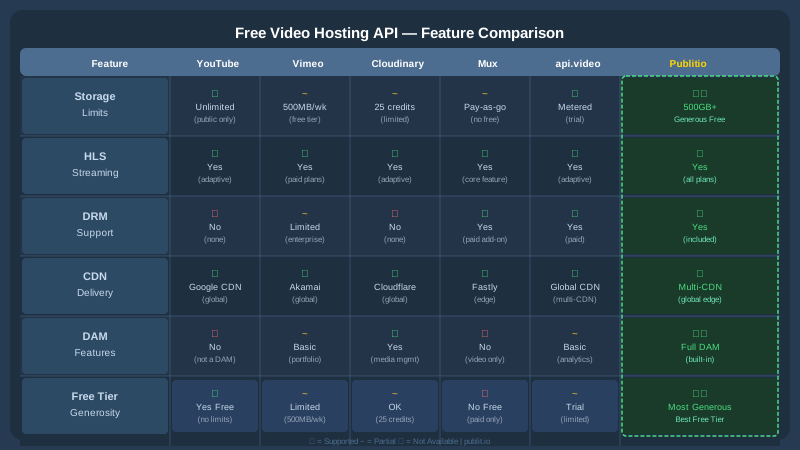
YouTube's API is the most widely known entry point for free video hosting. It offers virtually unlimited storage, a massive CDN, and a straightforward upload endpoint. However, it comes with severe restrictions for product builders: your videos carry YouTube branding, users can be recommended competitor content, monetization is controlled by YouTube, and you have almost no control over the player experience. The API quota system is notoriously limiting for high-volume applications. YouTube is excellent for content discovery, but it's a poor foundation for a product that needs a white-label or controlled video experience.
2. Vimeo API
Vimeo provides a clean REST API and good player customization. Its free tier is extremely limited — just 5 GB of total storage with a weekly upload cap. The paid tiers are priced for creators and small businesses, not for developers building scalable applications. There is no built-in HLS streaming on the free tier, and advanced features like domain-level privacy or DRM require the highest subscription plans. Vimeo works well for portfolio sites but struggles as a backend API for developer-driven products.
3. Cloudinary (Video)
Cloudinary is primarily an image management platform that has extended into video. Its free tier includes 25 GB of managed storage and 25 GB of monthly bandwidth — reasonably generous. The transformation API is powerful, and the developer experience is polished. However, video-specific features like adaptive HLS streaming, multi-resolution VoD delivery, and DRM are only available on higher tiers. Storage costs can also escalate quickly as your library grows, since Cloudinary counts both original files and transformed derivatives against your quota.
4. Mux
Mux is a developer-first video API built specifically for streaming. Its free development environment is genuinely useful for testing, with no storage caps during development. However, Mux's pricing moves to a usage-based model in production — charging per minute of video stored and per minute of video delivered. For high-traffic applications, costs can become significant. Mux also lacks a built-in DAM layer, meaning you need a separate solution for managing non-video assets, metadata, and file organization.
5. api.video
api.video is a modern, well-documented video API with a free sandbox that allows up to 30 seconds of video per upload during testing. Production usage requires a paid plan. It offers good HLS delivery and a clean developer experience, but it focuses narrowly on video — there's no image management, file storage, or broader DAM functionality. If you need a platform that handles all your media types in one place, api.video will require supplementary tools.
How Publitio's Free Video Hosting API Stands Apart
Publitio is an API-first media management platform purpose-built for developers who need video hosting, streaming, and asset management in a single unified system. Unlike the platforms above, Publitio is not a consumer product that has retrofitted an API — it was designed from day one as a developer platform, which means every feature is accessible programmatically and the free tier is genuinely usable for real projects.
You can explore the full capabilities through the free video API feature page and get started with the API documentation without speaking to a sales team.
What the Publitio Free Tier Actually Includes
Publitio's free plan gives developers access to the core platform — including video uploads, basic transcoding, image optimization, and file management — with enough headroom to prototype and launch lightweight applications. Unlike Mux's per-minute billing or Vimeo's tight weekly upload limits, Publitio structures its free tier around practical usage for builders. As your project scales, the pricing plans are transparent and based on storage and bandwidth rather than obscure processing units.
HLS Streaming Built Into Every Plan
One of Publitio's most significant technical differentiators is native HLS streaming support available across all plans. HTTP Live Streaming (HLS) delivers adaptive bitrate video that automatically adjusts quality based on the viewer's network conditions — this is the standard used by Netflix, Hulu, and virtually every professional streaming service. Many free-tier competitors either don't support HLS at all or restrict it to expensive enterprise tiers.
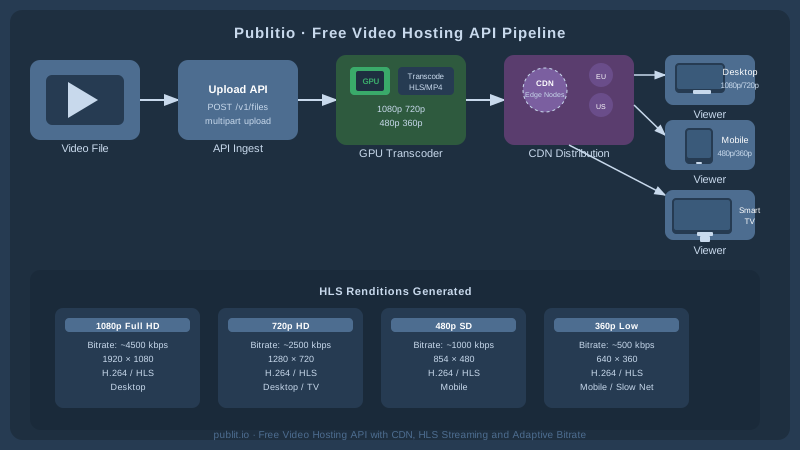
With Publitio, your videos are automatically processed into HLS format with multiple quality renditions. This means users on mobile connections get a smooth experience without buffering, while users on fast broadband connections see the highest available quality — all without any additional configuration on your end.
Video Processing and GPU-Accelerated Conversion
Publitio handles video processing server-side, including format conversion, resolution scaling, thumbnail generation, and clip extraction. For large files or high-volume workflows, GPU-accelerated video conversion dramatically reduces the time between upload and playback-ready delivery. This matters in production environments where users expect near-instant availability after an upload — something that CPU-based processing pipelines on cheaper platforms struggle to deliver.
Video-on-Demand Delivery with Global CDN
Every video uploaded through Publitio is delivered via a global CDN that caches your media at edge locations worldwide. This means a viewer in Tokyo gets the same low-latency experience as a viewer in New York. Combined with the video-on-demand infrastructure, Publitio handles the full delivery stack — from storage to transcoding to CDN distribution — in a single platform. You don't need to stitch together separate services for each layer of the pipeline.
Beyond Video: A Complete Media Management Platform
While this article focuses on the free video hosting API use case, Publitio's architecture goes well beyond video. This is a meaningful advantage for teams building real products, where video is rarely the only media type you need to manage.
Digital Asset Management for All Media Types
Publitio functions as a full digital asset management system, giving you a structured library for images, audio, documents, and video under one API. You can organize assets with folders, tags, and metadata, search across your entire library, and access any file through a consistent REST interface. This eliminates the common pattern of stitching together a video hosting service, a separate image CDN, and a file storage bucket — and the engineering overhead that comes with maintaining three different integrations.
For teams working specifically with video libraries at scale, the video management solution provides purpose-built workflows for ingestion, organization, and delivery. Similarly, image management and audio management capabilities mean that podcast platforms, multimedia publishers, and e-learning companies can handle their entire media stack through Publitio.
Watermarking and Content Protection
Protecting your video content is a first-class feature in Publitio, not an afterthought. The platform supports dynamic watermarks that can be applied to videos and images programmatically via the API — useful for branding, copyright protection, and identifying the source of unauthorized distribution. For more rigorous content protection, Publitio's digital rights management capabilities include HLS encryption, ensuring that your video streams cannot be easily downloaded or redistributed outside your intended player context.
Analytics for Video Performance
Understanding how your videos perform is essential for both product decisions and infrastructure planning. Publitio includes analytics that surface key metrics including play counts, engagement rates, geographic distribution of viewers, and bandwidth consumption. This data is available through the API as well as the dashboard, making it straightforward to incorporate video performance data into your own reporting systems.
WordPress Media Offloading
For teams running WordPress-based content operations, Publitio offers a dedicated WordPress media offloading plugin that automatically routes media uploads from your WordPress media library to Publitio's CDN. This offloads bandwidth from your web server, improves page load times, and centralizes your media management — all without changing your editorial workflow. It's a practical bridge between the WordPress ecosystem and a professional media API infrastructure.
Choosing the Right Free Video Hosting API for Your Use Case
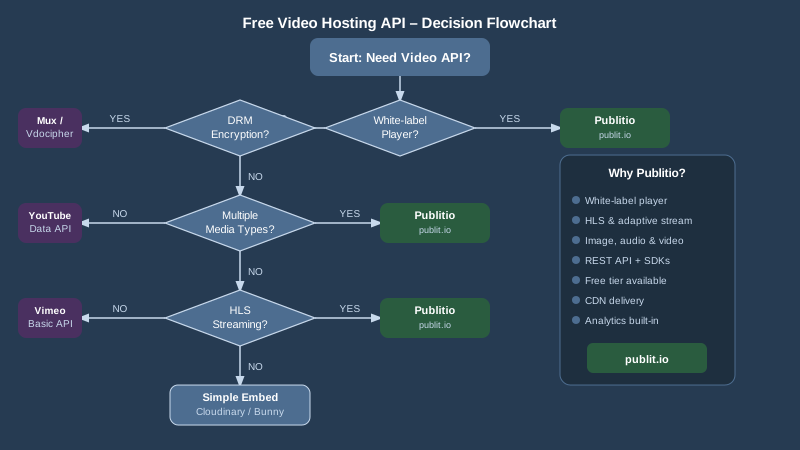
The best free video hosting API for your project depends on what you're building, how quickly you expect to scale, and which features you'll need in production — not just in development.
Use YouTube API If...
You're building a content aggregation tool, a social application, or any use case where YouTube's ecosystem and discoverability are features rather than liabilities. Don't use it if you need a controlled, branded player experience.
Use Cloudinary If...
Your primary focus is image transformation with occasional video needs, and you're comfortable managing multiple platforms as your video requirements grow. Be mindful of how storage costs accumulate with derivative assets.
Use Mux If...
You're building a video-first product that will generate predictable, high-volume traffic and you're comfortable with per-minute billing. Factor in the additional cost and complexity of managing non-video assets separately.
Use Publitio If...
You need a unified API for video, images, and files — with professional-grade HLS streaming, CDN delivery, DRM, and watermarking available from the start. Publitio is the right choice when you want a single platform that grows with your product, transparent pricing, and a developer experience that doesn't require a team of engineers to configure. It's particularly well-suited to SaaS products, e-learning platforms, media companies, and any team building a video feature that needs to ship fast without compromising on quality or security.
Getting Started with Publitio's Free Video Hosting API
Publitio provides thorough API documentation covering authentication, upload endpoints, video processing parameters, HLS configuration, and delivery URL construction. The REST API is language-agnostic, with official SDKs for the most common server environments. You can have your first video uploaded, transcoded, and streaming via HLS within minutes of creating an account — no lengthy onboarding, no approval process, no sales call required.
The platform's API-first philosophy means that every action you can perform in the dashboard is also available as an API call. This matters for teams building automated workflows — bulk ingest pipelines, content publishing systems, programmatic watermarking at scale, or real-time asset delivery integrated into a larger application architecture.
Whether you're evaluating free video hosting APIs for a side project or making a platform decision for a production application, Publitio offers a rare combination: a genuinely useful free tier, a clear and fair upgrade path, and a feature set that covers the full lifecycle of video delivery without requiring you to assemble a patchwork of third-party services.
Ready to build with a video API that's designed for developers? Create your free Publitio account at publit.io and start uploading, streaming, and delivering video content through a single powerful API today. No credit card required — just clean documentation, professional-grade streaming infrastructure, and a platform that scales alongside your ambitions.