


HLS Encryption Explained: How to Secure Your Video Streams
If you're delivering video content online, protecting that content from unauthorized access is non-negotiable. HLS encryption is one of the most widely adopted methods for securing HTTP Live Streaming video, ensuring that only authorized viewers can watch your streams. Whether you're running a subscription video-on-demand platform, distributing training content, or broadcasting live events, understanding how HLS encryption works — and how to implement it correctly — is essential for any serious video publisher. In this guide, we'll break down the technology behind HLS encryption, explain the different methods available, and show you how a platform like Publitio makes securing your video streams straightforward.
What Is HLS and Why Does It Need Encryption?
HTTP Live Streaming (HLS) is an adaptive bitrate streaming protocol developed by Apple. It works by breaking a video file into small segments — typically two to six seconds long — and delivering them over standard HTTP connections. A manifest file (the .m3u8 playlist) tells the player which segments to fetch and in what order. Because HLS uses standard HTTP, it works reliably across firewalls, CDNs, and virtually every modern device and browser.
However, that same openness creates a security problem. Without encryption, anyone who intercepts the HTTP requests or gains access to your CDN URLs can download your video segments directly. They can reconstruct the full video, redistribute it, or embed it in unauthorized players. For premium content, paywalled courses, or confidential corporate video, that's an unacceptable risk.
HLS encryption solves this by scrambling the video segments so that even if someone downloads them, they cannot play them back without the correct decryption key. The protocol itself defines how keys are distributed, how segments are encrypted, and how compliant players retrieve and use those keys transparently — giving viewers a seamless experience while keeping your content locked down.
How HLS Encryption Works: The Core Mechanics
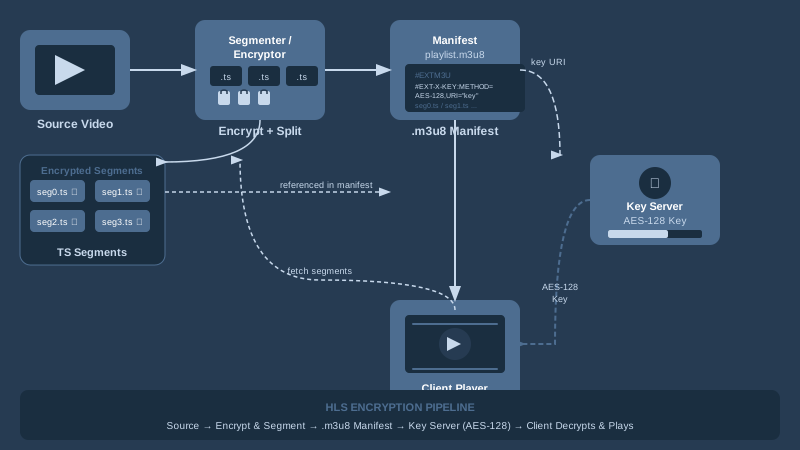
At its core, HLS encryption uses symmetric key cryptography to protect video segments. The process involves three main components: the encoder or packager that encrypts the segments, the key server that stores and delivers decryption keys, and the client player that retrieves and uses those keys during playback.
AES-128 Encryption in HLS
The most common form of HLS encryption is AES-128, which stands for Advanced Encryption Standard with a 128-bit key. When a video is packaged for HLS with AES-128 encryption enabled, each segment is encrypted using this key. The .m3u8 manifest file includes an #EXT-X-KEY tag that tells the player where to fetch the decryption key — a URL pointing to your key server.
The typical flow looks like this:
- Your server or encoding pipeline encrypts each video segment with a 128-bit AES key.
- The key URI is embedded in the HLS manifest.
- When the player loads the manifest, it makes an authenticated request to the key URI.
- Your key server validates the request (checking cookies, tokens, or headers) and returns the key.
- The player decrypts each segment in memory and renders the video.
Because the key request is a standard HTTP request, you can protect it with your own authentication logic — JWT tokens, signed URLs, session cookies, or any other mechanism your backend supports. This means you retain full control over who can decrypt your content.
Key Rotation for Enhanced Security
Using a single encryption key for an entire video stream is convenient but creates risk: if the key is ever compromised, the entire stream is exposed. Key rotation addresses this by periodically changing the encryption key during a stream. Each new key is referenced by a new #EXT-X-KEY tag in the manifest. Even if an attacker obtains one key, they can only decrypt the segments encrypted with that specific key — not the entire video.
Key rotation is especially important for live streams, where sessions can last hours. It adds complexity to your key server architecture, but modern video management platforms handle this automatically.
Sample-Level Encryption (SAMPLE-AES)
A variant of HLS encryption called SAMPLE-AES encrypts at the individual audio and video sample level rather than encrypting the entire segment container. This approach has two advantages: it's compatible with hardware decryption on mobile devices (reducing CPU overhead), and it integrates more cleanly with DRM systems like Apple FairPlay. SAMPLE-AES is commonly used when deploying HLS content within a broader DRM framework.
HLS Encryption vs. DRM: Understanding the Difference
A question that comes up frequently is: what's the difference between HLS encryption and Digital Rights Management (DRM)? They're related but distinct concepts, and for high-value content, you'll likely want both.
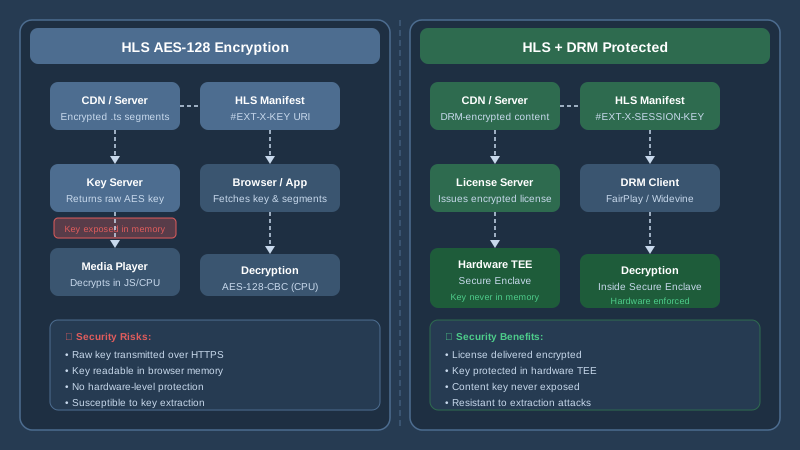
HLS encryption (particularly basic AES-128) protects your segments in transit and at rest on the CDN. However, it relies on your key server to enforce access control. If a sophisticated attacker can intercept or replay the key request — for example, by stealing a valid session token — they can obtain the decryption key and access the content. AES-128 HLS encryption is considered "soft" protection: it's effective against casual piracy but not against determined adversaries.
DRM systems (like Widevine, PlayReady, and Apple FairPlay) go further by binding decryption to specific devices using hardware-level security. Keys are never exposed in the clear; decryption happens inside a trusted execution environment (TEE) on the device. DRM is the standard for premium Hollywood content and any platform with strict content licensing requirements.
Publitio's Digital Rights Management solution supports multi-DRM workflows, allowing you to combine HLS with FairPlay for Apple devices, Widevine for Chrome and Android, and PlayReady for Microsoft platforms — all from a single platform. For most commercial video publishers, layering HLS encryption with DRM provides comprehensive protection across the full range of devices and threat models.
Implementing HLS Encryption: Key Considerations
Rolling out HLS encryption involves decisions at every layer of your video stack. Here are the most important factors to think through before implementation.
Key Server Architecture
Your key server is the backbone of your HLS encryption setup. It must be highly available (a key server outage means no one can watch your videos), secure (it's the single point that controls all decryption), and performant (it will receive a request for every video session started). You need to build in authentication middleware that validates viewer credentials before returning any key. Rate limiting and logging are also critical for detecting abuse.
Signed URLs and Token Authentication
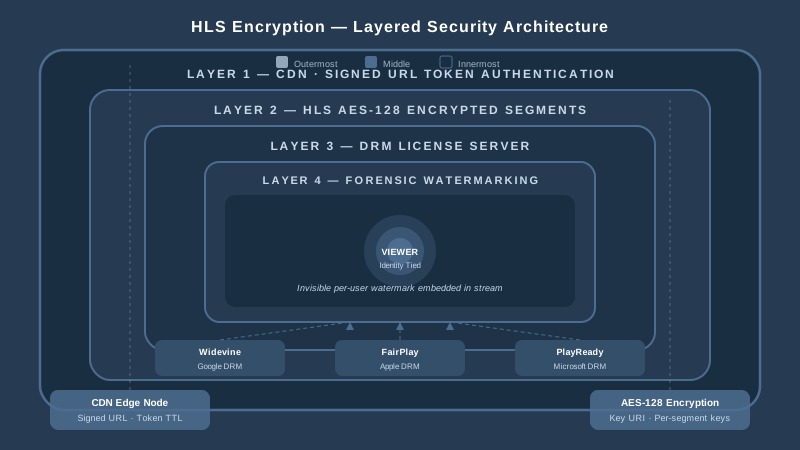
A common pattern is to combine HLS encryption with signed URLs for your manifest and segment files. Signed URLs are time-limited, HMAC-protected URLs generated by your server at session initiation. They prevent hotlinking and direct URL sharing. When combined with encrypted segments, they create a two-layer defense: an attacker needs both a valid signed URL and the decryption key to access your content.
CDN-level token authentication — where your CDN validates a token before serving any file — adds another layer. Publitio's CDN delivery infrastructure supports this kind of token-based access control, integrating with your encryption workflow to protect both the manifest files and the segments themselves.
Player Compatibility
One of HLS's great strengths is near-universal player support. AES-128 HLS encryption is supported natively by Safari, iOS, and Android, and by popular JavaScript players like Video.js, HLS.js, and Shaka Player in other browsers. SAMPLE-AES and FairPlay require Apple devices or Safari. Widevine covers Chrome, Firefox, Android, and most smart TV platforms. Before finalizing your encryption strategy, map your target audience's devices to ensure your chosen protection scheme is fully supported.
Performance Impact
Encryption and decryption do add computational overhead, but in practice the impact on modern hardware is minimal. Hardware-accelerated AES is built into virtually every CPU and mobile SoC manufactured in the last decade. The bigger performance consideration is your key server response time — a slow key server will introduce noticeable playback delays. Caching keys at the CDN edge (with appropriate TTLs) or using a distributed key server architecture mitigates this.
For large-scale video processing and packaging, Publitio's GPU-accelerated video conversion ensures that adding encryption to your transcoding pipeline doesn't become a bottleneck, even at high volumes.
HLS Encryption in Practice with Publitio
Implementing HLS encryption from scratch requires significant engineering investment: building a transcoder or integrating one, setting up a key server, configuring a CDN, and writing player integration code. For most teams, it makes far more sense to use a purpose-built video platform that handles this infrastructure for you.
Publitio's HLS streaming feature provides encrypted adaptive bitrate streaming out of the box. When you upload a video to Publitio, the platform handles transcoding into multiple bitrate renditions, packages the output as HLS with encryption, generates and manages your encryption keys, and delivers segments via a global CDN. You get a secure streaming URL that you can embed directly in your player of choice.
This pairs naturally with Publitio's broader video management capabilities, including metadata management, custom thumbnails, subtitle tracks, and per-asset access controls. For teams building VoD platforms or membership sites, the video-on-demand infrastructure means you can go from video upload to encrypted, CDN-delivered playback in minutes rather than weeks.
Protecting Videos with Watermarks
Encryption prevents unauthorized access, but it doesn't stop authorized viewers from screen-recording and redistributing your content. Forensic watermarking addresses this complementary threat by embedding an invisible, viewer-specific identifier into the video. If the content surfaces online, you can trace it back to the specific account that leaked it.
Publitio's watermarking feature allows you to add both visible and invisible watermarks to your videos, providing an additional deterrent against insider leaks and unauthorized redistribution. Used alongside HLS encryption, watermarking gives you a comprehensive content protection strategy that covers both access control and post-distribution tracing.
Monitoring and Analytics
Security isn't just about locking content down — it's also about understanding what's happening with your streams. Unusual spikes in key server requests, unexpected geographic access patterns, or abnormally high bandwidth consumption can all signal that your encryption setup is being probed or circumvented. Publitio's analytics give you visibility into stream performance and viewer behavior, helping you detect anomalies and respond quickly.
Best Practices for HLS Encryption
To summarize the most important principles for a secure HLS streaming setup:
- Always authenticate key requests. Never serve decryption keys without validating that the requesting user is authorized to watch the content. Use short-lived tokens that expire after the session ends.
- Use key rotation for live streams. Rotate encryption keys at regular intervals — every few minutes for live events — to limit the blast radius of a key compromise.
- Combine encryption with signed URLs. Protect your manifest files and segment URLs at the CDN level so attackers can't even begin requesting segments without a valid session.
- Layer in DRM for premium content. For high-value content with strict licensing requirements, layer multi-DRM on top of HLS encryption for hardware-level key protection.
- Add watermarking. Use forensic watermarking as a deterrent and a forensic tool for tracing leaks from authorized users.
- Monitor your key server. Log every key request, set up rate limiting, and alert on anomalous access patterns.
- Test across devices. Verify your encryption implementation works correctly on iOS Safari, Android Chrome, desktop browsers, and any smart TV or OTT apps you support.
Getting Started with Secure Video Streaming
HLS encryption is not a single feature you switch on — it's an architecture that requires thoughtful design across your encoding pipeline, key management infrastructure, CDN configuration, and player integration. The good news is that you don't have to build this from scratch. Publitio abstracts away the complexity, giving you encrypted HLS streaming, CDN delivery, DRM support, and watermarking through a clean API and intuitive dashboard.
If you're building or scaling a video platform and want to explore how Publitio handles your full video infrastructure stack, the documentation covers everything from API authentication to advanced streaming configurations. You can also explore Publitio's video API to understand how to integrate secure video delivery directly into your application. Check out the pricing page to find a plan that fits your scale.
Ready to stop worrying about video piracy and unauthorized access? Sign up at publit.io today and start delivering encrypted, DRM-protected HLS streams in minutes. Publitio handles the infrastructure so your team can focus on building great video experiences — not managing key servers.


