


Video CDN: How to Stream Faster and Cut Buffering for Good
If you have ever clicked play on a video only to watch a spinning loading icon eat up thirty seconds of your life, you already understand why a video CDN matters. A content delivery network built specifically for video changes the entire equation — moving your media physically closer to every viewer on the planet, slashing latency, and turning buffering from a constant frustration into a distant memory. Whether you are a developer building a video platform, a business running a media library, or a content creator trying to reach a global audience, understanding how a video CDN works — and choosing the right one — is one of the highest-leverage decisions you will make for your streaming stack.
What Is a Video CDN and Why Does It Exist?
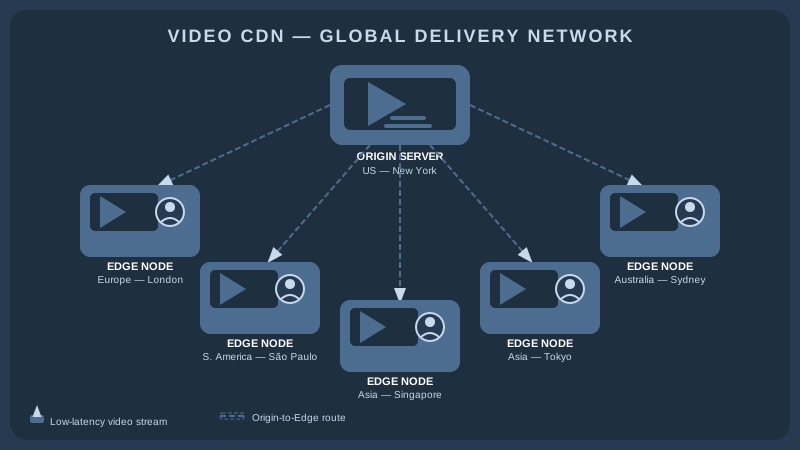
A content delivery network is a geographically distributed group of servers, called edge nodes or points of presence (PoPs), that cache and serve content from locations close to end users. A video CDN is a CDN optimised specifically for the demands of video delivery: large file sizes, real-time adaptive bitrate streaming, and the need for consistent throughput across millions of concurrent viewers.
Traditional web hosting puts all your content on a single origin server. When a viewer in Tokyo requests a video hosted on a server in New York, every data packet has to travel roughly 10,000 kilometres — each round trip adding tens or even hundreds of milliseconds of delay. Multiply that across an entire stream and you get the buffering hell that kills watch time, raises bounce rates, and destroys audience trust.
A video CDN solves this by caching your video segments at edge nodes worldwide. The Tokyo viewer pulls data from an edge server in Osaka or Seoul instead of New York. Round-trip times drop from 150 ms to under 10 ms. The stream starts faster, stays smoother, and adapts gracefully even when network conditions fluctuate.
The Core Components of a Video CDN
- Origin server: The authoritative source where your original video files live.
- Edge nodes / PoPs: Distributed servers that cache video segments closer to viewers.
- Routing logic: Intelligent DNS and Anycast routing that sends each user request to the optimal edge node.
- Cache rules: Policies that determine how long video segments are stored at each edge before being refreshed from origin.
- Adaptive bitrate (ABR) support: The CDN must handle chunked manifests (HLS, DASH) without stripping or corrupting playlist files.
How a Video CDN Actually Works: From Upload to Playback
Understanding the full journey of a video file helps you see exactly where a CDN adds value — and where gaps in your stack can still cause problems.
Step 1: Ingest and Transcoding
Before a CDN can deliver your video, the raw file needs to be transcoded into multiple renditions at different resolutions and bitrates. A viewer on a 4G phone should receive 720p at 2 Mbps; a viewer on fibre should get 1080p or 4K at 8–20 Mbps. This is adaptive bitrate streaming, and it is the backbone of every modern video platform. Publitio handles this automatically through its video processing pipeline, including GPU-accelerated conversion via its GPU video conversion feature, so you get fast, high-quality renditions without managing your own transcoding infrastructure.
Step 2: Packaging for HLS or DASH
After transcoding, the video is packaged into small segments — typically two to six seconds each — and a manifest file (an .m3u8 for HLS or an .mpd for DASH) is generated. The manifest tells the player which segments exist, at what bitrates, and in what order to request them. Publitio's HLS streaming feature handles this packaging automatically and supports encrypted streams for content protection.
Step 3: CDN Caching and Edge Delivery
When the first viewer in a region requests your video, the edge node fetches the manifest and initial segments from the origin and caches them locally. Every subsequent viewer in that region is served entirely from the edge — origin load drops dramatically, and delivery speed skyrockets. Publitio's built-in CDN delivery layer manages this process transparently, so you do not need to configure a separate CDN provider or worry about cache invalidation rules.
Step 4: Adaptive Bitrate Switching at the Player
The video player continuously measures available bandwidth and buffer health. If the network slows down, it requests lower-bitrate segments from the CDN. If bandwidth improves, it steps up to higher quality. Because the CDN has cached all renditions at the edge, these switches happen in milliseconds — the viewer barely notices. Without a CDN, every bitrate switch would require a round trip to the origin, making adaptive streaming largely ineffective in practice.
Why Buffering Happens — and How a Video CDN Eliminates It
Buffering is almost always a symptom of one or more of these root causes:
- High round-trip time (RTT): The viewer is physically far from the server.
- Origin overload: Too many concurrent viewers are hammering a single server.
- Poor bitrate selection: The player is requesting a bitrate higher than the available bandwidth can sustain.
- Inefficient segment delivery: Segments are not being pre-fetched or cached at the edge.
- Unoptimised video encoding: Files are too large relative to their quality, wasting bandwidth.
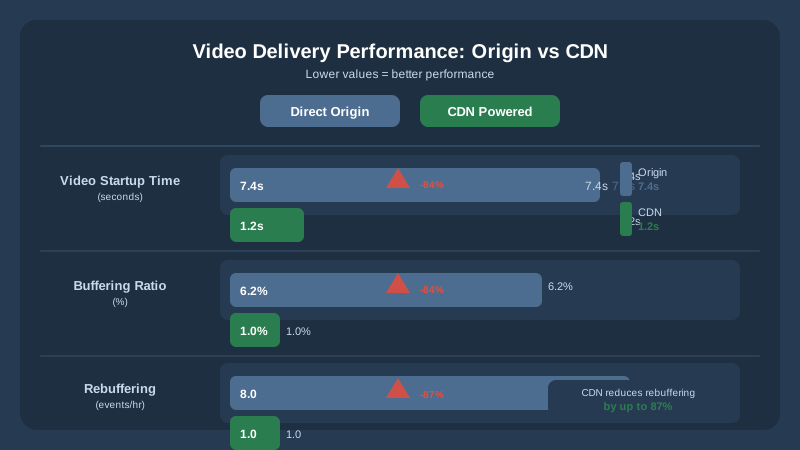
A video CDN directly addresses the first two causes by reducing RTT and offloading origin traffic. Combined with proper transcoding and HLS packaging, it also enables effective adaptive bitrate switching that handles the third and fourth causes. The result is a viewer experience where buffering simply does not happen under normal conditions — and degrades gracefully even under adverse network conditions rather than stalling completely.
Video CDN Features That Actually Move the Needle
Not all CDNs are created equal, and video has specific requirements that generic CDNs often handle poorly. Here is what to look for when evaluating a video CDN for your platform.
Global PoP Coverage
The value of a CDN is directly proportional to how close its edge nodes are to your viewers. A CDN with 30 PoPs concentrated in North America and Western Europe is essentially useless for an audience in Southeast Asia or sub-Saharan Africa. Look for genuine global coverage — not just a marketing map with dots — and evaluate actual latency numbers for your target regions.
HLS and DASH Protocol Support
HTTP Live Streaming (HLS) is the dominant protocol for video delivery, supported natively by iOS, Android, Smart TVs, and modern browsers. Your CDN must handle .m3u8 manifest files and .ts or .fMP4 segments correctly, with appropriate cache-control headers that allow segments to be cached aggressively while keeping manifests fresh. Support for encrypted HLS with AES-128 or SAMPLE-AES encryption is essential if you need to protect premium content — Publitio's digital rights management solution handles this end to end.
Low Time-to-First-Byte (TTFB)
The time between a player requesting a segment and receiving the first byte of data is critical for stream startup and bitrate switching speed. Optimised video CDNs use techniques like persistent TCP connections, HTTP/2 and HTTP/3 multiplexing, and pre-positioned caches to minimise TTFB. For live streaming, sub-second TTFB at the edge is the difference between a usable live experience and an unusable one.
Origin Shield
An origin shield is an intermediate caching layer between the edge nodes and your origin server. Instead of every edge node fetching a cache miss from origin independently, they all funnel cache misses through a single shield node. This dramatically reduces origin load, especially during traffic spikes, and reduces the bandwidth bill for origin egress. For video-on-demand, where the same content is requested repeatedly, an origin shield can keep origin hit rates above 99%.
Real-Time Analytics
You cannot optimise what you cannot measure. A good video CDN exposes per-stream analytics including startup time, buffering ratio, error rates, bitrate distribution, and geographic breakdowns. Publitio provides detailed analytics so you can see exactly how your content is performing and identify the regions or devices where the viewer experience needs improvement.
Token-Based URL Signing and Access Control
If you are delivering premium or gated video content, you need the ability to sign CDN URLs with expiring tokens so that direct links cannot be shared or hotlinked. This is a core security feature for any video management platform serving paying subscribers or enterprise clients.
Watermarking
For licensed content or internal distribution, visible or forensic watermarking adds an additional layer of content protection. Publitio supports video and image watermarks applied at the platform level before delivery, ensuring your branding or viewer-identifying marks are present without adding processing overhead at playback time.
Video CDN for Different Use Cases
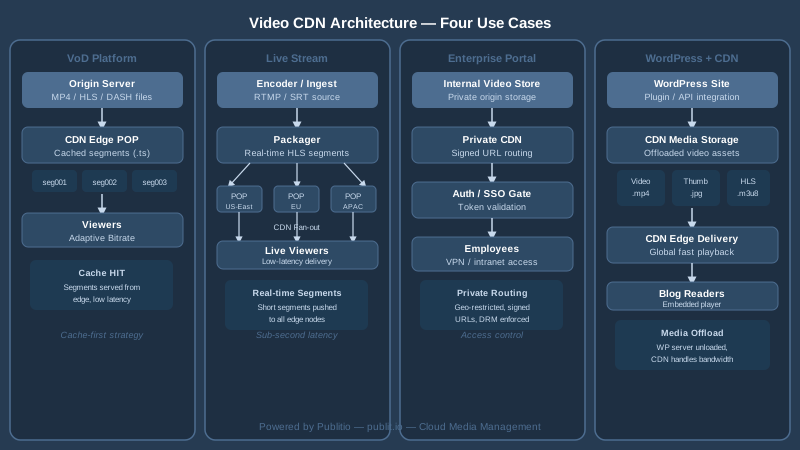
Video-on-Demand (VoD) Platforms
For VoD, the CDN's caching efficiency is paramount. Content is fixed, so segments can be cached indefinitely at the edge with very high cache hit rates. The priority is low startup time and seamless adaptive bitrate switching. Publitio's video-on-demand infrastructure is built on top of CDN delivery, meaning every video you host benefits automatically from edge caching without any additional configuration.
Live Streaming
Live streaming is the hardest CDN problem in video. Segments are generated in real time, so they cannot be cached in advance. The CDN must handle massive simultaneous request spikes — think a live sports event or a product launch — with minimal latency. CDN providers that excel at live streaming use predictive segment pre-fetching and real-time manifest distribution to keep latency within two to five seconds of the live edge.
Enterprise and Internal Video
Enterprise video — town halls, training libraries, product demos — often has a different traffic pattern: concentrated spikes during business hours, with viewers clustered in specific office locations. CDN configuration for enterprise use often prioritises private PoP options or private network routing rather than raw global scale. Combining this with a digital asset management platform ensures all enterprise media is organised, searchable, and securely deliverable.
Developer and API-First Platforms
If you are building a video feature into your application rather than running a standalone video site, you need a video CDN that exposes clean APIs. Publitio's video API lets you upload, transcode, manage, and deliver video programmatically, with CDN delivery included out of the box. Full API reference documentation is available at the Publitio developer docs.
WordPress Sites
WordPress powers over 40% of the web, and video is increasingly central to WordPress content strategies. But hosting video on the same server as your WordPress site is a recipe for slow load times and crushed hosting budgets. Publitio's WordPress media offloading plugin automatically offloads your media library — videos, images, and audio — to Publitio's CDN-backed storage, freeing your server and delivering every asset from the edge instead.
How to Evaluate Your Current Video CDN Performance
Before committing to a new CDN or validating your existing setup, run through this checklist to get an objective picture of your current streaming performance.
Measure Startup Time
Use browser developer tools or a dedicated video analytics tool to measure time-to-first-frame (TTFF). Industry benchmarks suggest that viewers start abandoning streams after two seconds of startup delay, and abandonment rises sharply with every additional second. A well-configured video CDN should deliver startup times under one second for cached VoD content in well-covered regions.
Check Your Buffering Ratio
Buffering ratio — the fraction of total playback time spent buffering — is the single most important quality-of-experience metric for streaming. A buffering ratio above 1% starts to meaningfully impact viewer satisfaction; above 5% and you will see significant drop-off in watch time and return visits. CDN-powered delivery should routinely achieve buffering ratios below 0.5% for VoD.
Review Your Cache Hit Rate
Most CDN control panels expose cache hit rates. For VoD content that has been viewed at least once in a region, you should expect cache hit rates of 90% or above. If you are seeing lower numbers, investigate whether your cache-control headers are set correctly and whether your CDN's TTL policies align with your content update frequency.
Test from Multiple Geographic Regions
Use synthetic monitoring tools to simulate viewers from your target regions. A CDN that performs brilliantly from California but poorly from Jakarta or Lagos is not a global CDN — it is a regional CDN with a global marketing team. Test from the regions where your actual audience lives, not just the ones where the CDN vendor has the most infrastructure.
Common Mistakes When Setting Up a Video CDN
- Serving video directly from origin "for now": There is no such thing as "we'll add a CDN later when traffic picks up." Traffic spikes are unpredictable, and the first time your site gets real attention is the worst moment to discover your infrastructure can't handle it.
- Caching manifest files too aggressively: HLS .m3u8 manifests should have short TTLs (10–30 seconds for live streams, a few minutes for VoD) so that players always get the current segment list. Caching manifests with the same long TTL as video segments is a common cause of playback failures after content updates.
- Ignoring CORS headers: If your video player is served from a different domain than your CDN, you need correct CORS (Cross-Origin Resource Sharing) headers on your CDN responses. Missing CORS headers silently block video playback in browsers without producing obvious error messages.
- Not using an origin shield: Skipping the origin shield might save a small amount of configuration time, but it leaves your origin exposed to the full request volume during cache misses — which can be devastating during a traffic spike on new or recently published content.
- Forgetting about mobile networks: Desktop performance tests are optimistic. Test your adaptive bitrate configuration aggressively on throttled connections (3G, 4G with packet loss) to ensure the lowest bitrate rendition is watchable and that ABR switching is responsive enough to avoid buffering on variable connections.
The Business Case for Investing in a Proper Video CDN
Every second of buffering costs you money. Studies consistently show that a one-second increase in video startup time reduces viewer satisfaction scores by double digits, and that sustained buffering during playback is the single strongest predictor of viewer churn on subscription video platforms. On the other side of the ledger, fast, reliable streaming improves ad completion rates, increases average watch time, reduces support tickets, and raises Net Promoter Scores.
The cost of a managed video CDN — especially when it is bundled into a platform like Publitio rather than assembled from separate vendor relationships — is almost always lower than the revenue impact of poor streaming quality. Check the Publitio pricing page to see how CDN-delivered video hosting scales with your usage without requiring enterprise contracts or minimum commitments.
For organisations managing large libraries of mixed media alongside video — images, audio files, documents — a unified platform that handles media asset management alongside CDN-powered video delivery means fewer vendor integrations, a single billing relationship, and consistent metadata and access control policies across all asset types.
Start Streaming Faster Today
A video CDN is not a luxury for large platforms — it is the minimum viable infrastructure for anyone serious about delivering video on the modern web. Buffering is not an unavoidable fact of life; it is an engineering problem with a well-understood solution. The right combination of transcoding, HLS packaging, edge caching, and adaptive bitrate delivery eliminates buffering for the vast majority of viewers under real-world network conditions.
Publitio brings all of these components together in a single API-first platform: automatic transcoding and GPU-accelerated conversion, HLS packaging with optional DRM encryption, global CDN delivery, real-time analytics, watermarking, and a WordPress plugin — all accessible through a clean REST API or a no-code dashboard. You do not need to stitch together five different vendors or manage your own infrastructure. You just upload your video and let Publitio handle everything from ingest to playback.
Ready to eliminate buffering for good? Sign up at publit.io and start delivering your video through a proper video CDN today. Your first uploads are free, and the platform scales transparently as your audience grows — no lengthy contracts, no surprise bills, and no more spinning loading icons.


