


HLS or MPEG-TS: Which Streaming Format Should You Use?
When building a video streaming pipeline, one of the earliest and most consequential decisions you'll face is choosing between HLS or MPEG-TS. Both formats have shaped how video is delivered across the internet and broadcast networks, yet they serve different purposes, excel in different environments, and come with distinct trade-offs. Whether you're launching a video-on-demand platform, setting up live streaming infrastructure, or integrating video into a web application, understanding the difference between these two protocols is essential to getting playback quality, latency, and compatibility right.
What Is HLS (HTTP Live Streaming)?
HLS, or HTTP Live Streaming, is an adaptive bitrate streaming protocol developed by Apple and introduced in 2009. It works by breaking a video stream into small, sequential chunks — typically ranging from 2 to 10 seconds — and serving them over standard HTTP connections. A manifest file (the .m3u8 playlist) tells the player which chunks are available and at what quality levels.
Because HLS rides on top of HTTP, it passes through firewalls and proxies with ease, making it highly compatible with modern web infrastructure. Adaptive bitrate (ABR) logic built into HLS players allows them to automatically switch between quality levels depending on the viewer's available bandwidth, which is critical for delivering a smooth experience on variable network connections.
Key Characteristics of HLS
- Adaptive bitrate streaming: Automatically adjusts video quality in real time based on network conditions.
- Broad device support: Natively supported on iOS, macOS, Apple TV, and widely supported via JavaScript players (HLS.js) on Android, Windows, and smart TVs.
- HTTP/CDN-friendly: Chunks are cacheable static files, making HLS ideal for large-scale CDN delivery.
- DRM support: HLS supports AES-128 encryption and can integrate with Apple FairPlay for content protection.
- Latency: Standard HLS introduces 6–30 seconds of end-to-end latency, though Low-Latency HLS (LL-HLS) can bring this down to 2–4 seconds.
What Is MPEG-TS (MPEG Transport Stream)?
MPEG-TS, or MPEG Transport Stream, is a standardized container format defined by the MPEG group (ISO/IEC 13818-1). It was originally designed for broadcasting video and audio over lossy and noisy transmission media — think satellite broadcasts, cable TV, and digital terrestrial television (DVB, ATSC). MPEG-TS packages audio, video, and metadata into small fixed-size packets of 188 bytes, which are transmitted in a continuous stream.
Unlike HLS, MPEG-TS is a low-level container format rather than a delivery protocol. It defines how content is packaged, not necessarily how it is transported. However, MPEG-TS is commonly used as the underlying container format within HLS segments themselves — a fact that creates some confusion when people compare the two.
Key Characteristics of MPEG-TS
- Fixed packet size: The 188-byte packet structure makes it highly resilient to packet loss, ideal for broadcast environments.
- Low-level transport: Designed for continuous streaming over UDP, often used with protocols like RTP and SRT.
- No native ABR: MPEG-TS itself does not include adaptive bitrate logic — that must be layered on top.
- Professional broadcast use: Widely used in broadcast contribution, satellite uplinks, and encoder-to-encoder feeds.
- Low latency potential: When used over UDP (e.g., SRT or RTSP), MPEG-TS can achieve sub-second latency suitable for live production workflows.
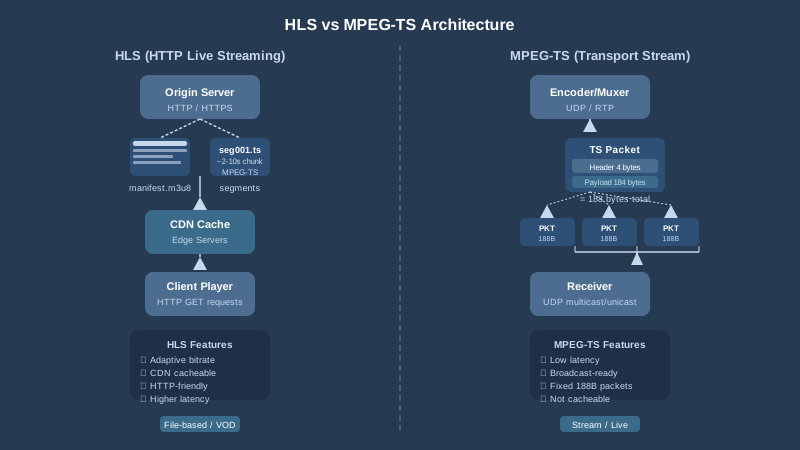
HLS or MPEG-TS: Understanding the Core Differences
Now that we have a clear picture of each format individually, let's look at how they compare across the dimensions that matter most for real-world streaming deployments.
Transport and Delivery Mechanism
HLS is delivered entirely over HTTP/HTTPS, which means it inherits all the infrastructure benefits of the web — proxies, caches, load balancers, and CDNs all work seamlessly. This makes HLS the default choice for internet-based video delivery to end users.
MPEG-TS, by contrast, is typically carried over UDP-based protocols such as RTP, SRT, or RIST, or over multicast networks. It is the workhorse of the broadcast and contribution layer — the segment of the pipeline between a camera or encoder and a streaming server, rather than between a server and a viewer's browser.
Latency Profiles
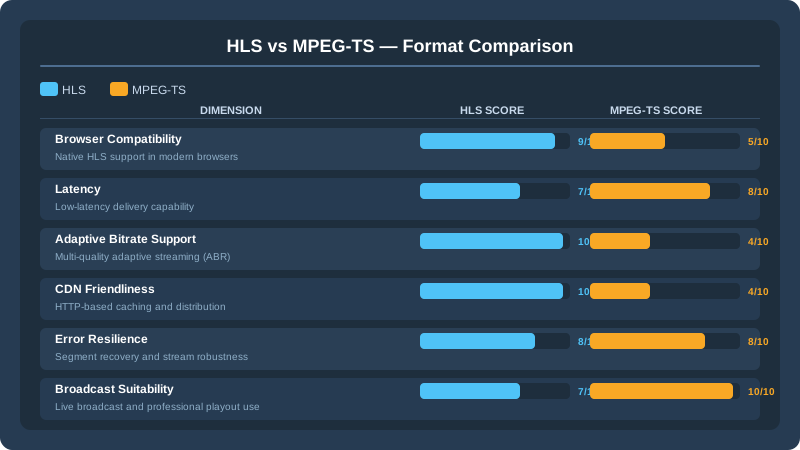
Standard HLS carries noticeable latency — anywhere from 6 to 30 seconds depending on segment length and player buffering behavior. This is acceptable for video-on-demand and most live streaming scenarios but becomes a problem for real-time interactive use cases. Low-Latency HLS (LL-HLS), introduced by Apple and standardized in RFC 8216bis, dramatically reduces this to 2–4 seconds using partial segments and preload hints.
MPEG-TS over UDP can achieve sub-second latency, making it a preferred choice for live production environments where camera feeds, switching, and encoding all need to be tightly synchronized.
Error Resilience and Reliability
MPEG-TS was engineered for lossy media. Its fixed 188-byte packet structure allows decoders to resynchronize quickly after packet loss — critical in satellite or over-the-air broadcast scenarios where signal interference is common.
HLS, riding over TCP-based HTTP, benefits from TCP's built-in retransmission and error correction. While this ensures reliable delivery, it also contributes to the inherent latency. For internet streaming where reliability is handled at the transport layer, this trade-off is usually worthwhile.
Adaptive Bitrate Support
HLS has native, well-specified ABR support through its multi-variant playlist format. Players can seamlessly switch between renditions encoded at different resolutions and bitrates — a 1080p rendition at 5 Mbps, a 720p rendition at 2 Mbps, a 360p rendition at 800 Kbps — giving viewers the best quality their connection can support.
MPEG-TS does not include ABR natively. Adaptive delivery using MPEG-TS requires additional layers such as HLS (which often uses MPEG-TS as its segment container) or MPEG-DASH, effectively making MPEG-TS a building block rather than a complete solution.
Browser and Device Compatibility
HLS has near-universal playback support. Safari plays HLS natively. Chrome, Firefox, and Edge can play HLS using JavaScript-based players like HLS.js. Mobile platforms — both iOS and Android — support HLS-based streaming well. Smart TVs, Roku, Fire TV, and most modern media players all support HLS.
Raw MPEG-TS over UDP is not natively playable in web browsers without significant additional work. It is primarily consumed by hardware decoders, professional software players like VLC, and broadcast equipment.
When to Use HLS
HLS is the right choice for the vast majority of internet-facing video delivery scenarios. If your viewers are watching content on a browser, a mobile app, a smart TV, or a set-top box over the public internet, HLS is almost certainly the correct format. Here are the scenarios where HLS excels:
- Video-on-demand (VoD) platforms: HLS with ABR ensures viewers get the best quality their connection can support, minimizing buffering. Our video-on-demand infrastructure is built around HLS delivery for exactly this reason.
- Live streaming to large audiences: HLS's HTTP-based delivery scales effortlessly through CDN infrastructure, handling millions of concurrent viewers without specialized network equipment.
- DRM-protected content: HLS integrates cleanly with Apple FairPlay, Google Widevine (when paired with DASH), and AES-128 segment encryption. If content protection is a priority, explore our digital rights management solutions.
- Multi-device delivery: A single HLS stream with multiple renditions covers browsers, mobile, and TVs without maintaining separate encode pipelines.
- Global delivery via CDN: HLS segments are static, cacheable files — ideal for global CDN-accelerated delivery with low origin load.
When to Use MPEG-TS
MPEG-TS shines in professional broadcast and contribution workflows where low latency, precision synchronization, and resilience over unreliable links are paramount. Consider MPEG-TS in these scenarios:
- Live production contribution feeds: Camera-to-encoder and encoder-to-streaming-server links often use MPEG-TS over SRT or RTP for reliable, low-latency ingest.
- Satellite and cable broadcast: Traditional broadcast distribution still relies heavily on MPEG-TS, and professional encoding hardware speaks MPEG-TS natively.
- Multicast delivery on managed networks: Enterprise or campus IPTV systems on controlled networks can use MPEG-TS multicast efficiently.
- Interfacing with broadcast hardware: If your workflow involves professional cameras, video switchers, or broadcast encoders, MPEG-TS is the lingua franca.
How HLS and MPEG-TS Work Together
Here's where many developers get confused: HLS and MPEG-TS are not always competing alternatives — in many streaming pipelines, they coexist at different stages of the workflow.
In a classic HLS streaming setup, the video content inside each .ts segment file is actually MPEG-TS encoded data. The HLS layer (the .m3u8 manifests, the ABR logic, the HTTP delivery) sits on top of MPEG-TS as the container. Apple later introduced MPEG-4 Fragmented MP4 (fMP4) as an alternative container within HLS segments, which is now preferred in LL-HLS and CMAF workflows, but MPEG-TS segments remain common and widely supported.
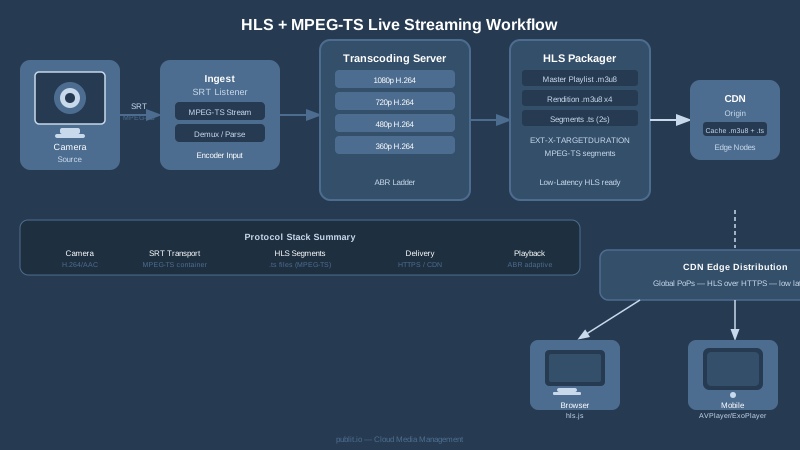
A typical end-to-end live streaming workflow might look like this:
- A camera or encoder sends a live feed via MPEG-TS over SRT to a streaming server.
- The streaming server ingests the MPEG-TS feed and transcodes it into multiple renditions.
- Transcoded renditions are packaged as HLS segments (which may themselves use MPEG-TS as the container format).
- HLS manifest files and segments are pushed to a CDN origin.
- Viewers around the world pull HLS segments from CDN edge nodes using standard HTTP.
Understanding this layered architecture is key to making informed decisions at each stage of your pipeline. If you're managing video assets at scale, our video management solutions and video processing features are designed to handle both ingest and HLS output packaging within a unified platform.
Choosing the Right Format for Your Platform
The decision between HLS or MPEG-TS ultimately comes down to where in the streaming chain you're operating and who your audience is. Here's a quick decision framework:
Choose HLS if:
- You are delivering video to end users over the public internet.
- Your viewers use browsers, mobile devices, or smart TVs.
- You need adaptive bitrate to handle variable network conditions.
- You want to leverage CDN caching for scalable global delivery.
- Content protection via DRM or encryption is a requirement.
- You are building a VoD platform, OTT service, or online learning portal.
Choose MPEG-TS if:
- You are working in a professional broadcast or live production environment.
- You need sub-second latency for live video contribution links.
- Your infrastructure relies on hardware encoders or decoders that speak MPEG-TS natively.
- You are operating over a managed network where multicast is possible.
- Compatibility with broadcast equipment (cameras, switchers, satellite uplinks) is required.
HLS Streaming with Publitio
For developers and media teams building internet-facing video applications, Publitio's HLS streaming infrastructure takes care of the heavy lifting. Upload your source video once, and Publitio automatically handles transcoding into multiple quality renditions, packages them as HLS streams, and delivers them globally through a high-performance CDN — all through a clean, developer-friendly API.
Our platform supports GPU-accelerated video conversion to dramatically speed up encoding jobs, making it practical to process large video libraries quickly. Combined with our streaming analytics, you can monitor playback performance, viewer engagement, and CDN delivery metrics in real time.
If you're managing a large library of video assets, Publitio also functions as a full media asset management platform, giving your team organized, searchable access to every file — videos, images, audio, and documents — all in one place. For teams running WordPress, our WordPress media offloading plugin lets you serve all media directly from Publitio's CDN, reducing server load and improving page performance.
Developers looking to go deeper can explore our full API documentation to integrate video upload, processing, and HLS delivery directly into their applications.
Final Thoughts
The question of HLS or MPEG-TS doesn't have a single universal answer — it depends on your role in the streaming pipeline. For last-mile delivery to internet viewers, HLS is the dominant, proven, and practically universal standard. For professional contribution workflows, broadcast infrastructure, and ultra-low-latency live production, MPEG-TS remains essential. In many real-world deployments, both formats play complementary roles at different stages of the same pipeline, each doing what it does best.
The good news is that for most development teams and media businesses, you don't need to manage either format at a low level. The right platform abstracts that complexity for you, letting you focus on your product rather than encoding pipelines.
Ready to launch reliable, scalable HLS video streaming without the infrastructure headache? Sign up at publit.io and start delivering professional-grade video experiences to your audience today. Explore our pricing plans to find the right fit — from individual developers to enterprise media teams — and get your first videos live in minutes.


