
HLS vs MPEG-TS: Key Differences and Which Streaming Format to Use
When building a video streaming pipeline, one of the most consequential decisions you will face is choosing the right transport format. The debate around HLS vs MPEG-TS comes up constantly among developers, media engineers, and platform architects because both formats are deeply intertwined with how video reaches viewers — yet they serve different purposes, operate at different layers of the stack, and carry very different trade-offs. Understanding these differences is not just academic; it directly affects latency, compatibility, DRM support, CDN performance, and the overall quality of experience you can deliver. In this guide, we break down what HLS and MPEG-TS are, how they relate to each other, where they diverge, and which one you should use for your specific streaming scenario.
What Is HLS?
HLS, or HTTP Live Streaming, is an adaptive bitrate streaming protocol developed by Apple and introduced in 2009. It works by breaking a video stream into small sequential chunks — typically two to six seconds long — and serving them over standard HTTP. A manifest file, written in M3U8 format, tells the player which segments are available, at what bitrates, and in what order to fetch them.
The genius of HLS lies in its adaptive bitrate logic. A player can switch between different quality renditions — say, from 1080p to 480p — on the fly depending on the viewer's available bandwidth. This makes HLS exceptionally resilient for delivery over unpredictable networks, including mobile connections. Because it rides on HTTP, HLS passes through firewalls and CDN caches effortlessly, making it the dominant protocol for large-scale video on demand and live streaming deployments on the web.
HLS is natively supported in Safari on iOS and macOS, and through JavaScript libraries like HLS.js it works across virtually every modern browser and device. It also integrates cleanly with DRM systems like FairPlay, Widevine, and PlayReady, making it the go-to choice for premium content protection.
If you want to explore how Publitio implements this protocol at scale, see our HLS streaming feature page.
What Is MPEG-TS?
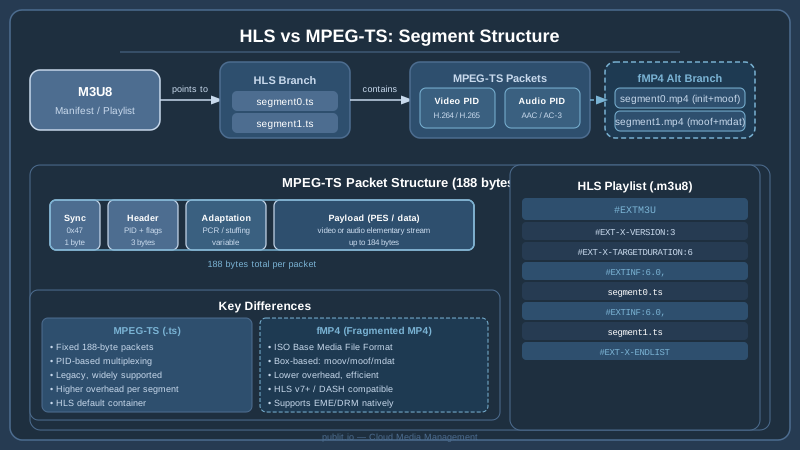
MPEG-TS, or MPEG Transport Stream, is a container format standardized by the ISO/IEC 13818 group as part of the MPEG-2 specification. It was originally designed for broadcasting — think satellite TV, cable, and over-the-air digital television (DVB, ATSC). The format packages audio, video, and metadata into fixed-size 188-byte packets, which are well suited to unreliable transmission channels where packet loss is common.
Each MPEG-TS packet carries a Packet Identifier (PID) that allows the decoder to demultiplex different elementary streams — video, audio, subtitles — from the combined transport stream. This multiplexing approach is robust and has been battle-tested in broadcast environments for decades.
In the context of internet video, MPEG-TS shows up in two ways. First, it was the original segment container used inside HLS. When Apple first defined the HLS specification, the video segments served in .ts files were MPEG-TS containers. Second, MPEG-TS is still widely used in live ingest protocols — notably RTMP replacements like SRT and RIST — and in professional broadcast contribution workflows.
How HLS and MPEG-TS Relate to Each Other
This is where many people get confused: HLS and MPEG-TS are not direct competitors. Rather, MPEG-TS has historically been the container format used inside HLS segments. When you stream with HLS, the .m3u8 manifest points to .ts segment files — those files are MPEG-TS containers holding the encoded video and audio.
In 2016, Apple updated the HLS specification to also support fMP4 (fragmented MP4) as a segment container, and the industry has been migrating toward fMP4 segments ever since. fMP4 offers better compression efficiency, improved DRM integration via CMAF, and lower latency potential. But MPEG-TS segments remain widely supported and are still the default in many encoding and packaging pipelines.
So the more precise framing of the HLS vs MPEG-TS question is really: within an HLS delivery pipeline, should you package segments as MPEG-TS (.ts) or as fMP4 (.mp4 / .cmaf)? Or, at a higher level: should you use HLS at all, or deliver raw MPEG-TS streams over UDP for your particular use case?
HLS vs MPEG-TS: Key Technical Differences
Transport Layer and Delivery Protocol
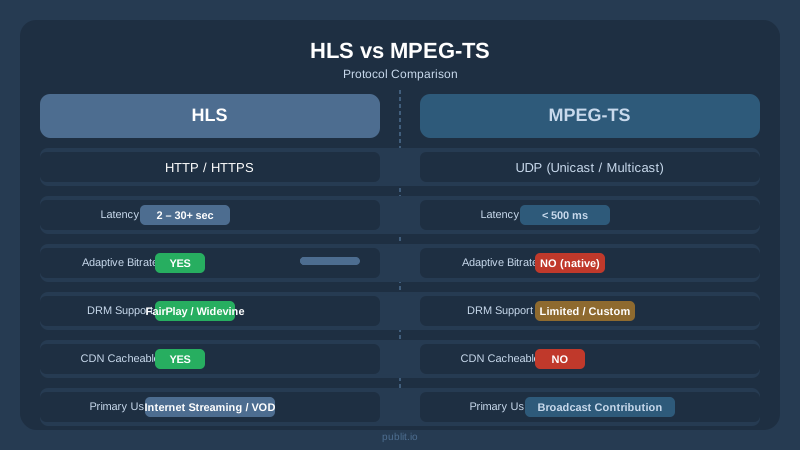
MPEG-TS in its native broadcast form is delivered over UDP — a connectionless, fire-and-forget protocol that prioritizes low latency over reliability. This is appropriate for satellite or cable where the infrastructure is purpose-built and packet loss handling is managed at the physical layer. On the open internet, raw UDP delivery is impractical for most consumer applications because firewalls block it and CDNs do not cache it.
HLS, by contrast, is entirely HTTP-based. Every segment request is a standard HTTP GET, which means CDN caching, load balancing, and geo-distribution work out of the box. This is one of the primary reasons HLS became dominant for internet streaming.
Latency Characteristics
Traditional HLS with MPEG-TS segments carries noticeable latency — typically 20 to 45 seconds end-to-end — because the player must buffer several segments before beginning playback. This is acceptable for video on demand but problematic for live sports, auctions, or interactive broadcasts.
Low-Latency HLS (LL-HLS), introduced by Apple in 2019, reduces this to two to five seconds by using partial segments and server push hints. LL-HLS works with both MPEG-TS and fMP4 segments, though fMP4 with CMAF tends to be preferred in LL-HLS implementations because of its more efficient byte-range delivery.
Raw MPEG-TS over SRT or RIST can achieve sub-second latency, making it the choice for broadcast contribution — getting a live feed from a camera or production truck to a streaming origin server — rather than for last-mile delivery to viewers.
Adaptive Bitrate Support
HLS natively supports adaptive bitrate streaming (ABR). A single master playlist can reference multiple renditions at different resolutions and bitrates, and the player automatically selects and switches between them. MPEG-TS as a bare format has no native ABR mechanism; it is a fixed-bitrate stream container. Any ABR capability in a broadcast MPEG-TS context requires external signaling at the application layer.
DRM and Content Protection
HLS supports robust DRM through AES-128 segment encryption, Apple FairPlay, Widevine, and PlayReady — especially when using the Common Media Application Format (CMAF) with fMP4 segments. This makes HLS the standard for protecting premium content like movies, series, and sports rights.
Bare MPEG-TS streams do support encryption (DVB-CSA in broadcast), but this is a broadcast-centric conditional access system that does not translate to internet DRM frameworks. If content protection is critical to your use case, HLS with proper DRM is the clear answer. Learn more about how Publitio handles this through our digital rights management solution.
Codec and Format Compatibility
MPEG-TS supports a broad range of codecs including H.264, H.265/HEVC, MPEG-2 Video, AAC, MP3, and AC-3. HLS segments — whether MPEG-TS or fMP4 — support H.264 and H.265, with emerging support for AV1. For maximum device compatibility with HLS, H.264 in MPEG-TS segments remains the safest baseline, while H.265 in fMP4 unlocks better compression for modern devices.
Error Recovery and Resilience
MPEG-TS was designed for lossy channels. Its fixed 188-byte packet structure means a decoder can resync quickly after packet loss by scanning for sync bytes. This makes it resilient in broadcast scenarios.
HLS handles reliability differently — at the HTTP layer. If a segment request fails, the player retries. If a CDN edge node is down, the player falls back. The resilience model is fundamentally different but equally robust for internet delivery at scale.
HLS vs MPEG-TS: Use Case Breakdown
When to Use HLS
HLS is the right choice for the overwhelming majority of internet video delivery scenarios. Choose HLS when:
- You are delivering video on demand to web browsers, mobile apps, smart TVs, or OTT devices.
- You need adaptive bitrate streaming to handle viewers on variable connections.
- Your content requires DRM protection — FairPlay, Widevine, or PlayReady.
- You want to leverage CDN infrastructure for global, scalable delivery.
- You are building a live streaming product and can tolerate standard HLS latency, or you are willing to implement LL-HLS for lower latency.
- You need cross-platform compatibility without asking viewers to install plugins.
Publitio's video on demand feature is built around HLS delivery, ensuring that every video uploaded is automatically processed into an adaptive bitrate HLS stream ready for global CDN distribution.
When to Use MPEG-TS
MPEG-TS remains the right choice in specific professional and broadcast contexts:
- Broadcast contribution and acquisition — moving live video from a camera or production truck to a streaming ingest server over SRT or RIST, where sub-second latency and robustness over lossy networks matter.
- Satellite and cable broadcast playout, where DVB or ATSC infrastructure expects MPEG-TS.
- Professional video production workflows that use MPEG-TS as an intermediate container before transcoding and packaging for internet delivery.
- Embedded and IoT devices with legacy MPEG-TS decoders in industrial or surveillance applications.
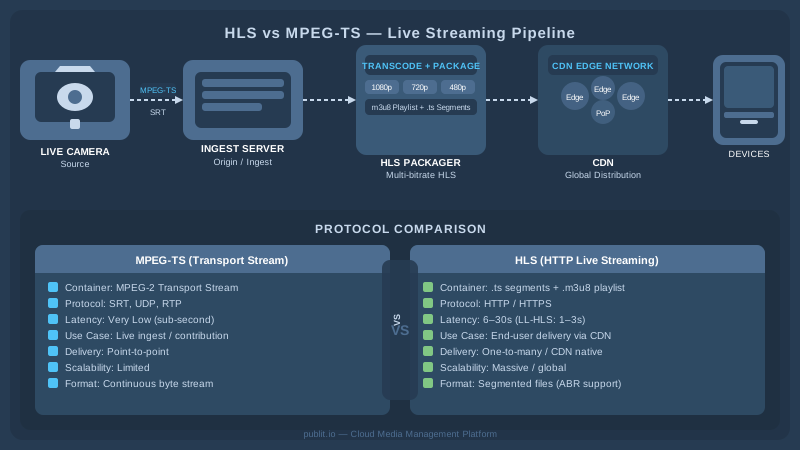
In practice, many modern streaming workflows use MPEG-TS at the ingest and contribution layer, then transcode and package to HLS (with either MPEG-TS or fMP4 segments) for last-mile delivery. The two formats complement each other rather than compete.
MPEG-TS Segments Inside HLS: Should You Switch to fMP4?
If you are already using HLS and your question is specifically whether to use .ts segments or fMP4 segments, here is a practical summary:
Stick with MPEG-TS segments (.ts) if: you need maximum device compatibility, especially for older devices and browsers; your encoder or packager defaults to MPEG-TS and changing it would require significant effort; or you are not using DRM and do not need CMAF.
Move to fMP4 segments if: you want to implement LL-HLS for low latency; you need CMAF-based DRM for multi-DRM efficiency; you want to serve both HLS and MPEG-DASH from a single set of segments (CMAF enables this); or you are encoding with H.265/HEVC and want better compression ratios.
Streaming Architecture and CDN Delivery
Whether you choose MPEG-TS segments or fMP4 inside HLS, the CDN delivery layer works the same way: the manifest and segments are HTTP objects that CDN edge nodes cache and serve from locations close to your viewers. This dramatically reduces origin server load and improves playback start times globally.
Publitio's CDN is purpose-built for video delivery, with edge nodes optimized for both HLS manifest freshness (short TTLs for live manifests) and segment caching (longer TTLs for VOD segments). You can explore this through our CDN feature page. For developers building custom players or integrations, our video API provides programmatic control over packaging, delivery, and playback URL generation.
Video processing — transcoding, packaging, thumbnail generation, and quality ladder creation — is handled automatically when you upload content to Publitio. Our GPU-accelerated video conversion ensures that even large files are processed and ready for HLS delivery quickly, without requiring you to manage encoding infrastructure.
Practical Recommendations for Developers and Platform Teams
For Video On Demand Platforms
HLS with fMP4 segments is the recommended approach for new VOD deployments. Use H.264 for your base compatibility renditions and H.265 or AV1 for your high-efficiency tiers. Implement multi-DRM via CMAF if your content requires protection. If you manage a large library of video assets alongside images and other media, a structured digital asset management solution will be essential to keep your workflow organized and scalable.
For Live Streaming Products
Accept MPEG-TS (over SRT, RIST, or RTMP) at your ingest layer — this is what most broadcast encoders and software like OBS output. Transcode and package to HLS on your origin server. If you need low latency, implement LL-HLS on top of this. For analytics on live stream performance and viewer behavior, Publitio's analytics feature provides the insights you need to optimize delivery.
For WordPress Site Owners
If you run video content on a WordPress site, you do not need to manage encoding pipelines yourself. Publitio's WordPress media offloading plugin automatically offloads your video files to Publitio's infrastructure, where they are processed into HLS streams and delivered via CDN — with no server configuration required on your end.
For Broadcast and Enterprise Media Teams
If your workflow involves managing large volumes of video — live archives, highlight clips, multi-language versions, and raw footage — you need more than a player. A dedicated video management solution gives you metadata management, access controls, and workflow automation across your entire video library, alongside the delivery infrastructure to publish that content at scale.
Conclusion: Choosing the Right Format
The HLS vs MPEG-TS question does not have a single universal answer because the two technologies operate at different layers and serve different purposes. For internet-facing video delivery to end users — whether VOD, live, or interactive — HLS is the dominant and correct choice, offering ABR, CDN compatibility, DRM support, and broad device reach. MPEG-TS remains essential at the broadcast contribution and ingest layer, where its robustness over lossy networks and ultra-low latency profile make it irreplaceable.
In most real-world deployments, you will use both: MPEG-TS to get the video from the source to your processing infrastructure, and HLS to get it from your infrastructure to your viewers. The goal is to build a pipeline that is reliable, scalable, and cost-effective at every stage — and to choose packaging formats that serve your specific latency, compatibility, and protection requirements at each step.
Ready to stop worrying about streaming infrastructure and focus on building great video experiences? Publitio handles HLS packaging, GPU transcoding, CDN delivery, DRM, and video API integration in a single platform. Sign up at publit.io today and get your first videos streaming via HLS in minutes — no encoding expertise required. Check out our pricing page to find a plan that fits your scale, or dive straight into the developer documentation to start integrating.