
MAM Marketing: How Media Asset Management Transforms Your Marketing Workflows
Modern marketing teams produce an overwhelming volume of media — videos, images, audio files, brand assets, campaign materials — and managing all of it efficiently has become one of the defining challenges of the digital age. That's where MAM marketing comes in. Media Asset Management (MAM) is no longer just a tool for broadcasters or post-production studios; it has become a foundational pillar for marketing organizations that need to store, organize, transform, and distribute media at scale. In this post, we'll explore exactly how MAM transforms marketing workflows, what features to look for in a MAM platform, and why teams that invest in the right solution gain a decisive competitive edge.
What Is MAM and Why Does It Matter for Marketing?
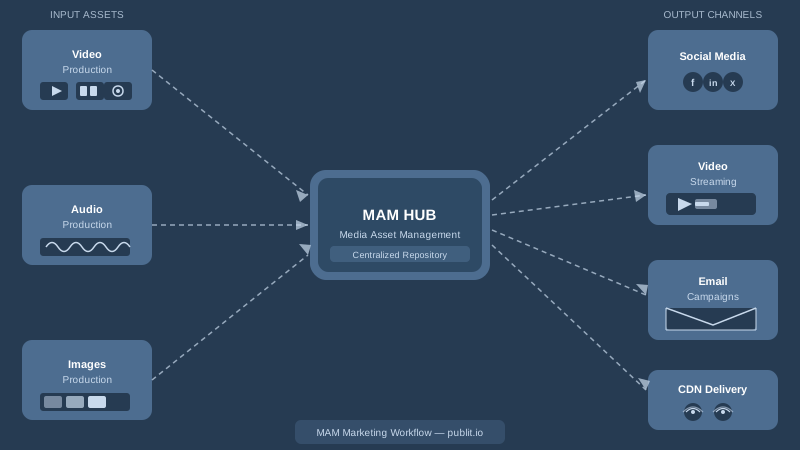
Media Asset Management refers to the systems, processes, and technologies used to ingest, catalog, store, retrieve, and distribute rich media files — primarily video, audio, and images. While a Digital Asset Management (DAM) solution tends to focus on a broader range of marketing collateral including documents, presentations, and brand guidelines, a MAM solution goes deeper into the specifics of rich media: encoding, transcoding, streaming protocols, and media-centric metadata.
For marketing teams, this distinction matters enormously. A brand producing dozens of video campaigns per quarter, managing multilingual audio tracks, or distributing assets across global CDN endpoints cannot rely on generic file storage or a basic DAM alone. They need the specialized capabilities that a MAM platform provides.
The business case is straightforward: without a centralized media asset management system, marketing teams waste hours searching for files, recreating lost assets, waiting for manual encoding processes, and struggling with inconsistent brand presentation across channels. These inefficiencies compound as teams scale, ultimately costing far more than the investment in the right platform.
The Core Pain Points MAM Marketing Solves
To appreciate the full value of a MAM-driven marketing approach, it helps to examine the specific pain points that teams experience before adopting one.
Asset Discovery and Version Control
Marketing teams frequently lose time hunting for the "right" version of a video or the approved crop of an image. Without a centralized system, assets live across shared drives, email threads, Slack messages, and personal laptops. A dedicated MAM platform enforces structured metadata, tagging, and version tracking so that every team member always retrieves the correct, approved asset on the first try.
Slow Content Delivery and Encoding Bottlenecks
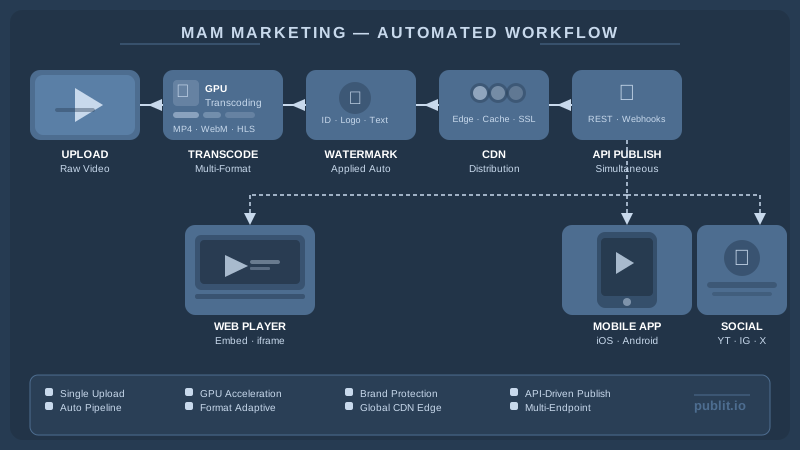
Video content especially suffers from encoding delays. When a campaign asset needs to be available in multiple resolutions and formats for web, mobile, and connected TV simultaneously, manual encoding pipelines create dangerous bottlenecks. A MAM platform with built-in GPU-accelerated video conversion dramatically reduces the time between upload and publication, keeping campaign timelines on track.
Inconsistent Brand Experience Across Channels
When assets are distributed manually without governance, teams risk publishing outdated logos, incorrect color variants, or watermark-free files that violate licensing terms. A robust MAM enforces brand standards programmatically — automatically applying watermarks, enforcing access permissions, and ensuring only approved assets reach external channels.
Global Distribution Latency
A marketing video that buffers on a prospect's device in Singapore or São Paulo is a marketing failure, regardless of how compelling its creative content is. Without a Content Delivery Network built into the media workflow, load times and buffering rates damage engagement metrics across geographies. Integrating CDN delivery into the MAM workflow ensures consistent performance globally without requiring separate vendor relationships or complex configuration.
Key Features of a MAM Platform Built for Marketing Teams
Not all MAM platforms are created equal. Marketing teams specifically need a solution that balances technical depth with operational simplicity. Here are the capabilities that matter most.
Video Management and Streaming at Scale
Video is the dominant format in modern marketing. From product explainers to customer testimonials, from live event recordings to social-ready short clips, marketing teams are video-first organizations. A capable video management solution gives teams the ability to upload, transcode, organize, and publish video assets from a single interface while supporting professional streaming protocols like HLS.
HLS (HTTP Live Streaming) is particularly important for marketing applications because it adapts video quality dynamically to the viewer's available bandwidth, preventing the buffering events that cause viewers to drop off. Platforms supporting HLS streaming also enable encryption and DRM, ensuring premium content reaches only authorized audiences — a critical requirement for gated webinars, paid course content, or exclusive product launches.
Image Management at Scale
Beyond video, marketing teams manage thousands of product images, lifestyle photographs, banner ad variants, and social media graphics. An integrated image management system within the MAM platform allows teams to store originals in full resolution and deliver optimized, format-correct derivatives on demand via API — without maintaining separate image CDN tools or manual export workflows.
Audio Asset Management
Podcast episodes, brand jingles, voiceover tracks, and music beds represent a growing category of marketing media. Dedicated audio management capabilities within a MAM platform ensure these files are versioned, accessible, and deliverable with the same efficiency as video and image assets.
API-First Architecture for Marketing Automation
Marketing stacks are complex ecosystems of CMS platforms, CRM systems, email marketing tools, and social publishing platforms. A MAM that operates on an API-first architecture allows development and marketing operations teams to automate asset delivery across the entire stack. Instead of manually exporting and uploading files to each platform, a single API call can retrieve, transform, and publish the correct asset to any connected destination.
Developers and marketing technologists can explore full integration capabilities through the platform's technical documentation, which covers everything from upload endpoints to streaming manifest generation.
MAM Marketing in Practice: Real-World Workflow Transformations
Understanding the theoretical benefits of MAM is one thing; seeing how it changes day-to-day marketing operations is another. Let's walk through three concrete workflow scenarios.
Scenario 1: Product Launch Video Campaign
A software company is launching a major product update and needs to publish a three-minute hero video across its website, a gated landing page, YouTube, LinkedIn, and an email campaign — all within 48 hours of the launch event recording being finalized.
Without a MAM platform, this means manually encoding multiple formats, uploading to five different destinations, creating embed codes, and hoping nothing gets lost in Slack. With a MAM platform like Publitio, the team uploads a single high-resolution master file. The platform's video processing pipeline automatically generates web-optimized versions at multiple resolutions. The gated landing page version gets DRM protection applied automatically. The video-on-demand delivery infrastructure handles all player embeds. The marketing team hits publish once; the rest is automated.
Scenario 2: Ongoing Social Media Content Pipeline
A consumer brand publishes fifteen to twenty social media videos per week across Instagram Reels, TikTok, Facebook, and YouTube Shorts. Each platform has different format requirements — aspect ratios, file sizes, maximum durations — and brand standards require a specific watermark placement on each.
A MAM platform with programmatic transformation capabilities means the team's social media manager uploads a single cut and specifies the output requirements. The platform handles all format derivatives automatically, applies consistent watermarks, and stores each variant linked to the same parent asset. Version history is preserved, and if brand guidelines change, the watermark template can be updated globally across all future outputs without manual rework.
Scenario 3: Enterprise CMS Integration via WordPress
A media publisher runs a WordPress-based content site with thousands of articles, each containing embedded images and videos. As the library grows, server storage costs escalate and page load times degrade — hurting both user experience and SEO rankings.
By implementing a WordPress media offloading solution, the publisher moves all media assets to a cloud-based MAM infrastructure with automatic CDN delivery. Images are served in next-generation formats with correct compression automatically. Videos are streamed via HLS rather than downloaded. Storage costs drop, page performance improves measurably, and the editorial team continues working within the familiar WordPress interface with zero disruption to their workflow.
Measuring the Impact: MAM Marketing ROI
Investing in a MAM platform is a strategic business decision, and like any marketing investment, it should be evaluated against measurable outcomes. Here are the key metrics teams use to quantify the return.
Time-to-Publish Reduction
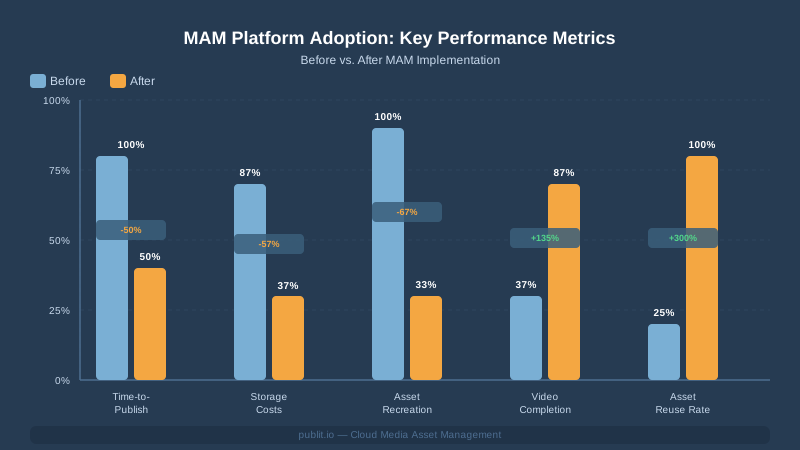
The most immediate and measurable impact of a MAM implementation is the reduction in time required to take a finished asset from storage to live publication. Organizations that previously required two to four hours of manual encoding and upload work per video asset commonly report reducing that to under fifteen minutes with automated pipelines. At scale — say, fifty video assets per month — that represents dozens of recovered hours that can be redirected toward creative production and strategy.
Engagement Metrics and Streaming Quality
Delivery infrastructure directly influences engagement. Teams that migrate from self-hosted or poorly optimized video hosting to a CDN-backed HLS streaming solution consistently see improvements in average watch time, completion rates, and bounce rates on video-heavy pages. Platform-level video analytics allow marketers to attribute these improvements to specific infrastructure changes and optimize accordingly.
Asset Reuse Rate
A well-organized MAM system makes it easy for teams to find and repurpose existing assets rather than commissioning new production. When teams can search and retrieve assets reliably, they increase the value extracted from each production investment. A campaign video produced for one channel becomes the source for a dozen derivatives across formats and platforms, each tracked in the MAM with its own performance data.
Cost Reduction in Storage and Bandwidth
Centralizing assets and eliminating duplicates reduces raw storage costs. Intelligent CDN delivery optimizes bandwidth consumption. For high-traffic properties, these savings alone can justify the cost of a MAM subscription, making additional workflow efficiencies essentially free from a financial perspective. Organizations can evaluate platform costs relative to their specific media volumes using Publitio's transparent pricing structure.
Choosing the Right MAM Platform for Your Marketing Team
The MAM market includes solutions ranging from enterprise broadcast-focused platforms costing hundreds of thousands of dollars annually to lightweight SaaS tools that lack the depth marketing teams need as they scale. Evaluating the right platform requires clarity on a few critical dimensions.
Scalability and API Flexibility
Marketing needs grow and change. A platform that works well for a team publishing ten videos per month must also scale to support ten thousand without requiring a platform migration. API-first architecture is the clearest signal of genuine scalability — it means the platform was designed to be integrated, automated, and extended rather than locked into a single interface paradigm. Teams interested in evaluating the depth of API capabilities can review the free video API offering as a starting point.
Streaming and Delivery Infrastructure
For video-heavy marketing operations, the quality of the streaming and CDN infrastructure is non-negotiable. Look for native HLS support, adaptive bitrate streaming, global CDN coverage, and DRM options for protected content. These capabilities determine the quality of experience your audience has with every piece of video content you publish.
Ease of Use Across Technical and Non-Technical Users
A MAM platform is only as valuable as the adoption rate within the team. Solutions that require developer intervention for routine tasks will see low adoption from creative and marketing staff. The best platforms offer intuitive interfaces for day-to-day users while exposing full API and configuration depth for technical implementers — ensuring every team member gets value from the system.
Support for the Full Media Spectrum
Marketing media isn't just video. A platform that handles video, images, audio, and documents within a unified asset management framework eliminates the tool sprawl that defeats the purpose of centralization. Ensure your chosen MAM covers every media type your team currently produces and any formats you're likely to adopt in the next two to three years.
The Future of MAM Marketing
The trajectory of MAM in marketing points clearly toward greater automation, deeper AI-assisted metadata and content tagging, and tighter integration with the broader marketing technology ecosystem. Teams that establish strong MAM foundations today will be positioned to adopt AI-driven content personalization, programmatic creative variation, and real-time asset optimization as those capabilities mature.
What will not change is the fundamental premise: marketing success depends on the ability to create compelling content and deliver it efficiently at scale. Every hour lost to disorganized asset management is an hour that could have been spent on strategy, creative, or audience development. A purpose-built MAM platform removes those operational inefficiencies systematically, letting marketing teams focus on what they do best.
The brands and marketing organizations that treat their media infrastructure as a strategic investment — rather than an operational afterthought — are the ones consistently building faster, more coherent, and more effective marketing programs. MAM marketing isn't a niche technical concern; it's a core competitive capability.
Ready to transform how your marketing team manages and delivers media? Publitio gives you a complete cloud-based MAM platform with GPU-powered video conversion, HLS streaming, global CDN delivery, DRM protection, and a powerful API — all in one solution designed to scale with your ambitions. Sign up at publit.io today and experience what efficient, professional media asset management looks like in practice. Your first assets are free to upload, and no credit card is required to get started.