
MPEG-TS vs HLS: Key Differences and When to Use Each Format
If you work with video streaming, you have almost certainly encountered the debate around MPEG-TS vs HLS. Both formats play a central role in how video content is packaged, transported, and delivered to viewers — but they serve different purposes, operate under different technical assumptions, and excel in very different scenarios. Understanding the distinctions between MPEG Transport Stream (MPEG-TS) and HTTP Live Streaming (HLS) is essential for engineers, developers, and media teams who want to make smart, future-proof decisions about their video infrastructure.
In this guide, we break down exactly how each format works, where they overlap, where they diverge, and — most importantly — when you should choose one over the other for your streaming workflows.
What Is MPEG-TS?
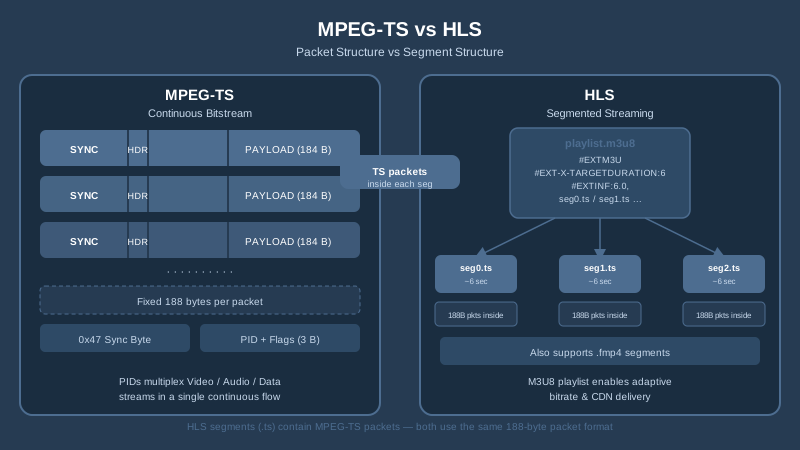
MPEG Transport Stream, commonly abbreviated as MPEG-TS or simply TS, is a standardized container format defined by MPEG (ISO/IEC 13818-1) and originally designed for broadcast television. It has been a cornerstone of digital broadcasting since the 1990s and is used in DVB (Digital Video Broadcasting), ATSC (the North American broadcast standard), and satellite transmissions.
MPEG-TS works by breaking audio, video, and metadata into fixed-size 188-byte packets. These small, discrete packets make the format inherently robust — if packets are lost or corrupted during transmission, the stream can often recover without losing the entire feed. This characteristic made it ideal for unreliable broadcast environments like satellite and cable.
Key Technical Characteristics of MPEG-TS
- Fixed 188-byte packet size — ensures consistent structure regardless of the content being carried.
- Multiplexing — multiple audio, video, and data streams can be combined into a single transport stream.
- Error resilience — built-in error correction makes it robust over lossy physical transmission channels.
- PCR clock synchronization — Program Clock Reference fields keep audio and video in sync during real-time broadcast.
- Low latency for live broadcast — the format was designed from the ground up to support real-time transmission.
MPEG-TS is also the underlying container format used inside HLS segments, which is one of the reasons the two formats are so frequently compared — they are more interconnected than many people realize.
What Is HLS?
HTTP Live Streaming (HLS) is an adaptive bitrate streaming protocol developed by Apple and introduced in 2009. Rather than transmitting a continuous stream of data over a specialized protocol, HLS breaks video into a sequence of small media segments and serves them over standard HTTP. A manifest file (the M3U8 playlist) tells the player which segments to download and in what order.
Because HLS runs entirely over HTTP, it works seamlessly through firewalls, content delivery networks, and standard web infrastructure — no special media servers required. This made it enormously popular and it quickly became the dominant streaming format on the web and mobile devices.
Key Technical Characteristics of HLS
- Adaptive Bitrate (ABR) — HLS can serve multiple quality renditions and the player automatically switches between them based on available bandwidth.
- HTTP delivery — runs over the same infrastructure used for any web content, with full CDN compatibility.
- M3U8 manifest — a plain-text playlist that indexes all available quality levels and segments.
- Segment-based delivery — content is broken into discrete chunks (typically 2–10 seconds each).
- Broad device support — natively supported by iOS, macOS, and most modern browsers and smart TVs.
- Encryption support — HLS supports AES-128 encryption and is compatible with DRM systems.
HLS originally used MPEG-TS as its segment container, but since 2016 it has also supported fragmented MP4 (fMP4) segments, which offer improved efficiency and broader compatibility with the MPEG-DASH ecosystem.
MPEG-TS vs HLS: A Direct Comparison
To understand which format suits your use case, it helps to look at them side by side across the dimensions that matter most in real-world deployments.
Delivery Protocol and Infrastructure
MPEG-TS was designed for physical broadcast channels — satellite, cable, and terrestrial broadcast. It is commonly delivered over UDP (User Datagram Protocol) in traditional broadcast environments, which prioritizes speed over guaranteed delivery. In internet streaming contexts, MPEG-TS is typically tunneled over protocols like RTP (Real-Time Transport Protocol) or SRT (Secure Reliable Transport).
HLS, by contrast, was built for HTTP delivery from the ground up. Every segment is simply an HTTP GET request. This makes HLS trivially easy to deploy behind a CDN, cache at edge nodes, and scale to millions of concurrent viewers without specialized infrastructure. For Publitio users, this means CDN-accelerated HLS delivery can be configured without any complex media server setup.
Latency
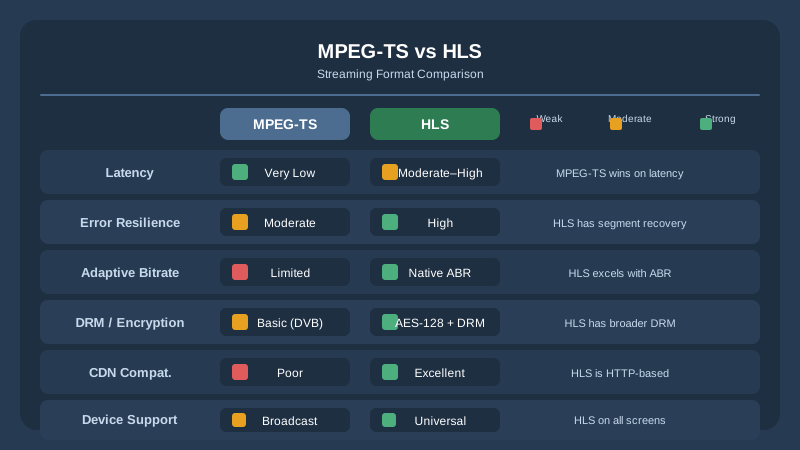
Latency is one of the most significant practical differences in the MPEG-TS vs HLS comparison. Traditional MPEG-TS broadcast streams can achieve sub-second latency, making them suitable for live sports and news broadcasting where real-time delivery is essential.
Standard HLS historically suffered from much higher latency — often 15–30 seconds — due to the overhead of creating, uploading, and downloading segments before playback. Apple's Low-Latency HLS (LL-HLS) specification, introduced in 2019, addresses this gap by using partial segments and server push hints, bringing latency down to 2–5 seconds in optimal conditions. However, LL-HLS adds implementation complexity and is not yet universally supported.
Adaptive Bitrate Streaming
Traditional MPEG-TS has no native adaptive bitrate mechanism. The stream is delivered at a fixed quality, and if a viewer's connection degrades, they experience buffering or degraded quality with no automatic adjustment. Some protocols that carry MPEG-TS (like SRT) can handle variable network conditions, but the adaptation logic lives in the transport layer, not the format itself.
HLS was built around adaptive bitrate streaming. The M3U8 master playlist can reference multiple variant playlists at different resolutions and bitrates, and a compliant HLS player will continuously monitor download speeds and buffer health to switch between them seamlessly. This makes HLS significantly more viewer-friendly for general internet delivery, particularly on mobile networks where bandwidth can fluctuate dramatically.
Error Resilience
MPEG-TS has strong native error resilience at the packet level. Because each 188-byte packet is largely self-contained and the stream includes continuity counters, receivers can detect packet loss and, in many cases, recover gracefully. This was critical for broadcast environments where transmission errors are common.
HLS relies on TCP's error correction, which guarantees delivery but introduces retransmission overhead. In low-latency live scenarios, a stalled TCP connection can cause playback interruptions. However, for most VoD and general streaming purposes, TCP reliability is more than adequate and simplifies the entire delivery stack.
DRM and Encryption
Both formats support content protection, but HLS has a more mature and widely deployed ecosystem for it. HLS supports AES-128 segment encryption natively and integrates with major DRM systems including FairPlay (Apple), Widevine (Google), and PlayReady (Microsoft) through SAMPLE-AES encryption and Common Encryption (CENC) standards.
MPEG-TS supports Conditional Access Systems (CAS) used in broadcast, but these are less relevant for internet-based streaming. For web and OTT delivery, HLS DRM integration is significantly more straightforward. Platforms that need robust content protection for premium video will find HLS — combined with a proper digital rights management solution — far more practical for internet distribution.
When to Use MPEG-TS
Despite HLS being the dominant internet streaming format, MPEG-TS remains the right choice in several important scenarios:
Broadcast and Satellite Distribution
MPEG-TS is the native format for DVB, ATSC, and ISDB broadcast standards. If you are distributing content over satellite, cable, or terrestrial broadcast infrastructure, MPEG-TS is not just preferred — it is required. Broadcast encoders, multiplexers, and set-top boxes all speak MPEG-TS natively.
Contribution and Production Workflows
In professional broadcast production, MPEG-TS over SRT or RTP is commonly used to move live video between production facilities, between an encoder and an ingest point, or from a remote location to a broadcast center. SRT in particular has become the go-to protocol for contribution over the public internet due to its combination of MPEG-TS compatibility and modern reliability features.
Low-Latency Live Streaming Over Controlled Networks
When you control the network — a LAN, a private WAN, or a venue's closed network — MPEG-TS over UDP can deliver near-zero latency that even Low-Latency HLS cannot match. For live events where production monitors need real-time feeds, MPEG-TS over a controlled network is often the best option.
Legacy Infrastructure Compatibility
If your delivery chain includes legacy hardware decoders, broadcast monitors, or playout systems that were built before HLS became ubiquitous, MPEG-TS may be the only format these devices understand. Replacing or retrofitting legacy broadcast infrastructure is expensive, so TS compatibility can be a deciding factor.
When to Use HLS
For most modern internet video delivery use cases, HLS is the clear choice — and understanding why helps clarify the full MPEG-TS vs HLS picture.
Video-on-Demand for Web and Mobile
HLS is natively supported by Safari, iOS, Android (via ExoPlayer), most smart TVs, and virtually every modern streaming platform. For video-on-demand delivery, HLS provides adaptive bitrate streaming, broad device compatibility, and CDN-friendly delivery without requiring any plugins or specialized infrastructure on the viewer's end.
Large-Scale Live Streaming Over the Internet
When you need to stream live events to thousands or millions of concurrent viewers over the public internet, HLS's HTTP-based delivery model scales effortlessly through CDN infrastructure. Edge caching means that popular streams don't require a proportional increase in origin server capacity as viewership grows.
Secure Premium Content Delivery
For platforms that monetize premium video — subscription services, pay-per-view events, corporate training portals — HLS's robust DRM ecosystem makes it the practical choice for protecting content. When combined with token-authenticated CDN URLs and proper encryption, HLS provides a comprehensive content security stack that MPEG-TS broadcast CAS systems cannot replicate for OTT delivery.
Multi-Device and Multi-Platform Distribution
If your content needs to reach viewers across web browsers, mobile apps, smart TVs, and connected devices simultaneously, HLS's universal support eliminates the need to transcode and package content in multiple formats. A well-configured HLS streaming pipeline with adaptive bitrate renditions covers virtually every screen type your audience might use.
Integration with Cloud Media Workflows
Modern cloud-based video management platforms are built around HLS. Automated transcoding, video processing pipelines, and CDN integration all assume HLS as the delivery output. Using HLS means your video infrastructure integrates cleanly with APIs, analytics, and asset management systems without custom format translation layers.
The Relationship Between MPEG-TS and HLS
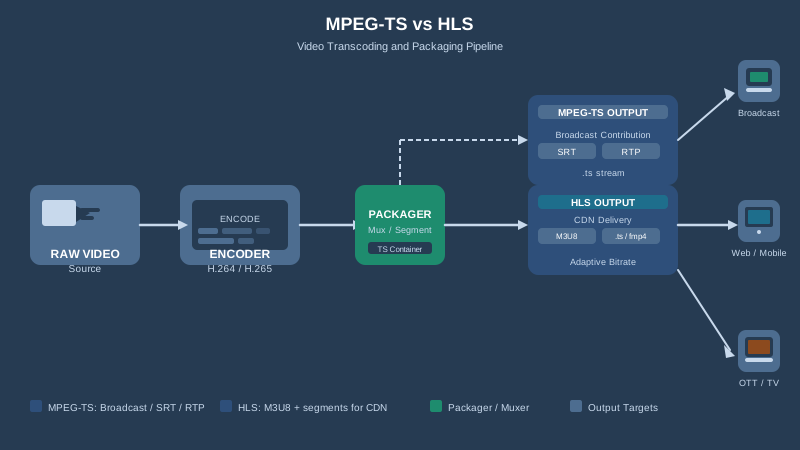
It is worth reiterating that MPEG-TS and HLS are not entirely separate worlds — they are deeply connected. The original HLS specification used MPEG-TS as the segment container format. When your encoder creates HLS output, it is typically producing a series of .ts files (MPEG Transport Stream segments) referenced by the M3U8 playlist. So in that sense, HLS is a delivery mechanism built on top of MPEG-TS.
This is why many encoding tools and cloud video platforms support both formats as outputs from the same transcoding pipeline. The video content encoded inside the MPEG-TS packets within an HLS stream is identical to what you would find in a standalone MPEG-TS broadcast stream — only the delivery wrapper and mechanism differ.
Modern HLS has moved toward fMP4 segments as the preferred container (used in CMAF — Common Media Application Format), which improves interoperability with MPEG-DASH and enables more efficient packaging. But TS-based HLS segments remain widely used and fully supported.
MPEG-TS vs HLS for Developers: Practical Considerations
For developers building streaming applications, the choice between MPEG-TS and HLS has direct implications for your tech stack and workflow.
Player Support and JavaScript Libraries
HLS has rich player ecosystem support. Libraries like HLS.js, Video.js, and Shaka Player bring HLS playback to browsers that do not support it natively. MPEG-TS playback in browsers typically requires a JavaScript demuxer (like mpegts.js) and is generally more complex to implement reliably, particularly across different browsers.
API-First Streaming Platforms
If you are building on top of a cloud media API, you will almost certainly be working with HLS outputs. Platforms designed for developers typically expose video API endpoints that return HLS manifests for playback, handle adaptive bitrate packaging automatically, and integrate with analytics and CDN delivery without requiring you to manage any of the underlying format complexity. You can explore Publitio's full API documentation to see how HLS delivery is surfaced through a developer-friendly interface.
Transcoding and GPU Acceleration
Producing multiple HLS renditions from a single source requires transcoding — a computationally intensive process. Cloud platforms that offer GPU-accelerated video conversion can dramatically reduce the time required to generate a full adaptive bitrate HLS ladder from an uploaded source file, which is critical for workflows where video needs to be available quickly after upload.
Summary: Choosing Between MPEG-TS and HLS
The right answer in any MPEG-TS vs HLS decision comes down to your delivery context:
- Choose MPEG-TS when you are working with broadcast infrastructure, professional video contribution, legacy hardware, or scenarios requiring sub-second latency over controlled networks.
- Choose HLS when you are delivering video over the public internet to web, mobile, or OTT audiences — especially when you need adaptive bitrate, CDN scalability, broad device support, or DRM-based content protection.
- Consider both together when your workflow involves professional broadcast contribution (TS) feeding into an internet distribution pipeline (HLS), which is increasingly common in modern hybrid broadcast and streaming architectures.
For the vast majority of modern streaming use cases — VoD platforms, live event streaming, OTT services, and developer-built video applications — HLS is the foundation you should build on. MPEG-TS remains indispensable in broadcast production and contribution workflows, but for reaching viewers on screens connected to the internet, HLS has won decisively.
If you are managing video assets, building a streaming platform, or looking to simplify your video delivery infrastructure, Publitio gives you everything you need in one place — from automated HLS transcoding and adaptive bitrate packaging to CDN delivery, DRM encryption, and a fully documented API. Whether you are a solo developer or a media team managing thousands of assets, Publitio's media asset management platform handles the complexity so you can focus on your content. Sign up at publit.io today and start delivering professional-grade video streaming to any device, at any scale.