


Multi DRM Video Protection: How to Secure Your Content Across Every Device
If you distribute video content online — whether it's a course library, a premium OTT channel, or an enterprise training portal — multi DRM video protection is the security layer that stands between your content and unauthorized copying or redistribution. A single DRM system is no longer enough. Today's viewers watch on Chrome, Safari, Android, smart TVs, and iOS devices simultaneously, and each ecosystem demands its own DRM technology. This guide breaks down how multi-DRM works, why it matters, and how a platform like Publitio's Digital Rights Management solution gives you comprehensive coverage without the complexity.
What Is DRM and Why Does One System Fall Short?
Digital Rights Management (DRM) is a set of technologies that encrypt video content and control how, when, and on which devices it can be played back. The encryption ensures that even if someone intercepts the video stream, they cannot decode it without a valid license issued by a trusted license server.
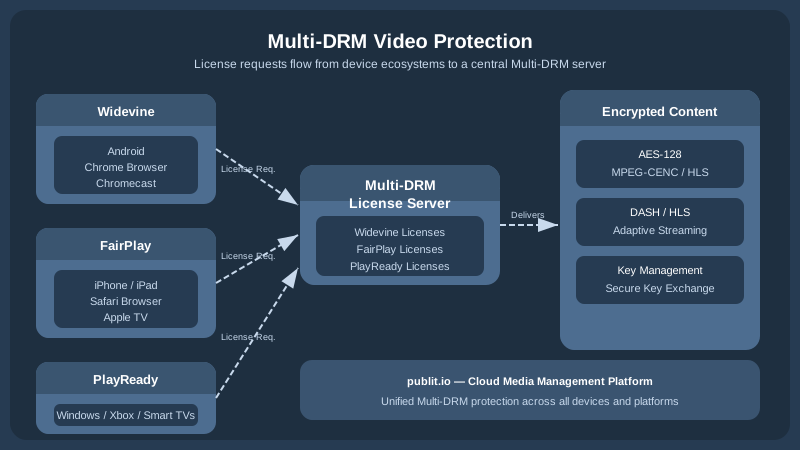
The challenge is that the three dominant DRM systems — Widevine (Google), FairPlay (Apple), and PlayReady (Microsoft) — are each tied to specific browsers and operating systems. Widevine works in Chrome, Firefox, and Android. FairPlay is exclusive to Safari and iOS. PlayReady covers Microsoft Edge and many smart TV platforms. No single DRM covers every surface.
This fragmentation means that if you deploy only Widevine, your content is completely unprotected on every Apple device. Deploy only FairPlay, and Android users are left with no protection at all. Multi DRM video protection solves this by packaging your content once and dynamically serving the right DRM license to each device, automatically and transparently.
The Three Pillars of Multi-DRM
- Widevine L1/L3: Google's DRM used across Android devices, Chrome, and Chromium-based browsers. L1 offers hardware-level security; L3 is software-based.
- FairPlay Streaming (FPS): Apple's DRM for Safari on macOS and all iOS/iPadOS devices. Mandatory for HLS streams on Apple hardware.
- PlayReady: Microsoft's DRM powering Edge, Xbox, Windows apps, and a wide range of smart TV and set-top-box platforms.
How Multi DRM Video Protection Works End-to-End
Understanding the lifecycle of a protected video stream helps you make smarter decisions about your infrastructure. Here's what happens from upload to playback:
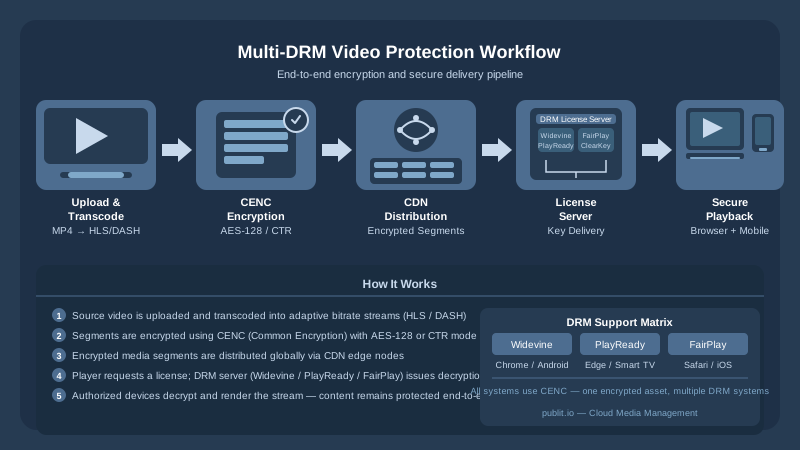
1. Ingestion and Encoding
Raw video files are ingested and transcoded into adaptive bitrate (ABR) formats. For DRM-protected delivery, this almost always means encoding into HLS (HTTP Live Streaming) for Apple ecosystems and DASH (Dynamic Adaptive Streaming over HTTP) for Widevine and PlayReady environments. Publitio's video processing pipeline handles multi-resolution transcoding automatically, preparing your content for secure ABR delivery without manual intervention.
2. Encryption and Packaging
After encoding, the video segments are encrypted using AES-128 or CENC (Common Encryption). CENC is particularly important in a multi-DRM context because it allows a single encrypted content package to be decrypted by Widevine, FairPlay, or PlayReady — you encrypt once, rather than maintaining three separate encrypted copies of every video file.
3. License Server and Key Management
When a user attempts to play protected content, their player sends a license request to the appropriate DRM license server. The server authenticates the request, checks entitlements (is this user subscribed? is this device authorized?), and returns an encrypted license containing the decryption key. The player uses this key to decrypt and render the video in real time. Keys are never exposed to the client application directly.
4. Secure Delivery via CDN
Encrypted video segments are delivered through a CDN to minimize latency and maximize reliability at scale. Because the segments are encrypted, CDN edge nodes handle the raw ciphertext — even a compromised edge node reveals nothing playable. Publitio's built-in CDN delivery layer is integrated directly into the video pipeline, so you don't need to wire up a separate CDN provider to get global, low-latency distribution.
5. Playback and Token Validation
Modern HTML5 players (Video.js, Shaka Player, hls.js) use the Encrypted Media Extensions (EME) browser API to communicate with the DRM system transparently. From the viewer's perspective, the video just plays. Behind the scenes, token-based authentication ensures that licenses are only issued to entitled, authenticated sessions.
Key Use Cases That Demand Multi DRM Video Protection
Not every video needs DRM — a public marketing video on your homepage doesn't require encryption. But for certain content categories, robust multi-DRM protection is non-negotiable:
OTT and Subscription Video Platforms
If users pay for access to your video library, DRM is the primary technical control preventing account sharing escalation into full credential theft and redistribution. Studios and distributors increasingly require proof of DRM implementation before licensing premium content to new platforms.
Online Education and eLearning
Course creators invest enormous resources in producing video curriculum. Without DRM, a single subscriber can download and redistribute an entire course library, decimating the creator's revenue model. Multi-DRM ensures course videos play only within your authenticated LMS or app environment.
Corporate Training and Internal Communications
Enterprises use DRM to prevent sensitive training materials, product roadmap presentations, and internal communications from leaking outside the organization. Combining DRM with domain restrictions and IP whitelisting creates a layered access control model. Publitio's video management platform supports these enterprise access control patterns natively.
Live and On-Demand Sports and Events
Pay-per-view events are particularly vulnerable to stream ripping and unauthorized rebroadcasting. Multi-DRM combined with short-lived license tokens and concurrent stream limits significantly reduces piracy exposure for live events. Explore how Publitio's video-on-demand infrastructure supports both live and on-demand protected delivery.
Media and Entertainment Archives
Film libraries, music video archives, and documentary collections represent enormous intellectual property value. Multi-DRM protects these assets across the long tail of consumption, where content may be accessed years after initial release across a wide range of device generations.
Multi-DRM vs. Other Content Protection Methods
DRM is often discussed alongside other protection techniques. It's worth understanding where each fits:
HLS Encryption (AES-128) Without DRM
Basic HLS AES-128 encryption protects segments in transit but is relatively easy to circumvent because the decryption keys are accessible to the player. It provides a meaningful barrier against casual copying but not against determined attackers. True multi-DRM replaces or augments this with hardware-backed key protection. Publitio's HLS streaming feature supports both standard AES-128 encryption and full DRM integration, giving you the right level of protection for each use case.
Watermarking
Forensic watermarking embeds an invisible, user-specific identifier into the video stream. It doesn't prevent piracy directly, but it allows you to trace the source of leaked content after the fact. Watermarking and DRM are complementary rather than competing: DRM prevents unauthorized playback; watermarking enables forensic attribution when DRM is bypassed. Publitio offers video and image watermarking as an additional layer within the same platform.
Geo-Blocking and Token Authentication
These are access control measures, not encryption. They control who can request content but don't protect the content itself once delivered. A determined attacker can often bypass geo-blocking. They are best used as a complement to DRM, not a replacement for it.
Implementing Multi DRM Video Protection with Publitio
Building multi-DRM infrastructure from scratch is a significant engineering undertaking. You need to integrate with multiple DRM license server SDKs, manage key rotation, handle token-based license authentication, build fallback logic for unsupported devices, and maintain all of this as DRM specifications evolve. For most teams, this is months of development work that doesn't directly advance your product's core value proposition.
Publitio abstracts this complexity into a single, API-first platform. Here's what that looks like in practice:
Upload Once, Protect Everywhere
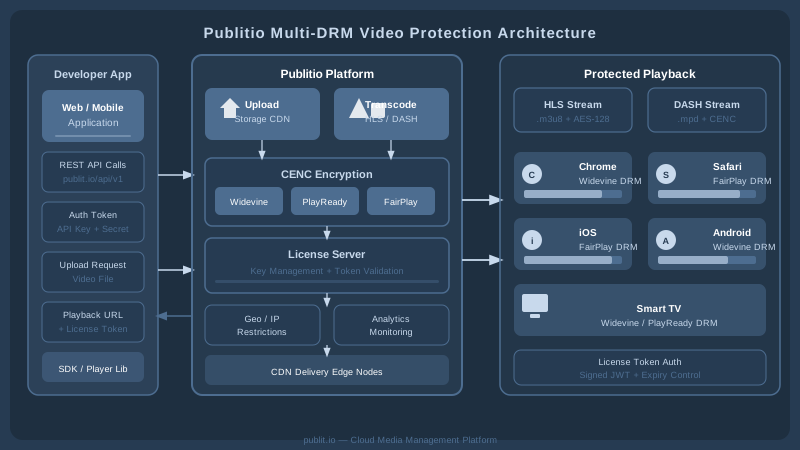
Upload your video through the Publitio API or dashboard. The platform automatically transcodes it into adaptive bitrate HLS and DASH streams, applies CENC encryption, and registers the content keys with the Widevine, FairPlay, and PlayReady license servers. You don't manage separate encoding jobs or separate encryption passes. The Publitio Video API exposes all of this through clean, documented REST endpoints, so your developers can integrate DRM-protected video delivery into any application stack.
License Token Generation via API
When an authenticated user requests playback, your backend calls the Publitio API to generate a short-lived, signed license token. This token is passed to the player, which uses it to request a DRM license. Because tokens are time-limited and tied to a specific user session, credential sharing and token reuse are tightly controlled. Full API documentation is available in the Publitio developer docs.
Player Integration
Publitio's DRM-protected streams are compatible with any EME-compliant HTML5 player. The platform provides player integration guides for the most popular open-source and commercial players, so your front-end team isn't starting from zero. For mobile applications, native SDK support for Android ExoPlayer and iOS AVPlayer is available.
Analytics and Monitoring
Security without visibility is incomplete. Publitio's video analytics give you insight into playback success rates, license request volumes, geographic distribution, and error rates — all of which are useful signals for detecting anomalous access patterns that might indicate a security incident.
Best Practices for Multi-DRM Video Security
Technology alone doesn't guarantee content security. These operational practices strengthen your overall DRM posture:
- Use short-lived license tokens: Tokens with a 15–60 minute TTL significantly reduce the window for token theft and replay attacks.
- Enforce concurrent stream limits: Limit each account to a defined number of simultaneous streams to curb credential sharing.
- Rotate encryption keys regularly: Especially for long-running subscription content, periodic key rotation limits the damage of any single key compromise.
- Require Widevine L1 for high-value content: Widevine L1 enforces hardware-level key protection and prevents screen capture on Android devices. Consider requiring L1 for your highest-value content tiers.
- Combine DRM with forensic watermarking: For content where the risk of high-quality leaks is significant, watermarking provides the attribution trail that DRM alone cannot.
- Audit license server logs: Unusual spikes in license requests from a single account or geography may indicate a coordinated piracy operation.
- Test across device matrix regularly: DRM implementations can break with OS or browser updates. Maintain a regression test suite covering your key device/browser combinations.
Pricing and Getting Started
One of the most common concerns teams have about multi-DRM is cost. Enterprise DRM licenses from Widevine, FairPlay, and PlayReady can individually run into significant annual fees, and the engineering cost of integrating them compounds the expense. Publitio's approach bundles DRM as part of a broader media management platform, so you're not paying for three separate DRM vendor relationships on top of your storage, encoding, and CDN costs.
You can review exactly what's included at each tier on the Publitio pricing page. Plans scale with your storage and bandwidth usage, making it practical for independent creators and early-stage platforms to implement enterprise-grade multi-DRM protection from day one — not as an afterthought when piracy becomes a crisis.
Conclusion: Secure Every Screen, Not Just Most of Them
The fragmentation of the device landscape is permanent. Apple will not adopt Widevine; Google will not adopt FairPlay. Any video protection strategy that relies on a single DRM system will leave a meaningful portion of your audience — and your content — exposed. Multi DRM video protection is not a luxury feature for large studios; it's the baseline technical requirement for any business that derives value from premium video content.
The good news is that implementing multi-DRM no longer requires a dedicated security engineering team or six-figure DRM vendor contracts. With the right platform, you can go from unprotected video hosting to full Widevine, FairPlay, and PlayReady coverage in days, not months, and manage it all through a single API and dashboard.
Ready to secure your video content across every device and platform? Sign up for a free Publitio account at publit.io and explore how our integrated multi-DRM, HLS streaming, and CDN delivery platform gives your content the protection it deserves — without the infrastructure overhead. Start your free trial today and see how straightforward enterprise-grade video security can be.


