


Secure Video Hosting: How to Protect Your Videos in the Cloud
Whether you are distributing premium training courses, confidential corporate communications, or monetized entertainment content, secure video hosting is no longer optional — it is a fundamental requirement. As more organizations move their media libraries to the cloud, the risks of unauthorized access, content piracy, and data breaches grow in parallel. Choosing the right platform means understanding which security layers genuinely protect your videos and which are mere marketing checkboxes. In this guide we break down every major protection mechanism available today, explain how they work together, and show you what to look for when evaluating a cloud video host.
Why Video Security Matters More Than Ever
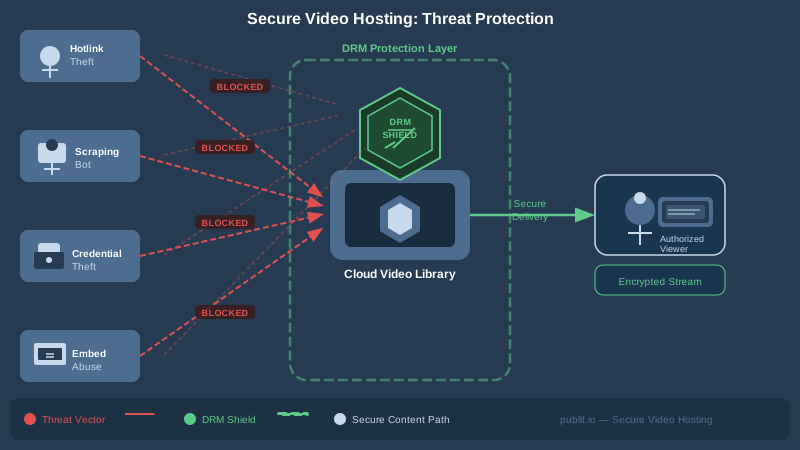
Video content represents some of the most valuable intellectual property a creator or business can own. A single leaked training module, a pirated pay-per-view event, or an unauthorized copy of a product demo can translate directly into lost revenue, damaged brand equity, and even legal liability. According to industry estimates, digital video piracy costs the global economy tens of billions of dollars every year — and the problem accelerates as broadband speeds make high-resolution downloads trivially fast.
Beyond piracy, organizations face compliance pressures. Healthcare providers streaming patient education videos must respect HIPAA guidelines. Financial institutions hosting investor briefings must guard against insider leaks. Academic institutions distributing licensed documentary content must honor publisher agreements. All of these scenarios demand a hosting infrastructure built with security at its core, not bolted on as an afterthought.
Core Features of a Secure Video Hosting Platform
Not all video hosts are created equal. When evaluating options, look for a platform that combines multiple interlocking security mechanisms. Relying on any single technique leaves exploitable gaps. Below are the essential pillars every serious platform should offer.
HLS Streaming with End-to-End Encryption
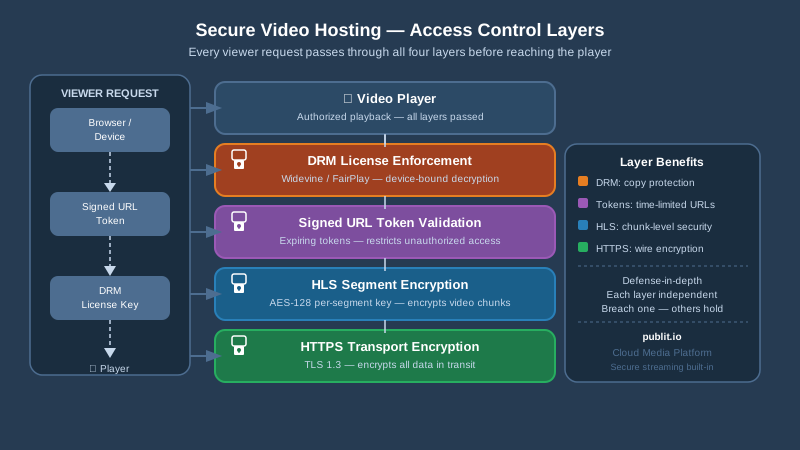
HTTP Live Streaming (HLS) has become the dominant adaptive bitrate protocol for video delivery, and for good reason: it breaks video into small encrypted segments delivered over standard HTTPS connections. When combined with AES-128 or stronger key encryption, each individual segment is useless without the correct decryption key — making offline recording attacks far less practical. Publitio's HLS streaming feature delivers content via encrypted segments, so even if a user manages to intercept traffic, they capture only scrambled data rather than playable video.
Digital Rights Management (DRM)
DRM is the gold standard for protecting premium and commercially licensed video content. A proper DRM implementation wraps your video in an encrypted container and issues time-limited, device-bound licenses to authorized viewers. The three major DRM systems — Widevine (Google), FairPlay (Apple), and PlayReady (Microsoft) — together cover virtually every modern browser and device. Multi-DRM support means your content is protected across the entire audience landscape without requiring separate workflows for each ecosystem. Publitio's digital rights management solution integrates multi-DRM licensing so you can set granular playback policies, including geographic restrictions, concurrent stream limits, and rental expiration windows.
Signed URLs and Token-Based Access Control
Even perfectly encrypted video is only as safe as the door that opens it. Signed URLs attach a cryptographic signature and an expiration timestamp to every access request. A URL that is shared, scraped, or stolen becomes invalid the moment its time window closes. Token-based authentication adds another layer: viewers must present a valid session token — issued only after successful login or payment — before the player is permitted to request stream segments. Together, these mechanisms ensure that embedding your video on an unauthorized third-party site produces nothing but a broken player.
Domain and IP Restrictions
Restricting playback to your own domains prevents hotlinking — the practice of embedding your video player on external sites to consume your bandwidth and bypass your paywalls. IP whitelisting and geo-blocking let you enforce regional licensing agreements or simply limit distribution to expected audience locations. These controls are especially valuable for enterprise use cases such as internal training portals or region-specific marketing campaigns.
Watermarking
Forensic and visible watermarking serve different but complementary purposes. Visible watermarks deter casual screen recording by making pirated copies immediately identifiable as stolen content. Forensic watermarks embed imperceptible, viewer-specific identifiers in the video stream itself; if a copy surfaces on a piracy site, you can trace it back to the exact account or session that leaked it. Publitio's watermarking feature lets you overlay dynamic text or image watermarks on your video files, adding a visible layer of ownership branding to every playback session.
Secure Video Hosting Architecture: What Happens Behind the Scenes
Understanding the technical pipeline helps you ask the right questions when evaluating any hosting vendor. Here is how a well-architected secure video workflow operates from upload to playback.
Ingestion and Processing
Security begins the moment a file is uploaded. Files should be transmitted over TLS-encrypted connections and stored at rest with AES-256 encryption. Once stored, the platform's transcoding pipeline converts your source file into multiple HLS renditions optimized for different network conditions. GPU-accelerated transcoding dramatically speeds up this step, which matters for large libraries or live-event workflows. Publitio's GPU video conversion infrastructure handles this processing stage at scale, and the video processing pipeline supports a wide range of input codecs and output profiles. Critically, processed renditions should be stored with the same encryption standards as the original.
CDN Delivery and Edge Security
A global Content Delivery Network is not just a performance tool — it is a security asset. By routing requests through distributed edge nodes, a CDN absorbs DDoS traffic, enforces rate limiting, and reduces the attack surface exposed by any single origin server. Edge nodes also handle token validation and signed URL verification before forwarding requests to origin storage, meaning malformed or expired requests are rejected at the geographic edge closest to the attacker rather than consuming origin resources. Publitio's CDN delivery network combines performance and security at the edge, ensuring low-latency delivery without sacrificing access controls.
Playback and License Delivery
When an authorized viewer hits play, the following sequence occurs in milliseconds: the player requests a license from the DRM license server, the server verifies the viewer's session token and playback policy, issues a device-bound license with the content decryption key, and the player begins decrypting and rendering segments. This entire flow is invisible to the end user but represents several security checkpoints operating in concert. Platforms that cut corners at this stage — for example, by embedding static decryption keys in the player JavaScript — are trivially bypassable.
Analytics and Anomaly Detection
Security is not purely preventive. Detailed playback analytics let you spot suspicious patterns: a single account generating thousands of segment requests, playback sessions originating from unexpected geographies, or sudden spikes in bandwidth that suggest unauthorized redistribution. Publitio's video analytics dashboard surfaces engagement and delivery data that can serve double duty as an early-warning system for abuse.
Secure Video Hosting for Specific Use Cases
Security requirements vary significantly by industry and content type. Here is how the features above map to the most common scenarios.
Online Courses and Membership Sites
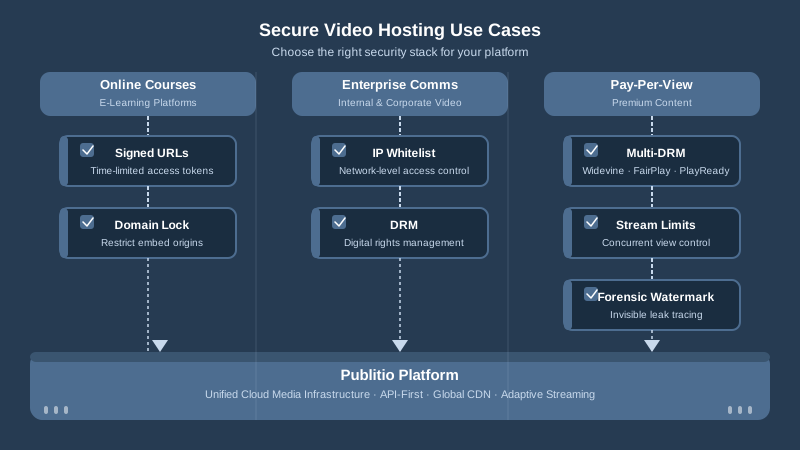
Course creators and membership platform operators need to ensure that paying subscribers cannot simply download the course library and cancel their subscriptions. The essential stack here includes HLS encryption, signed URLs with short expiration windows, domain restrictions to the membership site's domain, and optional visible watermarking to discourage screenshot-heavy piracy. Pairing these controls with a video-on-demand delivery architecture ensures smooth playback while maintaining strict access boundaries. Explore how video-on-demand capabilities can power a fully gated learning experience.
Enterprise Internal Communications
Executive all-hands recordings, HR policy updates, and product roadmap briefings contain information that must never reach competitors. For enterprise use, IP whitelisting (restricting playback to the corporate network or VPN), short-lived signed URLs, and DRM combine to create a closed distribution channel. The video management solution from Publitio supports organized, permission-controlled media libraries that integrate with existing identity providers.
Premium Entertainment and Pay-Per-View
For monetized entertainment content — sports events, concerts, film releases — DRM with concurrent stream limiting is non-negotiable. A subscriber sharing their credentials to stream on multiple devices simultaneously is a revenue leakage problem; a concurrent stream cap enforced at the license server level stops it cold. Geographic restrictions align with regional licensing windows, while forensic watermarking provides post-hoc evidence if a recording surfaces on a piracy site.
Developers Building Video Applications
If you are building a video-powered application from scratch, you need an API that exposes all of these security primitives programmatically. Hard-coded access policies that can only be changed in a dashboard are a bottleneck; a full API lets you generate signed URLs on demand, update playback policies in real time, and integrate DRM license requests into your own authentication flow. Publitio's video API and comprehensive developer documentation make it straightforward to build security-first video features into any application stack.
What to Look for When Choosing a Secure Video Hosting Provider
With dozens of platforms on the market, the following checklist will help you cut through the noise and identify providers that take security seriously rather than merely claiming to.
- Multi-DRM support: Widevine, FairPlay, and PlayReady coverage is the baseline for true cross-platform protection.
- Encrypted HLS delivery: Adaptive bitrate streaming with AES segment encryption should be standard, not a premium add-on.
- Signed URL generation via API: You need programmatic control, not just a dashboard toggle.
- Domain and geo-restriction controls: Granular allowlists and blocklists at the playback level.
- Watermarking: Both visible overlays and, for high-value content, forensic embedding.
- SOC 2 or ISO 27001 compliance: Independent audits of security practices, not self-reported claims.
- Transparent pricing without security paywalls: Vendors who lock DRM behind the most expensive tier create perverse incentives for customers to skip protection. Review Publitio's pricing to see how security features are packaged.
- Responsive support and SLA: When a security incident occurs, response time matters enormously.
Common Mistakes That Undermine Video Security
Even organizations that invest in the right tools sometimes sabotage themselves through implementation errors. The most frequent pitfalls include:
- Using long-lived or static URLs: Permanently valid URLs to video files are functionally equivalent to leaving your content publicly accessible. Always generate short-expiry signed URLs per session.
- Skipping HTTPS on the playback page: An encrypted video stream delivered through an HTTP page can still be intercepted by man-in-the-middle attacks that inject malicious player code.
- Embedding DRM keys client-side: Any key material that lives in JavaScript, mobile app binaries, or local storage can be extracted with modest effort. Keys must live on a server-side license endpoint.
- Neglecting social engineering vectors: Technical controls are powerless against an employee who emails a download link to an unauthorized party. Combine platform security with organizational access policies and credential hygiene.
- Ignoring analytics for security signals: Treat unusual playback patterns as potential security events, not just engagement anomalies.
Bringing It All Together with Publitio
Publitio is designed as an API-first, security-conscious cloud media platform that brings all of the mechanisms described in this guide into a single, coherent infrastructure. From encrypted HLS delivery and multi-DRM licensing to signed URL generation, watermarking, CDN enforcement, and detailed analytics, every security layer is available through both the dashboard and the full-featured API. The digital asset management backbone ensures your entire media library — not just video, but images, audio, and documents — benefits from the same access control and encryption standards. And for teams already running WordPress, the WordPress media offloading plugin extends these protections to your existing CMS workflow without a painful migration.
Security should never be an afterthought, and it should never require you to choose between protection and performance. The right platform delivers both — keeping your content safe while ensuring viewers enjoy smooth, low-latency playback on any device.
Ready to put your videos behind enterprise-grade protection without enterprise-grade complexity? Sign up for a free account at publit.io today and see how easy it is to deploy encrypted HLS streaming, DRM, watermarking, and signed URL access controls in minutes. Your content is too valuable to leave exposed — start protecting it now.


