


Secure Video Hosting for Online Courses: How to Protect and Deliver Your Content
If you're building or scaling an online course platform, secure video hosting for online courses isn't a nice-to-have — it's the foundation your business depends on. Your video content is your most valuable asset. Without the right protections in place, it can be downloaded, redistributed, and monetized by others without your permission, cutting directly into your revenue and undermining the value you provide to paying students. This guide breaks down exactly what secure video hosting means, what technologies are involved, and how a platform like Publitio gives you everything you need to deliver a polished, protected learning experience.
Why Video Security Matters for Online Course Creators
Online course creators invest enormous time and money producing high-quality video lessons. A single course can represent hundreds of hours of filming, editing, and instructional design work. Yet many creators host their content on general-purpose platforms that offer little to no protection against unauthorized access or content theft.
The risks are real and measurable:
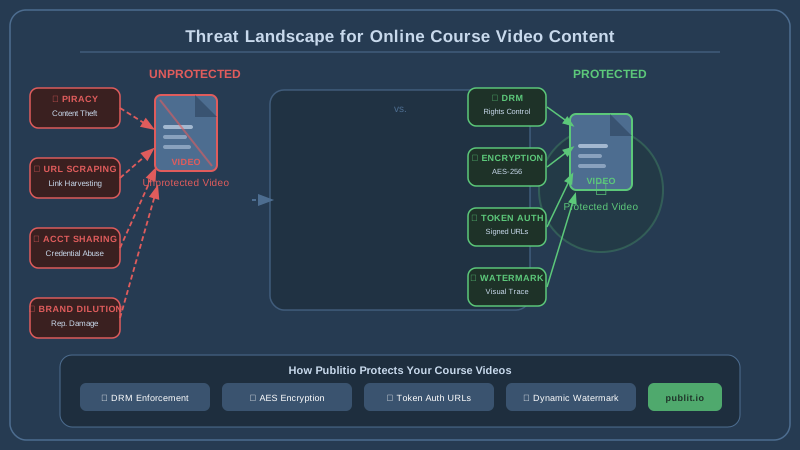
- Piracy and redistribution: Students who download and reshare your content deprive you of future sales and devalue your course in the marketplace.
- Account sharing: Without access controls, a single purchase can be shared across dozens of users.
- Direct URL scraping: If your video files are accessible via a predictable or unprotected URL, automated scripts can harvest and republish them.
- Brand dilution: Unprotected content appearing on third-party sites without context can damage your reputation and confuse potential students.
Choosing the right hosting infrastructure directly determines how well you can defend against all of these threats.
Core Technologies Behind Secure Video Hosting for Online Courses
Not all video hosts are equal. Platforms that genuinely protect course content combine multiple layers of security technology. Here's what to look for — and what Publitio provides out of the box.
HLS Streaming with Encryption
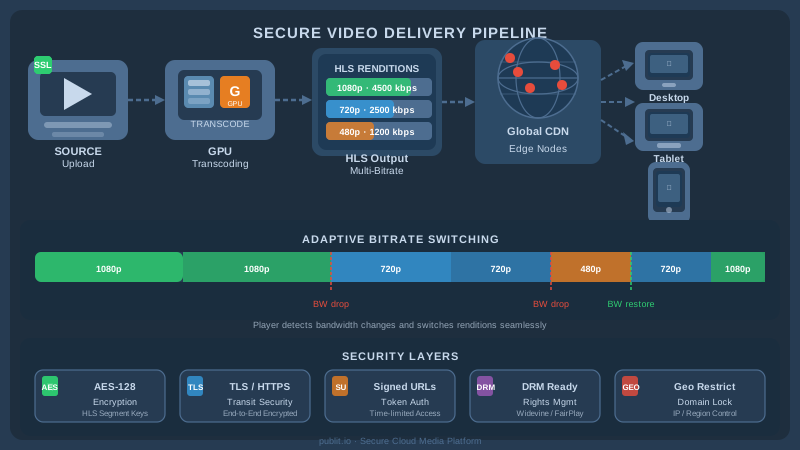
HTTP Live Streaming (HLS) is the industry-standard adaptive bitrate streaming protocol, used by Netflix, YouTube, and virtually every major media platform. When paired with AES-128 encryption, HLS ensures that video segments are delivered in an encrypted form that cannot be played back without the proper decryption keys — even if someone intercepts the stream.
Publitio's HLS streaming infrastructure automatically converts your uploaded videos into encrypted, adaptive HLS packages. This means your content is protected at the transport layer, and students receive the best possible quality for their available bandwidth — whether they're on fiber at home or on a mobile connection during their commute.
Digital Rights Management (DRM)
While HLS encryption is powerful, DRM adds an additional layer of studio-grade content protection. DRM systems like Widevine (used by Chrome and Android) and FairPlay (used by Safari and iOS) enforce licensing rules at the device level, preventing screen recording tools and download utilities from capturing protected streams.
Publitio's Digital Rights Management solution integrates DRM directly into your video delivery workflow. You don't need to negotiate separately with DRM providers or manage complex key servers — it's built into the platform and ready to enable on your content library.
Signed and Tokenized URLs
Even perfectly encrypted video files can be compromised if the delivery URLs are publicly accessible and permanent. Signed URLs generate a unique, time-limited access token for each viewing session. Once the token expires, the URL becomes invalid — meaning a student who copies and pastes a video link into a forum or group chat will share a link that simply stops working.
This is especially important for course platforms that require authentication before granting access to lesson videos. Publitio's API lets you generate signed delivery URLs programmatically, tying video access to your own user authentication system with minimal integration effort. Explore the full capabilities in the developer documentation.
Video Watermarking
Watermarking serves as both a deterrent and a forensic tool. Visible watermarks — displaying a student's name, email, or account ID over the video — discourage redistribution because the source of a leak can be immediately identified. Dynamic, per-user watermarks created at delivery time are particularly effective because there is no single "clean" version of the video that can be shared without attribution.
Publitio includes a robust watermarks feature that lets you overlay text or image watermarks dynamically at the CDN edge, without re-encoding the source file. You can customize position, opacity, and content — including variables pulled from your user database — to create personalized watermarks for every viewer.
Delivering Video at Scale: CDN and Performance
Security without performance creates a poor student experience. Buffering, high latency, and inconsistent quality lead to high dropout rates and negative reviews — regardless of how good your course content actually is. The delivery infrastructure underneath your video player matters just as much as the content itself.
Global CDN Delivery
A Content Delivery Network (CDN) distributes your video files across a network of edge servers located close to your students, wherever they are in the world. Instead of every student streaming directly from a single origin server, they receive content from the nearest CDN node — dramatically reducing latency and buffering.
Publitio's CDN delivery is built into every plan. Your videos are automatically distributed globally the moment you upload them, with no additional configuration required. Whether you have students in São Paulo, Singapore, or Stockholm, they all get a fast, smooth playback experience.
Adaptive Bitrate Streaming and GPU Conversion
Adaptive bitrate streaming (ABR) automatically adjusts video quality in real time based on a viewer's available bandwidth. This prevents the frustrating experience of a video grinding to a halt because a student's connection slowed down temporarily. Instead, the player seamlessly steps down to a lower quality, then steps back up when the connection improves — all invisibly.
To deliver ABR streams, your source videos must be transcoded into multiple quality renditions. Publitio's GPU video conversion infrastructure handles this at scale, using hardware-accelerated transcoding to process videos faster than traditional CPU-based approaches. Upload a single master file and Publitio generates all the required renditions automatically.
Building a Secure Video Hosting Solution for Online Courses with Publitio's API
For developers and platform builders, the most important consideration is how easily a video hosting solution integrates into your existing tech stack. A platform that forces you to use a specific frontend player or embed code may work fine for simple use cases, but it creates friction when you need to build custom access control logic, integrate with your LMS, or support white-labeled delivery.
Publitio is API-first by design. The video API gives you programmatic control over every aspect of media management and delivery — uploading, transcoding, watermarking, generating signed URLs, managing collections, and pulling analytics data. This means you can build an entirely custom student-facing experience while Publitio handles all the infrastructure underneath.
Key API Capabilities for Course Platforms
- Upload and ingest: Accept video uploads from instructors via your own UI, then push files to Publitio via API. No direct platform access required for content creators.
- Folder and collection management: Organize videos by course, module, or instructor using Publitio's asset management structure — powered by the same engine behind the video management solution.
- Dynamic URL generation: Generate signed, expiring playback URLs server-side based on your own authentication logic, so only verified, paying students can access lesson videos.
- Webhook notifications: Receive real-time status updates when encoding is complete, so you can immediately make new lessons available to students without polling the API.
Video-on-Demand for Asynchronous Learning
Online courses are, by definition, asynchronous — students watch when it's convenient for them, pause, rewind, and revisit content over time. This makes video-on-demand delivery the correct model, and it's where Publitio's infrastructure is optimized. Your content lives in the cloud, is available 24/7, and scales to handle any number of concurrent viewers without you managing servers or bandwidth capacity.
Analytics and Access Insights
Understanding how students engage with your video content is almost as important as protecting it. Analytics tell you which lessons have high dropout rates (signaling content that may need to be improved), which videos are most rewatched (signaling your strongest content), and whether there are technical delivery issues affecting specific regions or devices.
Publitio's analytics dashboard surfaces video performance data including play counts, bandwidth consumption, geographic distribution of viewers, and more. For course creators, this data is invaluable for continuously improving course quality and identifying where students are disengaging.
Combined with your course platform's own completion tracking, Publitio's video analytics give you a complete picture of the learning journey — and help you make data-driven decisions about which content to create next.
WordPress Integration for Course Creators
A significant portion of online courses are delivered through WordPress-based platforms — whether using LearnDash, LifterLMS, TutorLMS, or a custom theme. WordPress is flexible and widely understood, but its default media handling is not designed for video: large video files slow down your hosting, consume your storage quota, and lack the security and CDN delivery that course content requires.
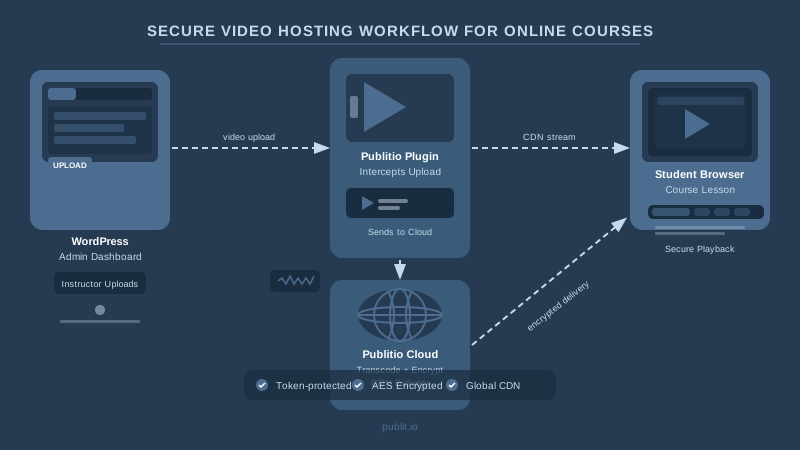
Publitio's WordPress media offloading plugin solves this cleanly. It intercepts media uploads in the WordPress admin, offloads them to Publitio's cloud storage, and rewrites delivery URLs to point through Publitio's CDN automatically. Your WordPress installation stays lean, your video files are protected by Publitio's security stack, and your students experience fast, reliable playback — without any changes to how you manage content in WordPress.
This is particularly useful for course creators who want the familiarity of a WordPress workflow combined with enterprise-grade video infrastructure, without the complexity of managing two separate systems.
Choosing the Right Plan for Your Course Platform
Publitio offers plans scaled to match the size and complexity of your operation — from independent course creators just launching their first product, to enterprise platforms hosting thousands of hours of content for global student audiences. All plans include the core security features — HLS streaming, CDN delivery, and API access — while higher tiers unlock advanced DRM, greater storage and bandwidth, and priority support.
You can review all plan details and compare feature availability on the Publitio pricing page. There's no need to overpay for infrastructure you don't need yet, and it's straightforward to upgrade as your course library and student base grow.
What to Look for in a Secure Video Hosting Provider for Online Courses
To summarize, here are the non-negotiable criteria when evaluating secure video hosting for online courses:
- Encrypted streaming: HLS with AES-128 encryption at minimum; DRM support for premium content protection.
- Tokenized access URLs: No permanent, guessable video links. Every playback session should require a freshly generated, authenticated URL.
- Dynamic watermarking: Per-user visible watermarks that deter redistribution and enable leak tracing.
- Global CDN: Edge delivery that ensures fast, consistent playback for students regardless of geography.
- Adaptive bitrate transcoding: Multiple quality renditions that automatically adjust to the viewer's connection.
- API-first design: Full programmatic control so you can integrate with your LMS, authentication system, and custom frontend.
- Analytics: Engagement and performance data to improve content and identify delivery issues.
- Scalability: Infrastructure that grows with your student base without requiring you to manage servers.
Publitio checks every one of these boxes, and it's designed specifically with media-heavy platforms — including online course providers — in mind. The video processing pipeline, the security layer, and the delivery infrastructure are all unified in a single platform with a consistent API, meaning you're not stitching together multiple third-party services and hoping they work reliably together.
Start Protecting and Delivering Your Course Content Today
Your courses represent your expertise, your time, and your livelihood. They deserve infrastructure that protects them. Whether you're an independent instructor building your first paid course, a developer building a multi-instructor LMS, or an enterprise training team deploying content to thousands of employees, Publitio gives you the secure, scalable, API-driven video hosting foundation you need.
Ready to experience secure video hosting for online courses built for the way modern platforms actually work? Sign up at publit.io today — get started for free, explore the full feature set, and see how easy it is to deliver a protected, professional video learning experience that your students will trust and your competitors can't replicate.


