


How to Choose the Right Video DRM Solution for Your Streaming Platform
As video streaming continues to dominate digital media consumption, protecting your content from piracy and unauthorized access has never been more critical. Selecting the right video DRM solution is one of the most consequential technical and business decisions a streaming platform can make. Get it wrong, and you risk revenue loss, licensing violations, or a degraded viewer experience. Get it right, and you build a secure, scalable foundation that supports your content library for years to come. This guide walks you through every major consideration — from understanding DRM fundamentals to evaluating platform compatibility, licensing models, and integration complexity — so you can make a fully informed choice.
What Is Video DRM and Why Does It Matter?
Digital Rights Management, or DRM, is a set of technologies and policies that control how digital content is accessed, copied, and distributed. In the context of video streaming, a DRM system encrypts your video files and requires authenticated, licensed playback before a viewer can watch them. Without DRM, your content can be intercepted, downloaded, redistributed, and monetized by parties who have no right to do so.
For independent creators, OTT platforms, enterprise media teams, and educational providers alike, the consequences of unprotected video go beyond simple piracy. Many Hollywood studios and major content licensors contractually require DRM compliance before they will grant distribution rights. If your platform lacks an approved DRM implementation, you may be locked out of premium content deals entirely.
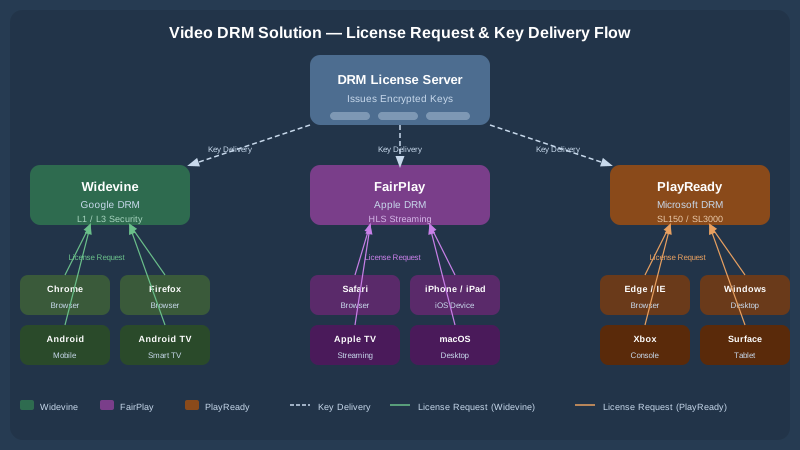
The three dominant DRM systems in use today are:
- Widevine — developed by Google, used extensively on Android devices, Chrome, and Chromecast
- FairPlay Streaming — Apple's proprietary DRM for Safari, iOS, tvOS, and macOS
- PlayReady — Microsoft's DRM system, widely used on Windows, Xbox, and Edge
A production-grade video DRM solution almost always needs to support all three to achieve broad device coverage. This is commonly referred to as multi-DRM.
Key Factors to Evaluate When Choosing a Video DRM Solution
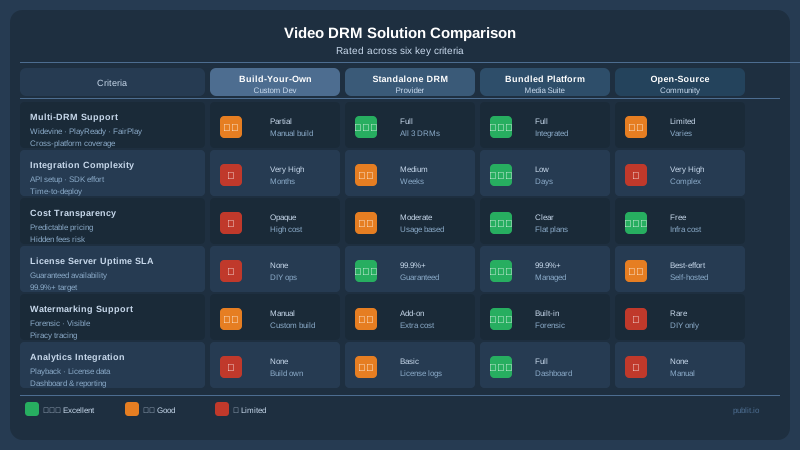
Not all DRM systems are created equal. Before committing to a provider or building your own stack, you need to assess several critical dimensions. Here is a structured breakdown of what to look for.
1. Multi-DRM Coverage and Device Compatibility
Your viewers use a wide range of devices — smartphones, smart TVs, laptops, tablets, and gaming consoles. Each device may rely on a different DRM system. A robust video DRM solution must seamlessly support Widevine, FairPlay, and PlayReady without requiring separate encoding pipelines for each.
Look for a solution that integrates with HLS streaming, since HTTP Live Streaming is natively supported by Apple devices using FairPlay, and modern players like Shaka Player and hls.js can use HLS with Widevine or PlayReady on other platforms. MPEG-DASH with Common Encryption (CENC) is another widely used delivery format for multi-DRM scenarios.
2. Encryption Standards and Security Levels
DRM is only as strong as the encryption beneath it. AES-128 encryption is a widely accepted baseline for video content, but premium content providers often require higher security levels. Widevine, for example, defines three security levels (L1, L2, L3), with L1 being the most secure and requiring hardware-based decryption. If you plan to distribute 4K HDR content from major studios, your platform will likely need to achieve Widevine L1 and PlayReady SL3000 certification on supported devices.
Evaluate whether your DRM solution can enforce:
- Hardware-level security on certified devices
- Output protection controls (HDCP for connected displays)
- License expiry and offline viewing restrictions
- Persistent versus temporary license storage
3. License Server Architecture and Latency
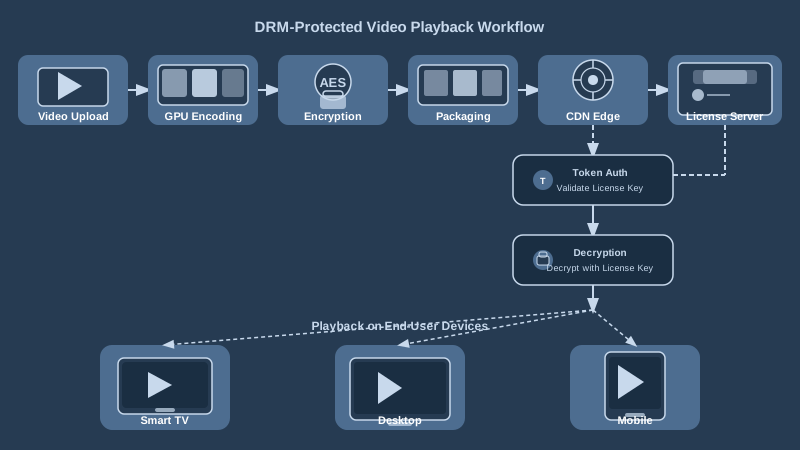
Every time a viewer attempts to play a protected video, their player must request a license from a DRM license server. If that server is slow, unavailable, or geographically distant from your users, playback will be delayed or fail entirely. Evaluate whether the DRM provider operates license servers globally and whether they integrate with a fast CDN layer. Platforms that combine DRM with CDN delivery can dramatically reduce the latency between license request and playback start.
4. Integration With Your Video Processing Pipeline
DRM does not operate in isolation. It must be tightly integrated with your video encoding and packaging pipeline. When a video is uploaded, it must be encrypted and packaged into protected segments before being stored and delivered. Check whether the DRM solution supports automated encryption during video processing, or whether you will need to build custom middleware to bridge the gap.
5. Token-Based Authentication and Access Control
DRM should work hand-in-hand with your user authentication system. License servers typically use signed tokens (often JWT) to verify that a requesting user is authorized to receive a decryption key. Evaluate how the DRM solution handles token generation, validation, and expiry. Weak or overly simplistic token systems can create vulnerabilities that sophisticated attackers exploit to extract decryption keys.
6. Watermarking for Forensic Tracing
DRM prevents most casual piracy, but determined bad actors — including licensed viewers who record their screens — can still leak content. Forensic watermarking embeds an invisible, unique identifier into each video stream that can be traced back to the original viewer or session if the content is leaked. If you distribute premium or first-run content, combining DRM with video watermarking gives you an additional layer of accountability and a legal evidence trail.
7. Analytics and Monitoring
Understanding how your protected content is being accessed is vital for both business and security purposes. A good video DRM solution should integrate with — or at least be compatible with — a robust analytics layer. Monitoring license request patterns, playback success rates, and geographic access data can help you identify suspicious activity or delivery issues before they escalate. Pair your DRM implementation with video analytics to maintain full visibility into your content's performance and security posture.
Build vs. Buy: Evaluating Your Video DRM Solution Options
One of the first strategic decisions you will face is whether to build a custom DRM stack or adopt a managed platform. Each approach has real trade-offs.
Building a Custom DRM Stack
Building your own DRM infrastructure means procuring licenses from Widevine, FairPlay, and PlayReady directly, setting up your own license servers, integrating a video packager (such as Shaka Packager or Bento4), and managing ongoing compliance and certification requirements. This path gives you maximum control but comes with significant overhead:
- Obtaining Widevine and PlayReady licenses requires approval from Google and Microsoft respectively
- FairPlay requires an Apple developer agreement and certificate management
- You are responsible for server uptime, key management, and security patching
- Engineering time and expertise requirements are substantial
Custom stacks make sense for very large enterprises with dedicated security and media engineering teams. For most organizations, the cost-benefit analysis tilts strongly toward a managed solution.
Using a Managed Multi-DRM Platform
Managed DRM platforms handle the heavy lifting: license acquisition, key management, server infrastructure, and often video packaging as well. You integrate via API, configure your policies, and let the platform do the rest. This dramatically reduces time-to-market and ongoing operational complexity.
When evaluating managed solutions, ask the following questions:
- Does the platform support all three major DRM systems out of the box?
- Can you manage your media assets and DRM from a single dashboard?
- What SLAs does the provider offer for license server uptime?
- How transparent is the key management and encryption process?
- Is the platform compliant with GDPR and relevant data protection regulations?
Publitio's digital rights management solution is built for teams that want enterprise-grade content protection without the engineering overhead of building a DRM stack from scratch. It integrates natively with the broader Publitio media management ecosystem, so your DRM configuration exists alongside your asset library, not as a separate silo.
DRM and HLS Streaming: Why the Delivery Format Matters
Your choice of streaming protocol has direct implications for how DRM is implemented. HLS (HTTP Live Streaming) is the most widely used adaptive bitrate streaming protocol, supported natively on all Apple devices and broadly on Android, smart TVs, and desktop browsers via JavaScript players.
For DRM-protected HLS delivery, Apple's FairPlay Streaming is the required DRM on Safari and iOS. On non-Apple devices using HLS, Widevine is typically applied via hls.js or similar libraries. This means a well-architected platform must be capable of serving protected HLS streams with the appropriate DRM system based on the requesting device — a process known as dynamic DRM selection.
Publitio's HLS streaming feature supports adaptive bitrate delivery optimized for compatibility across devices. When combined with DRM encryption at the packaging stage, this creates a fully protected, adaptive delivery pipeline.
For platforms managing large volumes of video content, encoding efficiency also matters significantly. GPU-accelerated encoding reduces the time between upload and protected delivery. Explore how GPU video conversion can accelerate your transcoding pipeline while maintaining the quality your viewers expect.
Licensing Models and Cost Considerations
DRM solutions are typically priced using one or more of the following models:
- Per-license request — you pay a small fee each time a viewer's player requests a DRM license. This model scales with viewership.
- Per-stream or per-title — a flat fee per piece of content protected, regardless of how many times it is played.
- Platform subscription — a monthly or annual fee that includes a defined volume of license requests, storage, and bandwidth.
- Enterprise contract — custom pricing negotiated based on expected usage, SLA requirements, and content sensitivity.
When budgeting for a video DRM solution, account for more than just the DRM license costs. Factor in encoding and storage costs for encrypted assets, CDN bandwidth for protected streams, and the engineering time required for integration and maintenance. A platform that bundles DRM with video hosting, CDN, and asset management — like Publitio — can offer better overall economics than stitching together four or five separate services.
Review Publitio's pricing plans to understand how DRM, video hosting, and CDN delivery can be combined in a single, transparent package.
Integration Complexity and Developer Experience
Even the most secure DRM system is only useful if your team can integrate and maintain it. Pay close attention to the quality of a provider's API, SDK, and documentation. A well-documented, RESTful API with clear error responses, sandbox environments, and language-specific SDKs will dramatically reduce integration time.
Publitio is built as an API-first platform. Developers can manage, upload, transform, and protect media assets programmatically through the video API, with comprehensive references available in the developer documentation. This makes it straightforward to integrate DRM-protected video delivery into custom applications, mobile apps, or existing CMS workflows.
For teams running WordPress-based platforms, media management and DRM-protected delivery can be connected through the WordPress media offloading solution, which allows you to serve protected content directly from Publitio's CDN without changing your editorial workflow.
Checklist: Choosing the Right Video DRM Solution
Use this checklist as a final filter before committing to a platform or provider:
- ☑ Supports Widevine, FairPlay, and PlayReady (multi-DRM)
- ☑ Compatible with HLS and/or MPEG-DASH delivery formats
- ☑ Integrates automated encryption into the video processing pipeline
- ☑ Operates globally distributed license servers with SLA guarantees
- ☑ Supports token-based authentication for license requests
- ☑ Offers forensic watermarking or integrates with a watermarking service
- ☑ Provides analytics and monitoring for license and playback activity
- ☑ Clear, transparent pricing with no hidden overage fees
- ☑ Well-documented API with SDKs and a sandbox environment
- ☑ Compliant with applicable data protection regulations
- ☑ Responsive support with defined escalation paths
Final Thoughts: Making the Right Choice for Your Platform
Choosing a video DRM solution is not a one-size-fits-all decision. The right choice depends on your content's sensitivity, your audience's device diversity, your team's engineering capacity, and your budget. But across all these variables, a few principles remain constant: prioritize multi-DRM coverage, insist on transparent key management, combine DRM with complementary security layers like watermarking and strong authentication, and choose a provider whose platform can grow with you.
For most streaming platforms and media teams, a managed, API-first platform that bundles DRM with video hosting, processing, and CDN delivery offers the best balance of security, speed, and operational simplicity. Rather than managing five different vendors and stitching together a fragile stack, you can focus on what matters most — creating and distributing great content.
Ready to protect your video content with a complete, developer-friendly media platform? Sign up at publit.io today and explore how Publitio's integrated DRM, HLS streaming, CDN delivery, and media management tools give your streaming platform the security and scalability it deserves — without the complexity of building it yourself.


