
Video Hosting Free vs Paid: Which Plan Is Right for You in 2025?
If you have ever searched for video hosting free options, you already know the landscape is crowded with promises that often fall short the moment your audience starts to grow. Whether you are a solo creator launching your first course, a startup building a video-on-demand product, or an enterprise team managing thousands of media assets, choosing the right video hosting plan in 2025 can make or break your content strategy. This guide breaks down exactly what free and paid plans deliver, where the hidden trade-offs hide, and how to match the right tier to your real-world needs.
What Does "Free Video Hosting" Actually Mean in 2025?
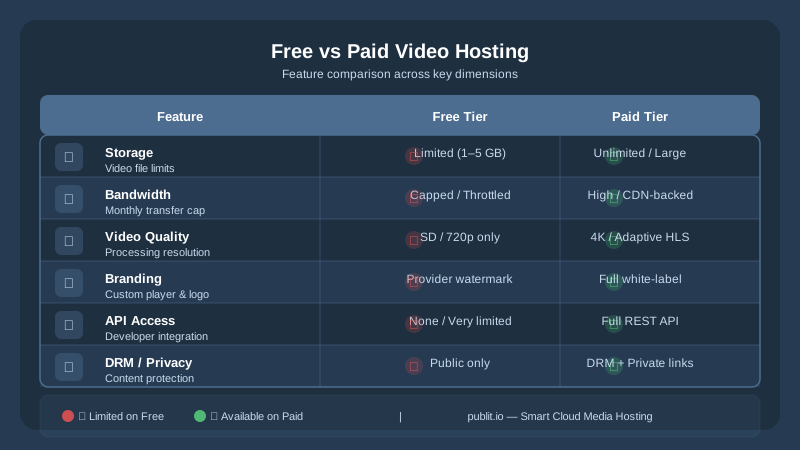
Free video hosting has evolved considerably over the past few years. Platforms that once offered genuinely unlimited storage and bandwidth have quietly introduced caps, compression penalties, or forced advertising. In 2025, a truly useful free tier typically provides a defined monthly bandwidth allowance, limited storage, basic encoding, and some form of an embeddable player — but it rarely offers the full feature set a growing business needs.
Understanding what is included — and what is deliberately left out — is the first step toward making an informed decision. Here are the core dimensions to evaluate any free plan against:
- Storage limits: How many gigabytes or terabytes can you store before you are charged or throttled?
- Bandwidth and delivery: Is CDN delivery included, or are you relying on slow origin servers?
- Video processing quality: Does the platform transcode to adaptive bitrates automatically?
- Branding: Will the platform's logo appear on your player?
- API access: Can you integrate the service into your own application?
- Privacy and security: Can you restrict who views your videos or apply DRM?
- Analytics: Do you get meaningful viewer engagement data?
Most free plans score reasonably on one or two of these dimensions and poorly on the rest. That is not necessarily a problem — it depends entirely on what your project actually requires right now and where it is headed.
Who Should Use a Video Hosting Free Plan?
Free plans are not a consolation prize — they are a legitimate starting point for specific use cases. Let's look at who gets genuine value from a free video hosting tier.
Individual Creators and Hobbyists
If you are posting occasional tutorial videos, family memories, or passion-project content to a small audience, a free plan covers your needs without any financial commitment. You do not need adaptive HLS streaming, DRM-protected content, or enterprise-grade video analytics at this stage. The priority is simply getting your video online and shareable with a reliable player.
Developers Testing an Integration
Developers evaluating an API before committing to a paid plan benefit enormously from a robust free tier. A platform like Publitio offers a free video API that lets you test uploads, transcoding workflows, and playback integrations in your application before you scale. This de-risks technical decisions and accelerates prototyping without budget approval cycles.
Early-Stage Startups Validating a Product
If you are building an MVP and still testing whether users actually want your video-based product, paying for enterprise video infrastructure before you have proven demand is premature. A free tier lets you ship a working demo, gather user feedback, and validate your assumptions before spending on bandwidth and storage at scale.
Small Businesses With Light Video Needs
A local business that embeds one or two product videos on its website — videos that receive a few hundred views per month — is unlikely to hit the limits of a well-designed free tier. If video is a minor supporting element rather than a core product feature, free hosting may simply be the right permanent answer.
The Real Costs Hidden Inside Free Video Hosting Plans
Here is the uncomfortable truth about most free video hosting offers: the costs are real; they are just paid in ways that do not involve your credit card. Before deciding that free is the right long-term choice, account for these less-obvious trade-offs.
Forced Advertising and Loss of Brand Control
Many consumer-grade free platforms monetise your content by displaying pre-roll or mid-roll advertisements that you have no control over. Competitors' ads can appear directly before your own product videos, creating a brand experience that undermines trust and conversion. If your video is a sales or marketing asset, this trade-off may cost you far more in lost revenue than a paid plan would in subscription fees.
Compression and Quality Degradation
Free tiers frequently apply aggressive compression to reduce storage and delivery costs. The result is blocky, low-resolution playback that signals low quality to your audience — regardless of how polished the original footage was. Paid plans typically offer full-resolution storage and multi-bitrate video processing that preserves quality across every screen size and connection speed.
No Privacy Controls or DRM
Free plans almost never include domain-level restrictions, password protection, or digital rights management. If your video is a paid course, a confidential internal training resource, or a premium piece of content, you cannot responsibly distribute it on a platform that anyone can download or re-share. For protected content, you need a platform with proper digital rights management capabilities built in from day one.
Bandwidth Overages or Throttling
A video that unexpectedly goes viral — even modestly so — can exhaust a free plan's monthly bandwidth in hours. Once the cap is hit, platforms either throttle delivery (resulting in buffering and abandonment) or redirect users to an upgrade page, effectively taking your content offline until you pay. For anything business-critical, this fragility is an unacceptable risk.
What Paid Video Hosting Plans Unlock
A paid video hosting plan is not just a free plan with more storage — it represents a qualitatively different level of capability. Here is what serious plans bring to the table.
Adaptive HLS Streaming for Smooth Playback Everywhere
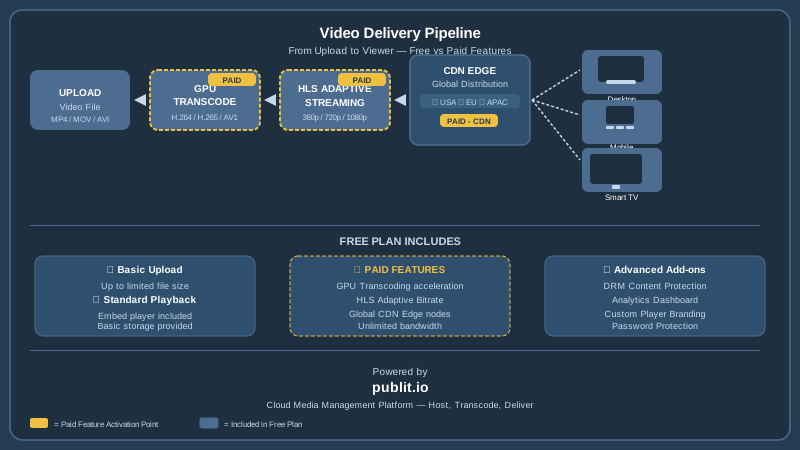
Paid plans on platforms like Publitio include full HLS streaming with adaptive bitrate delivery. This means the player automatically adjusts video quality in real time based on each viewer's available bandwidth — eliminating buffering without sacrificing quality for viewers on faster connections. For any video-centric product, adaptive streaming is non-negotiable.
Global CDN Delivery
Every millisecond of latency increases abandonment rates. Paid plans route your video through a global CDN network with edge nodes close to your viewers, dramatically reducing load times and buffering regardless of where in the world your audience is located. Free plans frequently skip CDN delivery entirely, serving content from a single origin server.
Video-on-Demand Infrastructure
Building a subscription video library, an e-learning platform, or a corporate video portal requires reliable video-on-demand infrastructure — not just a basic embed. Paid plans provide the organised libraries, metadata management, custom player controls, and access restriction features that make a real VoD product possible.
GPU-Accelerated Transcoding
Processing large video files is computationally intensive. Platforms that offer GPU video conversion can transcode files dramatically faster than CPU-only pipelines — meaning your videos are available to viewers minutes after upload rather than hours. For high-volume publishing workflows, this speed difference is significant.
Watermarking and Content Protection
Protecting premium video content requires more than a password. Dynamic watermarks embedded in the video stream deter unauthorised redistribution and can even identify the source of a leak if a video is shared without permission. This is a paid-tier feature that creators and media companies need but free plans never include.
Comprehensive Video Analytics
Understanding how viewers engage with your video — where they drop off, which chapters get replayed, which devices your audience uses, and how completion rates vary by traffic source — is only possible with proper analytics. These insights directly inform content strategy and conversion optimisation, making them a business asset rather than a luxury add-on.
Video Hosting for Specific Use Cases: Free or Paid?
Rather than applying a blanket recommendation, it is more useful to map the free-versus-paid decision to the actual context in which you are deploying video.
WordPress Websites
Self-hosted WordPress sites often suffer when video files are uploaded directly to the server — they bloat the hosting account, slow down load times, and strain shared hosting resources. A purpose-built WordPress media offloading solution moves your media assets off your server and delivers them via CDN, dramatically improving performance. Even a lightweight free tier can solve the bloat problem, but if your WordPress site is a business tool, the analytics, privacy controls, and quality of a paid plan will pay dividends.
E-Learning and Online Courses
Course creators need to protect paid content from being shared freely, require reliable playback without buffering during a learning session, and benefit from engagement analytics that show which lessons learners complete or skip. These are paid-tier requirements across the board. A free plan will not adequately serve a course business model.
Enterprise Media Asset Management
Large organisations managing thousands of video files alongside images, audio, and documents need a unified media asset management system rather than a basic hosting service. At this scale, free plans are conceptually the wrong category — the conversation is about SLA guarantees, role-based access controls, custom workflows, and integration with existing enterprise tools.
SaaS and Application Developers
If you are embedding video capabilities directly into a SaaS product or mobile app, you need a reliable, well-documented API that scales predictably with your user base. A free tier is an excellent place to start your integration. The path to a paid plan is determined by your monthly upload volumes, storage growth, and bandwidth consumption as your product grows — not an arbitrary feature gate.
Marketing Teams and Content Hubs
Marketing teams producing video at scale — product demos, testimonials, webinar recordings, social content — need organised digital asset management alongside hosting. The ability to retrieve, share, and repurpose assets quickly is worth paying for. Disorganised free hosting quickly becomes a productivity drain that costs more in staff time than a paid subscription.
How to Evaluate a Free Tier Before You Commit
Not all free tiers are created equal. When evaluating a video hosting free plan, ask these specific questions before uploading your first file:
- What happens when I exceed the storage or bandwidth limit? Is the content taken offline, throttled, or do you receive an automatic upgrade to a paid plan?
- Is the free tier time-limited? Some platforms offer a generous free trial that converts to a paid-only service after 30 or 90 days.
- Can I migrate my content easily? Before uploading hundreds of videos, confirm that the platform offers bulk export so you are not locked in.
- What is the upgrade path? Review the pricing page to understand what the next tier costs and what it unlocks, so you can plan your budget as you grow.
- Does the free API have rate limits? Developer-focused free tiers often include strict rate limits that are impractical for even light production use.
Making the Switch from Free to Paid: What to Expect
When the time comes to move from a video hosting free plan to a paid tier, the transition is typically smoother than creators expect — particularly on platforms that have designed their free and paid tiers to share the same underlying infrastructure. You should not need to re-upload your content, rebuild your embeds, or reconfigure your player. Look for a platform where upgrading is a billing change, not a migration project.
The signals that tell you it is time to upgrade are usually clear:
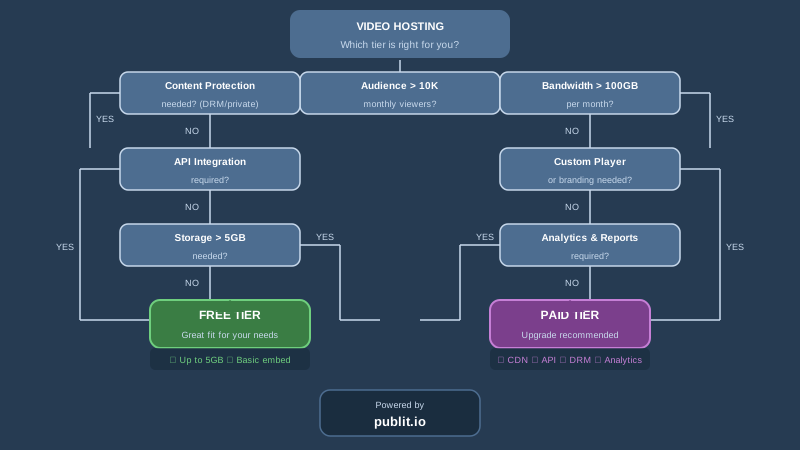
- You are regularly hitting bandwidth or storage caps mid-month.
- Viewers are reporting buffering or quality issues.
- You need to restrict access to content and cannot do so on the free plan.
- You want to remove third-party branding from the player.
- Your API integration is hitting rate limits that block production workflows.
- You need engagement analytics to justify video investment to stakeholders.
Any one of these signals is sufficient justification. The cost of poor video performance — lost viewers, lost sales, damaged brand perception — almost always exceeds the monthly cost of the appropriate paid plan.
Publitio: A Free Tier Built for Real Projects, Paid Plans Built to Scale
Publitio is an API-first media management platform that takes the free-versus-paid question seriously. The free tier is designed to be genuinely useful for developers, early-stage projects, and small-scale deployments — not a crippled demo that frustrates you into upgrading. You get real API access, real encoding, real CDN delivery, and a clear, predictable path to paid plans as your project grows.
As your needs expand, Publitio's paid plans add adaptive HLS streaming, GPU-accelerated transcoding, global CDN delivery, DRM content protection, dynamic watermarking, video analytics, video-on-demand libraries, and full digital asset management — all through the same API and dashboard you started with on the free tier. There is no platform switch, no migration cost, and no learning curve.
Whether you are a developer building your first video feature, a creator launching a paid course, or a media team managing thousands of assets, Publitio scales with your ambition without forcing you to overpay before you need to.
Ready to find your plan? Start with Publitio's free tier today and explore everything the platform can do — no credit card required. When your project grows, your plan grows with it. Visit publit.io to create your free account and experience the difference that purpose-built video hosting makes for your content, your audience, and your business.