


How to Choose the Right Video on Demand Platform for Your Business
Whether you're a media company distributing premium content, an e-learning provider delivering course libraries, or a brand building a video marketing strategy, selecting the right video on demand platform is one of the most consequential technology decisions you'll make. The platform you choose will affect how your audience experiences your content, how much control you have over delivery and monetization, and how efficiently your team can manage a growing library of video assets. With dozens of options on the market, each promising seamless streaming and enterprise-grade features, knowing exactly what to evaluate before committing is critical. This guide walks you through every key consideration so you can make a confident, informed decision.
What Is a Video on Demand Platform and Why Does It Matter?
A video on demand platform is a system that allows you to upload, store, manage, encode, and deliver video content to viewers at any time — on their schedule, not yours. Unlike live streaming, VoD puts the viewer in control of when and how they consume content. From a business perspective, this means you need infrastructure that is always on, always fast, and always secure.
The platform you choose becomes the backbone of your video operation. It touches your storage costs, your video quality, your security posture, your developer workflows, and ultimately your viewer satisfaction. A weak choice early on creates technical debt that becomes increasingly expensive to undo as your library grows. A smart choice scales with you and opens up monetization and distribution channels you may not have anticipated when you started.
Key Features to Look for in a Video on Demand Platform
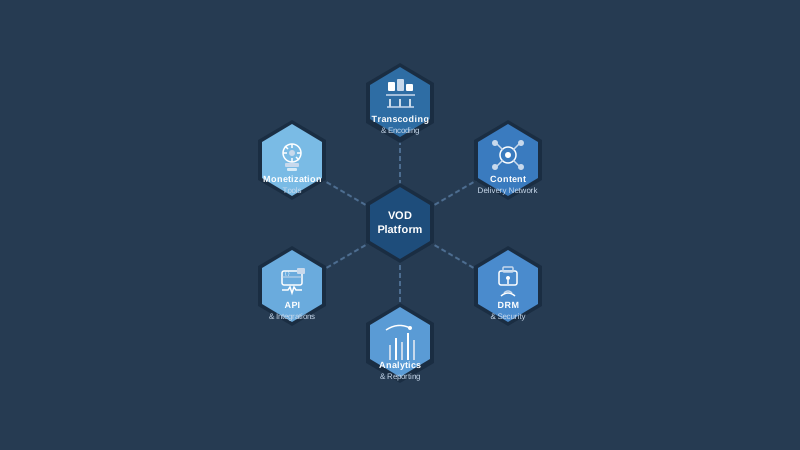
Not all VoD platforms are built the same. Some are consumer-friendly tools with drag-and-drop interfaces but limited API access. Others are developer-first infrastructure products that give you full control but require engineering resources to implement. Understanding the feature landscape helps you match your requirements to the right solution.
Video Encoding and Adaptive Bitrate Streaming
Raw video files are rarely ready for delivery straight out of the camera. A capable video hosting platform should automatically transcode your uploads into multiple resolutions and bitrates. This enables adaptive bitrate streaming — where the player dynamically adjusts quality based on the viewer's connection speed — resulting in fewer buffering events and a smoother watch experience across devices and network conditions.
Look for platforms that support modern formats like HLS (HTTP Live Streaming) and DASH, and that can deliver to a wide range of devices including browsers, mobile apps, smart TVs, and set-top boxes. HLS in particular has become the dominant protocol for both VoD and live delivery, and any serious platform should offer it natively.
Content Delivery Network (CDN) Integration
A video on demand platform without a global CDN is like a broadcast tower with no transmitters. CDN integration ensures that your video files are cached at edge servers located geographically close to your viewers, reducing latency and dramatically improving load times. When evaluating platforms, ask whether CDN delivery is included in the pricing or billed separately, which CDN providers they partner with, and whether you can bring your own CDN if you have an existing contract.
DRM and Content Security
If your video content has real commercial value — premium courses, subscription films, proprietary training material — you need to protect it from unauthorized copying and redistribution. Digital Rights Management (DRM) is the industry-standard solution. Look for platforms that support Widevine, FairPlay, and PlayReady — the three major DRM systems covering Chrome, Android, Safari, iOS, and Edge respectively. Without multi-DRM coverage, you'll leave portions of your audience either unprotected or locked out.
Beyond DRM, look for URL signing, token-based authentication, domain whitelisting, and geo-restriction features. These layers work together to ensure your content is only accessible to the viewers you authorize, on the platforms and in the regions you choose.
Digital Asset Management Capabilities
Video rarely exists in isolation. Around every piece of video content, there are thumbnails, subtitle files, metadata, promotional images, transcripts, and documentation. A platform that only manages video without addressing the broader asset ecosystem will leave you juggling multiple tools. A strong digital asset management layer within your VoD platform lets you organize, tag, search, and version all your media assets in one place — dramatically reducing time spent hunting for files and eliminating duplication.
For teams managing libraries of hundreds or thousands of assets, DAM capabilities aren't a nice-to-have. They're essential for operational efficiency and consistency in your content delivery workflow.
API Access and Developer Tools
Modern video workflows don't happen in isolation. Your VoD platform needs to integrate with your CMS, your app, your e-commerce system, your analytics stack, and your authentication service. This means robust API access is non-negotiable for any organization that wants to build a custom viewing experience or automate parts of its workflow.
When assessing platforms, explore the depth and quality of the API. Is it RESTful? Are endpoints well-documented? Are there SDKs for the languages your team works in? Can you automate uploads, manage assets programmatically, and retrieve playback URLs via API? Check the developer documentation to get a sense of how much flexibility you'll actually have before you sign up.
Evaluating Scalability and Reliability
Your VoD needs today may look very different from your needs in 18 months. A platform that handles a library of 100 videos well may buckle under 10,000. Before committing, think carefully about where your content operation is heading and whether the platform can grow with you without forcing a painful migration.
Storage and Bandwidth Limits
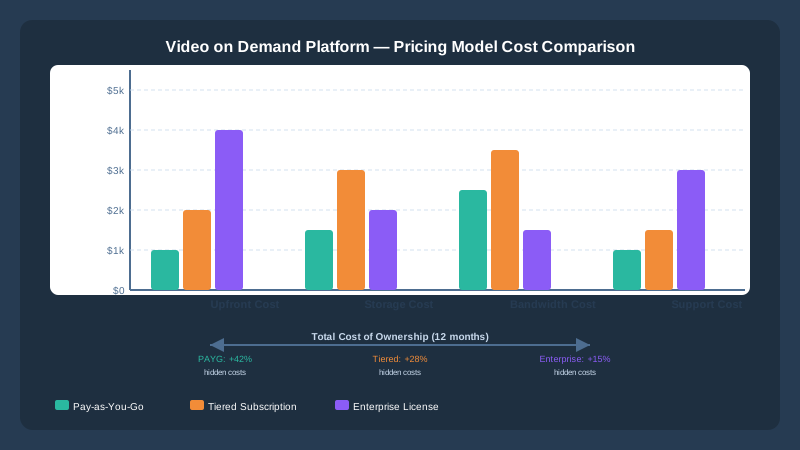
Understand exactly what you're paying for. Some platforms bundle storage and bandwidth into flat monthly plans. Others charge per gigabyte stored and per gigabyte of bandwidth consumed. Neither model is universally better — it depends on your usage patterns. If you have a large library with moderate traffic, storage-heavy pricing may hurt you. If you have a small library with very high traffic volume, bandwidth costs will dominate. Build a realistic projection of both and compare platforms on that basis, not on headline pricing alone.
Uptime and SLA Guarantees
A VoD platform is a mission-critical service. Downtime directly affects your viewers' experience and your revenue. Ask platforms for uptime SLAs (Service Level Agreements), historical uptime data, and incident response processes. Look for platforms with redundant infrastructure, active status pages, and a track record of transparent communication during outages.
How to Choose a Video on Demand Platform Based on Your Business Model
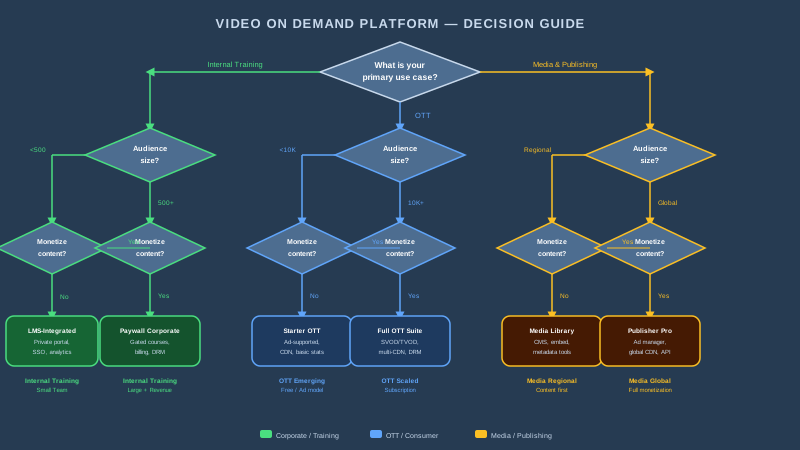
Different business models have different requirements. A one-size-fits-all checklist rarely surfaces the nuances that matter most to your specific situation. Here's how to think about VoD platform selection through the lens of what your organization actually does.
For Media Companies and Content Distributors
If you're distributing premium video content — films, documentaries, series, sports broadcasts — your top priorities are DRM protection, scalable streaming infrastructure, and monetization flexibility. You need a platform that supports pay-per-view, subscription access, and promotional windowing without requiring you to rebuild your entire tech stack. Make sure the platform supports multi-bitrate HLS delivery and can handle traffic spikes around new releases without degrading quality.
For E-Learning and Online Course Creators
Course creators and EdTech platforms need VoD infrastructure that integrates cleanly with LMS platforms, supports chapter navigation, works reliably across low-bandwidth connections, and offers per-user or per-course access control. Content security matters here too — your course videos represent your core intellectual property. Look for platforms where you can restrict playback to authenticated users and control whether downloads are permitted.
For Enterprises and Corporate Communications
Enterprises using video for internal communications, training, and knowledge management have different needs from public-facing content distributors. Single sign-on integration, role-based access control, audit logging, and the ability to embed video within intranets and internal tools are high priorities. For enterprises managing large asset libraries across departments, DAM integration becomes especially important for ensuring brand consistency and reducing redundant file storage.
For Developers and Agencies Building Products
If you're a developer building a product on top of VoD infrastructure — or an agency delivering a video-powered platform to a client — the API experience is your primary evaluation criterion. You need clean, well-documented endpoints, fast response times, generous rate limits, webhook support, and ideally a sandbox environment for testing. Platform reliability and pricing predictability also matter enormously when you're building a commercial product that your customers will depend on.
Pricing Models and Total Cost of Ownership
The sticker price of a VoD platform rarely tells the full story. To understand true cost, you need to account for storage, bandwidth, encoding minutes, additional seats, support tiers, and the cost of any third-party tools you'll need to fill functionality gaps. A platform that looks expensive upfront may actually be cheaper in total cost of ownership if it eliminates the need for a separate DAM tool, a CDN contract, or a DRM licensing agreement.
When reviewing pricing, ask yourself:
- Is CDN bandwidth included or billed separately?
- Are there encoding charges per video or per minute?
- What happens when you exceed your storage limit — are overage charges reasonable?
- Is there a free trial or developer tier that lets you test the platform before committing?
- Are there long-term contract discounts available for committed usage?
Security, Compliance, and Data Privacy
Depending on your industry and geography, you may be subject to data privacy regulations that affect how your video platform handles viewer data. GDPR in Europe, CCPA in California, and sector-specific regulations in healthcare and finance all have implications for how video metadata, viewer analytics, and user data are collected, stored, and processed.
When evaluating platforms, ask where data is stored, whether they offer data residency options, how viewer analytics are collected and who owns that data, and whether the platform is SOC 2 compliant. These questions are especially important for enterprise customers and organizations in regulated industries.
Integration with Your Existing Tech Stack
A VoD platform that doesn't connect cleanly with your existing tools will create workflow friction and integration costs that erode its value. The most common integration points to consider are:
- CMS platforms — WordPress, Drupal, Contentful, and others. Some platforms offer native plugins; others rely on API integration.
- E-commerce and subscription platforms — Shopify, WooCommerce, Stripe, and similar tools for managing paid access.
- Analytics platforms — Google Analytics, Mixpanel, or custom dashboards for tracking video engagement metrics.
- Authentication systems — OAuth, SAML, JWT-based token systems for controlling who can watch what.
Publitio, for instance, offers a rich feature set that includes a WordPress media offload plugin — enabling WordPress users to serve media directly from Publitio's CDN without modifying their publishing workflow. This kind of native integration reduces the engineering effort required to get value from the platform immediately.
Player Customization and User Experience
The video player is the face of your VoD service. Your viewers interact with it directly, and its quality — in terms of both performance and aesthetics — reflects on your brand. Look for platforms that give you meaningful control over player branding, including custom colors, logos, thumbnail previews, chapter markers, subtitle rendering, and playback speed controls.
Also evaluate mobile experience carefully. A significant and growing share of video consumption happens on mobile devices. Your player should deliver a native-quality experience on iOS and Android, with touch-optimized controls and reliable performance on cellular connections.
Support Quality and Documentation
Even the most technically capable platform is only as useful as its support resources allow you to be. Before selecting a video on demand platform, evaluate:
- The completeness and accuracy of the developer documentation
- The availability and responsiveness of technical support (email, chat, phone)
- The existence of a community forum, knowledge base, or tutorial library
- SLA response time commitments at your pricing tier
Poor documentation is a silent tax on your engineering team. Every hour a developer spends reverse-engineering undocumented behavior is an hour not spent building your product. Strong documentation and responsive support are genuine competitive advantages, especially during critical integration phases.
Making Your Final Decision
After working through this evaluation framework, you should have a clear picture of your requirements ranked by priority. The final decision process should include shortlisting two or three platforms that meet your core requirements, signing up for free trials or developer tiers, running a structured proof of concept with realistic content and usage patterns, and involving key stakeholders — including engineers, content managers, and finance — in the evaluation.
The right video on demand platform for your business is the one that best aligns with your technical requirements, your content security needs, your team's capabilities, and your growth trajectory — all at a total cost of ownership that makes commercial sense. Don't optimize purely for price or purely for features. Optimize for fit.
Why Publitio Is Built for Serious Video Operations
Publitio is a cloud-based media management platform purpose-built for businesses that take video seriously. It combines video hosting, HLS streaming with DRM and encryption, CDN delivery, and comprehensive digital asset management into a single API-first platform. Whether you're a developer building a custom streaming product, a media company protecting premium content, or an enterprise managing thousands of video assets across teams, Publitio gives you the infrastructure, security, and flexibility to deliver exceptional video experiences at scale.
Ready to find out if Publitio is the right video on demand platform for your business? Sign up at publit.io and start your free trial today — no credit card required. Explore the full feature set, test the API, and see firsthand how straightforward it is to build powerful video workflows on infrastructure that's designed to grow with you.


