


Video Streaming API: How to Stream Video at Scale Without the Complexity
Building a video streaming experience that actually works at scale is one of the hardest infrastructure challenges a development team can face. Between encoding pipelines, adaptive bitrate delivery, DRM encryption, CDN routing, and player compatibility, the moving parts multiply fast. That's exactly why more product teams are turning to a purpose-built video streaming API instead of assembling a fragile stack of third-party services. In this guide, we'll break down what a modern video streaming API does, why it matters for scale, and how Publitio makes it possible to deliver professional-grade video without the operational complexity that usually comes with it.
What Is a Video Streaming API and Why Does It Matter?
A video streaming API is a programmatic interface that lets developers upload, process, store, and deliver video content over the internet — all through clean, documented endpoints. Rather than managing your own encoding servers, configuring a CDN from scratch, or wrestling with HLS manifest generation, you make API calls and the platform handles the heavy lifting.
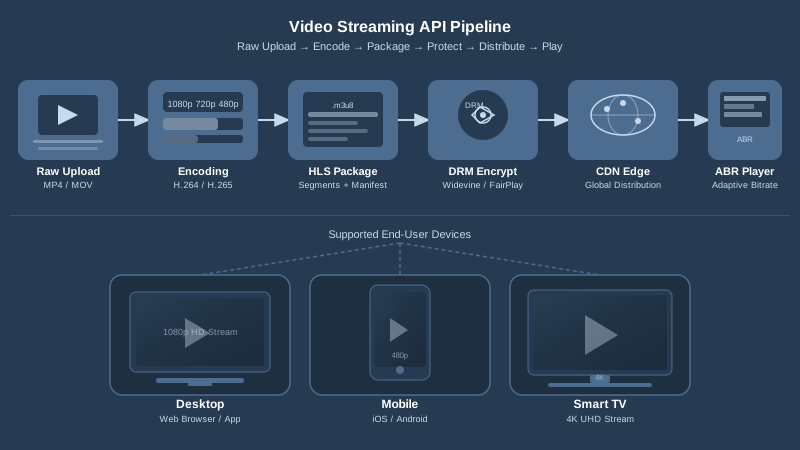
This matters because video delivery is deceptively complex. A single uploaded file might need to be transcoded into five different quality levels, packaged into HLS segments, encrypted for DRM compliance, watermarked for license tracking, distributed across edge nodes on a CDN, and served adaptively based on the viewer's bandwidth — all before the first frame plays. Doing any one of those steps poorly means buffering, failed playback, or pirated content. Doing all of them manually means months of engineering work before you ship a single feature.
A well-designed video streaming API abstracts that entire pipeline into a few HTTP requests. You upload a file, set your parameters, and get back a stream-ready URL. The infrastructure lives on someone else's servers, monitored by people whose entire job is keeping video delivery reliable.
Core Capabilities You Should Expect From a Video Streaming API
Not all video APIs are created equal. Some focus purely on storage, others on transcoding, and others on analytics. When you're evaluating a platform for production use, there's a minimum set of capabilities that should be non-negotiable.
Adaptive Bitrate HLS Streaming
HTTP Live Streaming (HLS) is the dominant protocol for video delivery across web, mobile, and smart TV platforms. A proper HLS streaming implementation breaks your video into short segments and serves them at multiple quality levels, allowing the player to switch resolutions in real time based on available bandwidth. This is the difference between a smooth viewing experience on a congested mobile network and a buffer wheel that drives users away.
Publitio's HLS streaming support handles this automatically. Upload your source video once, and the platform generates multi-bitrate renditions and the corresponding manifest files, ready for delivery through any HLS-compatible player.
GPU-Accelerated Video Processing
Encoding speed matters when your users are uploading content and expecting fast turnaround. Traditional CPU-based transcoding is slow and expensive at scale. GPU-accelerated video conversion dramatically reduces processing time for high-resolution source files, meaning your viewers wait seconds instead of minutes before their content is ready to stream.
Video-on-Demand Infrastructure
Whether you're running a course platform, a media library, or an OTT service, video-on-demand delivery requires more than just a file URL. You need reliable storage, fast start times, seeking support, and the ability to handle concurrent viewers without degradation. A robust VoD setup means your entire catalog is always accessible, from a video uploaded yesterday to one from five years ago.
Digital Rights Management and Content Protection
For paid content or proprietary video assets, you need more than a private URL. Token-based access, signed links, and full digital rights management protect your content from unauthorized distribution. DRM ensures that even if someone intercepts a stream URL, the encrypted segments are useless without the correct license key — a critical layer for media companies, e-learning platforms, and enterprise video portals.
CDN Delivery at the Edge
Your video API is only as fast as your delivery network. A CDN that caches your video segments at edge locations close to your viewers reduces latency, improves start times, and absorbs traffic spikes without straining your origin servers. This is what separates a video platform that works for a hundred viewers from one that works for a million.
How a Video Streaming API Handles Scale
Scale is where most homegrown video setups fall apart. A system that works fine for a few dozen concurrent viewers can collapse under a few thousand. Understanding how a well-architected video streaming API manages scale helps you make smarter infrastructure decisions.
Encoding at Scale
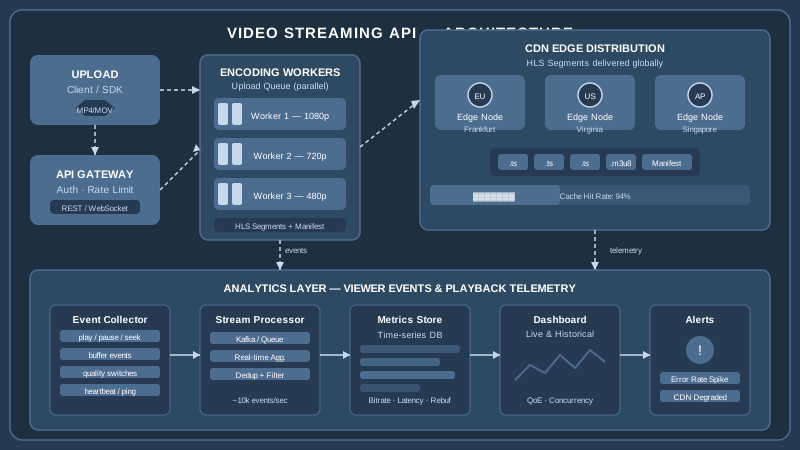
When traffic spikes — a viral video, a live event replay, a product launch — your encoding queue needs to handle bursts without creating a backlog. Cloud-based encoding infrastructure can spin up additional capacity on demand, something that's impossible with a fixed number of dedicated transcoding servers. Publitio's video processing pipeline is built to handle this elasticity, so your ingestion rate stays consistent regardless of how much content is being uploaded simultaneously.
Storage and Retrieval at Scale
As your video library grows into thousands or millions of assets, retrieval performance becomes critical. Flat file storage doesn't scale — you need indexed metadata, fast search, and organized asset hierarchies. This is where video management intersects with media asset management: the ability to find, organize, and serve the right video to the right place at the right time, programmatically.
Analytics and Performance Monitoring
Scaling without visibility is flying blind. Video analytics give you the data to understand how your content is performing — view counts, engagement rates, buffering events, geographic distribution of viewers, and playback quality metrics. This information feeds directly into decisions about encoding profiles, CDN configuration, and content strategy.
Using Publitio's Video Streaming API in Practice
Publitio is an API-first platform, which means every feature available in the dashboard is also available through REST API endpoints. This is important for teams who need to embed video workflows directly into their applications, CMS integrations, or backend services.
Upload and Transcode With a Single API Call
A typical integration starts with a file upload endpoint. You POST your video file or provide a remote URL, include your API credentials, and specify any encoding or delivery options. Publitio picks up the file, runs it through the processing pipeline, and returns a JSON response containing the asset ID, public URL, and streaming endpoint. From that point, your video is accessible via HLS with multi-bitrate support, ready for any HTML5 player or native mobile SDK.
The API documentation covers the full range of endpoints: upload, update, delete, list assets, generate signed URLs for private content, set expiry parameters, and more. The authentication model uses API key and secret pairs, making it straightforward to integrate into any backend language or framework.
Watermarking for Brand Protection and Licensing
Programmatic watermarking is a capability that matters deeply to media companies, content creators, and enterprise teams distributing licensed footage. Through the API, you can apply image or text watermarks to your videos at processing time, specifying position, opacity, and size — all without touching a video editing tool. For licensing workflows, this means every derivative of a video asset can carry identifying information that survives unauthorized redistribution.
Building a Video Portal or OTT Application
If you're building a video-on-demand platform, course library, or internal corporate media portal, Publitio gives you the building blocks at the API level. You can create folder structures, tag assets with custom metadata, retrieve paginated asset lists, generate player-ready stream URLs, and integrate access control for premium content — all through standard HTTP requests. The platform handles the infrastructure, and you focus on your product experience.
WordPress Integration Without Custom Development
For teams running content on WordPress, Publitio's WordPress media offloading plugin moves your video and image assets out of your local hosting environment and onto Publitio's CDN-backed infrastructure. This reduces server load, improves page performance, and gives your WordPress content the same streaming capabilities as a fully custom integration — without writing any code.
Comparing DIY Video Infrastructure to a Video Streaming API
It's worth being honest about what the build-it-yourself path actually involves, because teams often underestimate it until they're deep in the weeds.
A self-managed video stack typically requires: FFmpeg for encoding (with all the command-line complexity that entails), a job queue for managing transcoding tasks asynchronously, cloud object storage for segments and manifests, a CDN configuration with cache invalidation rules, a key server for DRM, a database for asset metadata, monitoring and alerting for every component, and dedicated engineering time to keep all of it running. That's before you've added any features specific to your product.
The total cost isn't just the infrastructure bill — it's the engineering opportunity cost. Every sprint spent maintaining video infrastructure is a sprint not spent on the features that differentiate your product. A video streaming API collapses that entire stack into a managed service with a predictable pricing model.
For teams evaluating the tradeoffs, Publitio's pricing page offers transparent tiers based on storage and bandwidth, making it straightforward to model costs against your expected usage before committing.
Who Benefits Most From a Dedicated Video Streaming API?
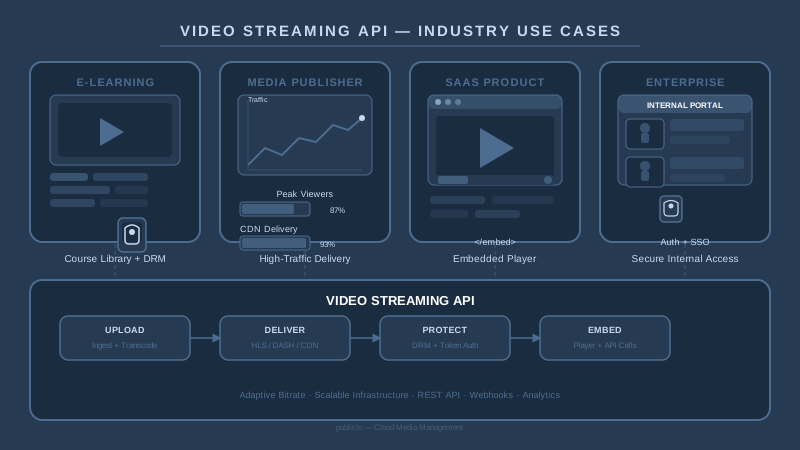
The use cases for a video streaming API span a wide range of industries and team sizes.
E-Learning and Course Platforms
Course creators and ed-tech platforms need reliable video delivery, content protection for paid courses, and the ability to manage a large and growing video library. HLS streaming ensures smooth playback across device types, while DRM prevents students from downloading and redistributing paid content.
Media and Publishing Companies
Publishers distributing news clips, documentaries, or entertainment content need a platform that can handle both high-volume ingestion and high-traffic delivery spikes. A video streaming API that integrates with CMS workflows and provides detailed analytics supports editorial decisions alongside technical delivery.
SaaS Products With Embedded Video
Product teams building video recording, review, collaboration, or training features into their SaaS applications need a streaming API that they can integrate quickly without building an entire video pipeline in-house. Publitio's API-first architecture makes it composable: you use the parts you need and integrate them into your existing product infrastructure.
Enterprise Internal Communications
Large organizations hosting internal training libraries, executive communications, or knowledge management systems need secure, private video delivery. Signed URLs, access tokens, and DRM support make it possible to restrict video access to authenticated users without building custom access control from scratch.
Key Questions to Ask When Evaluating a Video Streaming API
Before committing to a platform, there are a few questions worth asking explicitly:
Does it support true adaptive bitrate HLS? Not just progressive download or a single MP4 URL, but genuine multi-bitrate HLS with manifest generation and segment delivery.
Is DRM and content protection built in? Or is it an expensive add-on that requires a separate vendor integration?
What does the API documentation look like? Thorough, well-maintained docs are a proxy for how seriously a platform treats developers as first-class users.
Is there GPU-accelerated encoding? For high-resolution source files, this has a direct impact on how quickly your content becomes available after upload.
What does pricing look like at your expected scale? Understand the billing dimensions — storage, bandwidth, API calls, encoding minutes — and make sure they align with your usage patterns.
Publitio is designed to answer all of these questions affirmatively. It's a platform built for developers who want complete control over their video workflows through a clean API, without needing to manage the infrastructure that makes reliable streaming possible.
Getting Started With Publitio's Video Streaming API
The fastest way to understand what's possible is to work with the actual API. Publitio offers a free tier that lets you explore uploads, HLS streaming, CDN delivery, and the full API surface without a credit card. The free video API tier is designed for developers who want to prototype, evaluate, and integrate before scaling up.
From there, the platform grows with you: expanded storage, higher bandwidth, GPU encoding, DRM, and advanced analytics are available as your needs increase. Whether you're shipping a side project or scaling a production platform with millions of monthly views, the architecture is the same — you're always building on a foundation designed for reliability at scale.
Video streaming infrastructure doesn't have to be the hardest part of your product. With the right API, it can be the part you barely think about.
Ready to start streaming video at scale? Sign up for a free account at publit.io and get your first video live in minutes. No encoding servers, no CDN configuration, no complexity — just a video streaming API that works exactly the way you need it to.


