
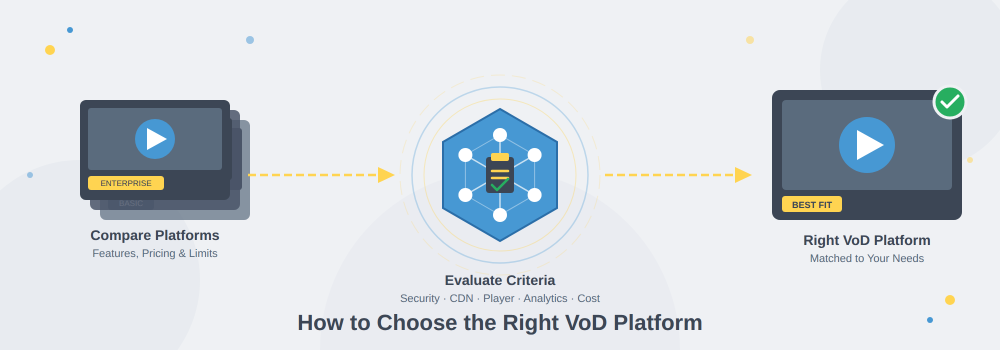

How to Choose the Right VoD Platform for Your Business in 2026
Choosing the right VoD platform is one of the most consequential technical decisions a modern media business, content creator, or enterprise can make. Whether you are launching an OTT channel, distributing training videos, monetizing a film library, or delivering product demos at scale, the platform you choose will shape your viewer experience, operational costs, and long-term scalability. In 2025, the market is crowded with options — and the differences between them matter more than ever. This guide walks you through every critical factor to evaluate before committing to a video-on-demand solution.
What Is a VoD Platform and Why Does It Matter?
A video-on-demand platform is a complete infrastructure layer that lets you upload, store, manage, encode, and deliver video content to viewers on any device, at any time. Unlike traditional broadcast, VoD gives the audience full control over when and how they watch. For businesses, this translates into powerful opportunities: sell content through subscriptions or pay-per-view, build internal learning management systems, host product tutorials, or power a media brand entirely in the cloud.
The "right" platform is not simply the most feature-rich one — it is the one that aligns with your delivery requirements, technical team capabilities, budget, audience geography, and content protection needs. Getting this choice wrong means re-platforming later, which is expensive, time-consuming, and disruptive to your audience.
Key Factors to Evaluate When Selecting a VoD Platform
1. Video Encoding and Adaptive Streaming Support
The foundation of any reliable VoD experience is high-quality video encoding. Your platform should automatically transcode uploaded files into multiple quality levels so that viewers on slow connections receive a lower-bitrate stream while those on fiber get full HD or 4K. The industry standard for this is HLS (HTTP Live Streaming) with adaptive bitrate (ABR) playback.
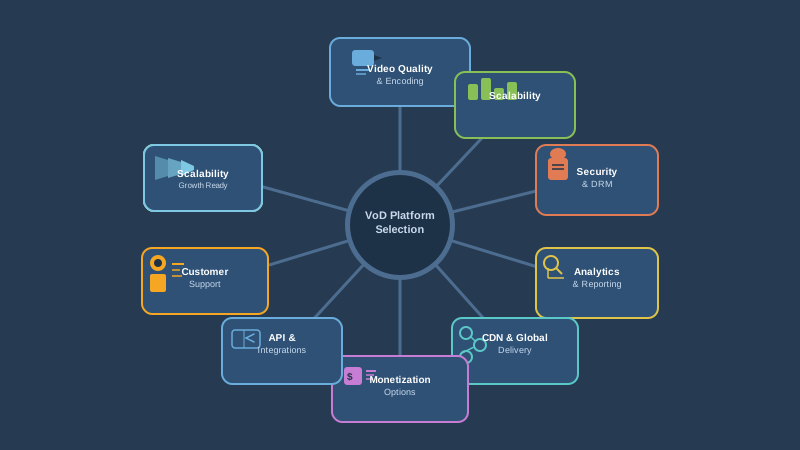
Not every platform handles encoding the same way. Some impose strict file format limitations, slow processing queues, or only offer a single output resolution. Look for a platform that supports multi-bitrate HLS transcoding, allows you to define custom encoding profiles, and processes files quickly — ideally within minutes, not hours. Publitio's video hosting solution provides automated HLS transcoding with multi-bitrate output, making adaptive streaming accessible without complex infrastructure setup.
2. Content Delivery Network (CDN) Integration
Even perfectly encoded video becomes unwatchable if delivery infrastructure cannot handle global audiences. A robust CDN distributes your video files across edge nodes worldwide so that a viewer in Tokyo receives content from a nearby server rather than one located in a data center across the ocean.
When evaluating a VoD platform, ask these questions: Does CDN delivery come built in, or do you need to configure a third-party CDN separately? How many PoPs (points of presence) does the CDN cover? Are there bandwidth caps, and how is overage pricing structured? Platforms that bundle CDN delivery natively tend to simplify operations and reduce the risk of misconfiguration. Publitio includes global CDN delivery as part of its core offering, so you never need to manage a separate CDN contract or DNS configuration.
3. DRM and Content Protection
If your business model depends on paid or premium video content, content protection is non-negotiable. Without proper Digital Rights Management (DRM), your videos are vulnerable to unauthorized downloading, redistribution, and piracy — directly eroding your revenue.
Modern DRM systems include Widevine (for Chrome and Android), FairPlay (for Safari and iOS), and PlayReady (for Microsoft environments). A serious VoD platform should support multi-DRM encryption natively, ideally integrated directly into the HLS pipeline so your content is encrypted before it ever leaves your origin. Beyond DRM, look for features like signed URLs, token-based access control, domain restrictions, and geo-blocking. Publitio's DRM and encryption capabilities are built directly into the video delivery pipeline, giving content owners enterprise-grade protection without needing a separate licensing server.
4. API Access and Developer-Friendliness
In 2025, any platform worth considering needs to be API-first. Your VoD platform should not be a closed box that forces you to use only its own player or its own CMS interface. Developers need programmatic access to upload files, trigger encoding jobs, retrieve playback URLs, manage metadata, and integrate video delivery into custom applications, mobile apps, or headless CMS environments.
Evaluate the quality of the platform's API documentation. Are endpoints clearly described with practical examples? Is there an SDK available for your preferred language? What are the rate limits? Does the platform offer webhooks for asynchronous events like encoding completion? Publitio's developer documentation covers the full API surface with code examples, making integration straightforward for engineering teams building custom workflows.
5. Digital Asset Management Capabilities
VoD is rarely just about video in isolation. Most organizations managing a video library also need to manage related assets: thumbnail images, subtitle files, promotional graphics, audio tracks, and supporting documents. A VoD platform that also functions as a Digital Asset Management (DAM) system eliminates the need to maintain separate tools for different asset types.
Look for features like folder-based organization, custom metadata tagging, bulk upload and management, advanced search, and version control. The ability to manage images with on-the-fly transformations — resizing, cropping, format conversion — alongside video is particularly valuable for teams producing content at scale. Publitio's digital asset management solution unifies video, image, and file management in a single platform, reducing tool sprawl and operational complexity.
6. Player Customization and Embed Options
Your video player is a direct reflection of your brand. A generic, unbranded player with limited customization options may be acceptable for internal use, but if you are delivering content to paying customers or building a premium streaming experience, you need control over the player appearance, behavior, and functionality.
Evaluate whether the platform provides a native player with configurable controls, color themes, and logo placement. Can you disable or customize the share button? Does the player support chapters, captions, and multiple audio tracks? Is the player responsive across desktop, tablet, and mobile? What about playback analytics — do you get per-video data on views, play rates, watch time, and geographic distribution?
7. Monetization Models
Different businesses use VoD to generate revenue in fundamentally different ways. An online education platform may rely on subscription access (SVOD). An independent filmmaker may prefer pay-per-view or digital download (TVOD). An ad-supported news channel needs pre-roll and mid-roll ad insertion (AVOD). An enterprise SaaS company may just want to host product videos without any paywall at all.
Before committing to a platform, map your current and future monetization model against what the platform natively supports. Avoid platforms that are rigidly designed for only one model — your business needs may evolve, and switching platforms mid-growth is painful. Some platforms provide native payment integration; others expect you to handle payment externally and use the API to grant or revoke access to protected content.
8. Scalability and Performance Under Load
The worst time to discover that your VoD platform cannot handle traffic spikes is during a live premiere, a product launch, or a viral moment. Scalability is not just about storage — it is about concurrent stream handling, encoding queue throughput, and CDN burst capacity.
Ask prospective platforms about their architecture. Is infrastructure cloud-native and auto-scaling? What happens when you simultaneously upload 1,000 files or serve 50,000 concurrent streams? Look for platforms with transparent SLAs, uptime guarantees, and ideally a public status page that demonstrates their reliability track record.
VoD Platform Use Cases: Matching Features to Your Business Type
Media and Entertainment Companies
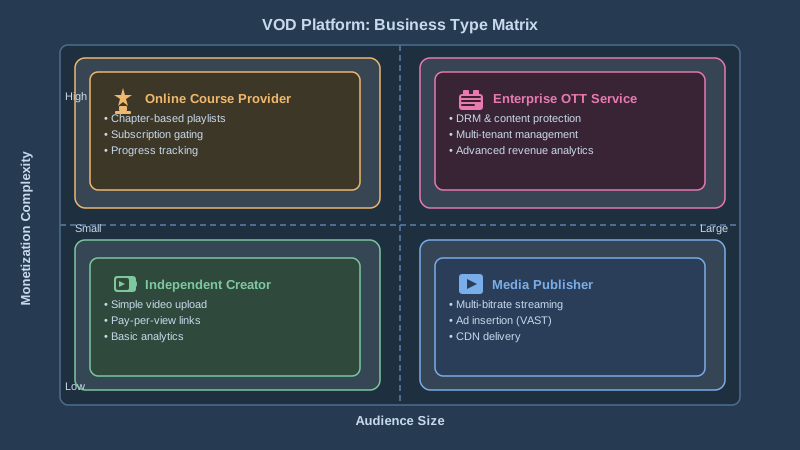
For media companies, the priority list typically looks like: DRM-protected HLS delivery, multi-bitrate encoding, robust CDN coverage, player branding, and a clean API for integration with existing CMS and subscriber management systems. The ability to manage large asset libraries — including related images and files — alongside video is also critical. A platform that handles both DAM and VoD in a unified interface significantly reduces workflow complexity.
E-Learning and Corporate Training
E-learning platforms have different priorities. Content protection matters, but access control is often handled at the application layer rather than through full DRM. Encoding speed matters because course creators frequently publish new content. API access is essential for integration with LMS platforms. Storage and bandwidth costs are critical to model carefully since training libraries can grow very large. The ability to embed videos in external platforms — like a WordPress LMS or a custom-built training portal — must be seamless.
SaaS Products and Developer Teams
Developer-focused teams building video capabilities into their products need an API-first VoD platform above all else. They need clean REST APIs, detailed documentation, predictable pricing, and a platform that stays out of the way. Pre-built frontend components are a nice bonus, but the core value is reliable backend infrastructure. Explore Publitio's full feature set to see how the platform is designed to serve developer workflows.
WordPress Publishers and Content Creators
Not every VoD use case involves a custom-built application. Many publishers run WordPress sites and simply need their media managed and delivered efficiently — without blowing up their server costs or relying on YouTube as an intermediary. A VoD platform with a native WordPress integration lets you offload media files to cloud storage and CDN delivery while keeping your existing editorial workflow intact. Publitio's WordPress media offload plugin handles this seamlessly, replacing your default media library with cloud-based asset management and video delivery.
Pricing Structures to Watch Out For
VoD platform pricing is notoriously complex. Common pricing variables include storage (per GB), bandwidth or data transfer (per GB or per TB), encoding minutes, number of videos, number of seats, and API call volume. Some platforms charge for each of these independently, making cost modeling difficult — especially as your library grows or your audience scales.
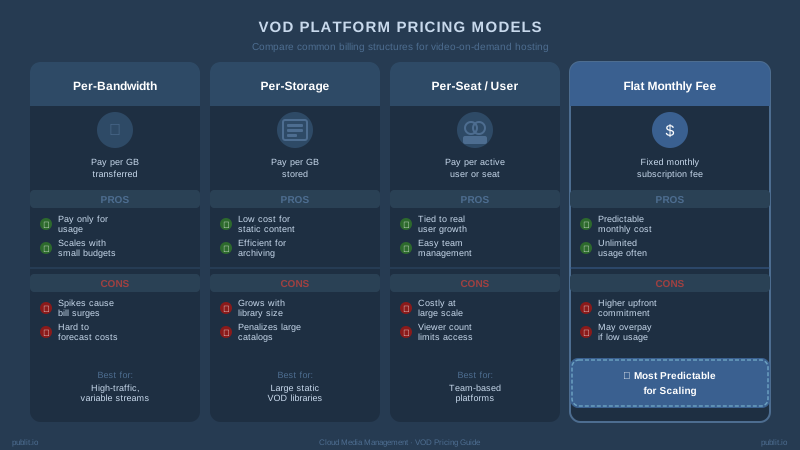
Watch out for platforms that offer low entry-level pricing but charge punitive rates for bandwidth overages — this is the most common source of bill shock in the VoD industry. Before signing up for any plan, model your expected monthly storage, encoding volume, and bandwidth consumption. Then compare the realistic total cost, not just the headline plan price.
Transparent, usage-based pricing with clearly defined tier boundaries is almost always preferable to enterprise contracts with opaque custom pricing. Review Publitio's pricing plans to see how storage, bandwidth, and features are structured across tiers — with no hidden encoding surcharges.
Migration and Lock-in Considerations
One often-overlooked factor when choosing a VoD platform is how easy it is to leave. Vendor lock-in in the media world is real. If your platform stores video in a proprietary format, uses internal asset IDs that are not portable, or makes bulk export difficult, switching providers later becomes a massive operational project.
Evaluate what data export options a platform provides. Can you bulk-download all your original files? Can you export metadata in standard formats? Does the platform use open standards for delivery (like standard HLS) or proprietary streaming protocols that only work with their own player? Choosing an open, API-accessible platform from day one protects your flexibility as your business evolves.
Questions to Ask Before Making Your Final Decision
- Does this platform support HLS adaptive streaming out of the box?
- Is DRM or signed URL access control included, or is it an add-on?
- How is CDN delivery priced, and are there bandwidth caps?
- What does the API documentation look like, and is there an active developer community?
- Can the platform handle both video and other asset types in a unified interface?
- Is pricing transparent and predictable as usage grows?
- What is the process for migrating away if needed?
- Does the platform provide playback analytics?
- Is there a WordPress integration or plugin available?
- What support options are available, and at which plan tier?
Why Publitio Is Built for Modern VoD Platform Needs
Publitio was designed from the ground up as an API-first, cloud-native media management and VoD platform. Rather than bolting video features onto a file storage product — or adding asset management as an afterthought to a video tool — Publitio treats video hosting, digital asset management, HLS streaming, DRM encryption, and CDN delivery as equally first-class capabilities within a unified platform.
This architecture matters in practice. Teams using Publitio can manage their entire media supply chain — from raw file upload through transcoding, metadata tagging, access-controlled delivery, and playback analytics — without stitching together multiple vendor relationships or maintaining complex integrations. Whether you are a solo developer building a VoD product, a media company managing thousands of assets, or an enterprise team standardizing on a single DAM and video delivery platform, Publitio scales with you.
Ready to Find the Right VoD Platform for Your Business?
If you have been evaluating your options and are looking for a platform that combines reliable HLS video streaming, powerful digital asset management, enterprise-grade DRM protection, and a developer-friendly API — all under transparent, scalable pricing — Publitio is built for exactly that. Stop stitching together separate tools for video hosting, file storage, and CDN delivery. Start with a platform designed to handle it all. Sign up at publit.io today and see how easy it is to launch and scale your VoD infrastructure in 2025.


